
The broad-blade poleax or brodex ( English broad ax , literally “wide ax”) is a type of poleax with a wide trapezoidal canvas, rectangular beard and striker.
In the X-XI centuries, such axes were common in Scandinavia and the Baltic . They featured a rounded blade; the transition from the web to the butt was rather subtle. These axes were often decorated with silver inlay [1] . Relative to ancient Russian finds, out of 1600 archaeologically known axes, only 2 axes of this type belong to this type, which indicates their rarity. They date back to the 11th century. These axes were the forerunners of berdysh [2] .

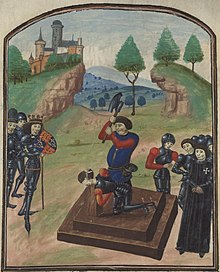
One should distinguish between broad-blade poleaxes with one- and two-sided sharpening. For the most part, broad-blade poleaxes with double-sided sharpening were military weapons and had only limited domestic use, since they were inconvenient for such purposes. It is characteristic that in the New Age and later similar axes were used by executioners for executions - for example, in Sweden such axes ( Swedish skrädyxa ) were used from the 17th century to 1903. Axes with one-sided ("chisel") sharpening were often mainly a working tool and were convenient for processing large flat surfaces (in particular, they were used for the manufacture and surface treatment of timber and beams). There were axes with both left and right sharpening. According to archeology, such axes appeared in the VIII century and for a long time were popular in the east of Denmark (the modern south of Sweden, Skane ).
Notes
- ↑ Paulsen R.
- ↑ Kirpichnikov A.N., 1971 .
Literature
- Paulsen R. Axt und Kreuz in Nord und Osteuropa.
- Kirpichnikov A.N. Ancient Russian weapons. Issue 2. Spears, Streets, battle axes, maces, knives IX-XIII centuries .. - 1971.