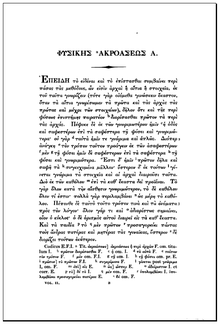
“Physics” ( Greek Φυσικά ) is Aristotle's fundamental treatise, laying the foundations of physics as a science (in the pre-classical, Donutian sense). The treatise consists of 8 books. For the first time, physics is considered not as a doctrine of nature ( Greek Φύση ), but as a science of motion ( Greek κίνησις ), the category of which implies time, emptiness and place.
Contents
In the first book, Aristotle polemicizes with the Eleatics ( Parmenides and Meliss ), who claimed the impossibility of movement, because, in their opinion, nothing arises from nothing. Aristotle at the end of the book just allows the emergence of the existing from the non-existent, to substantiate this thesis, he introduces a distinction between possibility and reality, and also between form and matter.
In the second book, Aristotle turns to nature and proves that nature contains the beginnings of movement and peace. He contrasts it with art and sees in it the beginnings of matter and form. He then sets forth the doctrine of the four causes and separates the accidental from the spontaneous.
In the third book, Aristotle goes on to the main content, identifying nature with movement, after which it is movement ( Greek κίνησις ) that becomes the main topic of his argument. Movement is the transition of opportunity into reality and is closely related to the concepts of time, place and emptiness. Aristotle ends the book by considering infinity .
In the fourth book, Aristotle considers movement as the main form of movement, an important factor of which is the place . He also considers the void ( Greek κενόν ) and chaos as varieties of place ( Greek τόπος ). However, the void Aristotle did not consider really existent. Any place is characterized by three dimensions: length, width and depth. At the same time, Aristotle distinguishes between bodies ( Greek σῶμα ) and place, since the body can be destroyed, but there is no place. The ultimate place of all things is heaven, which is identified with the universe. Aristotle also notes that simple elements have a tendency: in this way, fire tends to go up, and the earth tends to go down. Aristotle ends book 4 with a discourse on time . He refutes those who identify time with movement, since movement can increase or slow down, while time is always constant, however, if there is no change, then there is no movement. “Time is the number of movement” ( Greek ὁ χρόνος ἀριθμός ἐστιν κινήσεως ), states Aristotle (IV, 11).
In the fifth book, Aristotle considers such types of movement as the emergence and destruction. While analyzing philosophical categories, he notes that not all of them can be applied to movement, but only for quality, quantity and place.
In the sixth book, Aristotle asserts the continuity of time and polemizes in absentia with Zeno in this regard. He argues that movement exists, in addition there is infinite movement if it goes in a circle.
In the seventh book, Aristotle claims the existence of the Prime Mover, since any movement must be initiated by something. Aristotle calls the first movement a movement ( Greek φορᾶς ) and has 4 of its types: attraction, pushing, bearing, rotation.
In the eighth book, Aristotle raises the question of the eternity of movement and comes to paradoxes. However, he believes that the cause of the eternal circular motion must be a motionless prime mover ( Greek πρώτως κινοῦν ). In this case, the prime mover should be one and eternal. Circular motion ( Greek κυκλοφορία ) Aristotle calls primary and more perfect than straightforward.
Quotes
- Ignorance of movement necessarily entails ignorance of nature - III, I, 200b15
- Time - a measure of movement - III, II, 221a
- There is a primary stationary engine - VIII, V, 258b5
- The movement must always exist - VIII, V, 258b10
- The circular motion is more primary than the rectilinear - VIII, VIII, 265a15
Links
- Physics . Aristotle , translation by V.P. Karpov. Date of treatment June 13, 2009. Archived April 2, 2012.
- Physics in the original language with translation into English