Baekche ( cor. 백제 [pɛk̚tɕ͈e] ; 18 BC (according to legend) - 660 ) is one of the Three Ancient Korean States , along with Goguryeo and Silla .
| Vanity | |
| Baekche | |
|---|---|
| 百 濟 | |
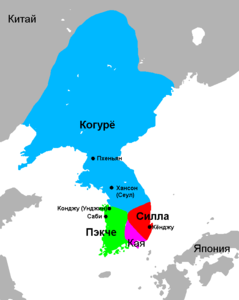 | |
←  → →18 days (legend) / 234 - 660 | |
| Capital | Vireson |
| Languages) | Goguryes language |
| Religion | Zen Buddhism, Taoism |
| Square | 27,000 km |
| 王 Wang / Õ (kogure.) | |
| • 234-286 | Koi |
| Baekche | |
|---|---|
 | |
| Hangul | 백제 |
| Hancha | 百 濟 |
| McCune - Reischauer | Paekche |
| New romanization | Baekje |
 History of Korea History of Korea |
|---|
Prehistoric korea |
Chronology |
It was founded by the leader of Onjo , according to legend, the son of the founder of Goguryo, in the area of modern Seoul . Baekje began to dominate the Mahan tribal alliance during the Samhan period. In the 4th century , during its heyday, it controlled most of the western territories of the Korean Peninsula . In 660, it was conquered by the Tang Dynasty and Silla became part of the Silla .
History
Legendary Period
According to the Samguk Sagi , Baekje was founded in 18 BC. e. the leader of Onjo , who led a group of people from Goguryo to the Hangang River area, near modern Seoul . Baekje was declared the successor of Puyeu , a Korean state on the territory of modern Manchuria since the decline of the state of Cochoson . Goguryeo , however, also called herself the heir to Puyo, after she conquered it.
According to Samguk Yusa , Onjo was the son of the legendary Jumon (Tonymenson), the founder of Goguryo. Yuri , the son of Chumon from his marriage in Puyo, moved to Goguryo and became the heir. The sons of Chumon from their new marriage, Onjo and Piryu , realizing that Yuri would become Jumon's successor, left to seek happiness to the south. On the way they were accompanied by a retinue of ten vassals.
Onjo settled in Vireson, which, according to South Korea, dominates modern Seoul , and according to the Japanese description (for which this state was very important because it was connected through the female line with the Imperial Dynasty of Yamato) it is either Asan or the settlement in Yesan .
Traces of the history of the Baekje state can be found in Chinese records. According to the Chinese chronicle of Sangozhi , during the Samkhan period, one of the tribes of the Mahan tribal union on the banks of the Hangan was called Baekche (百 濟).
During the early centuries of Korean history, sometimes referred to as the era of the early Korean states , Baekje gradually increased its influence among other Mahan tribes.
Extension (234-475)
During the reign of the first historically confirmed ruler, Koi (234–286), Paekche began to absorb the tribes of the Mahan tribal union. A state arose on the territory of Daifang County According to the Nihonseki Japanese chronicles, Paekche reached the borders of the Kai Confederation in the east, reaching the Naktong River . According to Chinese information, he was married to the daughter of Gunsun Du governor Liaodong [1] .
Van Kynchkhogo (346-375) expanded the territory to the north, having conquered part of the state of Goguryo , simultaneously annexing the remaining Mahan tribes in the south. In 345, Baekje first appeared in Chinese chronicles as a vanity.
During the reign of Kinchkhoi, Baekchet territory included almost the entire western part of the Korean Peninsula (excluding the territory of the future province of Pyeongando ), and in 371 Baekche defeated Goguryo near Pyongyang. However, this did not interfere with trade relations between the two states.
In Baekje, Chinese culture and technology has been actively adapted. In 384, Buddhism became the official religion. Baekche also became a powerful maritime power, maintaining ties with the Japanese rulers of the Yamato period .
In 415 [approx. 1] or at 417 [approx. 2] the year of Van Jongji (Baekje) (Chinese I Ying (餘 映)) received honorary titles from Emperor An-di : Shichijie (使 持節, Messenger with Jie's regalia), Commander Baekje (че 百 濟 諸 軍事), Commander the pacifier of the East (鎮東 將軍), Van Baekche (百 濟 王). In 420, Liu Song Wu-di added the title Commander-in-Chief of the Peace of the East (鎮東 大 將軍). In 424, an ambassador (by rank главный - chief administrator) from Baekje Zhang Wei (張 威) arrived to Emperor Liu Song Shao-di with gifts. In 425, Liu Song Wen-di sent two advisers to the van with a comforting message. After that, good relations were established between Liu Song and Baeke and every year the van sent local goods to the Chinese court.
In 430, Wang Piyu (余 毗 Yu Pi) resumed paying tribute to China and the emperor allowed him to inherit his father's titles. The next time he paid tribute of 450.
In 454, van Caro ascended the throne (慶, Qing). In 457 he requested permission to inherit the ranks of the ancestors, the emperor allowed. In 458, Caro asked the emperor to give the titles to the best commanders of his state: yusyanwan (右賢王) and 11 others for his faithful service, the emperor agreed to this. In 471, the van again sent gifts to the emperor.
In 472, the embassy in Bei Wei was first sent to Xiao Wen-di , who transmitted the letter of Wang to the emperor. In the letter, among other things, the van asked for an alliance against Koguryeo, and the enemies of the emperor from Bei Yan , who were sheltered by the Koguryo people, were mentioned, as well as that the Koguryo people could drown the Wei ambassadors. Wang even sent a saddle found among things supposedly drowned by Wei ambassadors. The emperor replied very evasively: he admitted that Koguryo behaves differently from a faithful vassal, but still not like a clear enemy. Therefore, Baekche had to forget about the alliance with China against Goguryeo.
Undzha period (475-538)
Somewhere between 483-493, Van Tonson asked the emperor Wu-di for titles. He appointed the van: Commander-in-Chief of the county and High Commander Baekje [approx. 3] , Commander-in-Chief of the East [approx. 4] , by van Baekche. In 502, the new emperor of Wu-di , the Liang dynasty that replaced Qi, added the title Van: The Great Leader of the Eastern Campaign [approx. 5] . But Baekche began to weaken in rivalry with Goguryeo.
Most of Korea’s Three-State maps depict Baekje occupying the future provinces of Chuncheong-do and Chollado .
In 521, Van Muren announced to the emperor of China that after several victories over Goguryo they made peace and Baekje was once again a great power. He regained the titles that his ancestors wore. His son Son inherited them with some exceptions [approx. 6] .
Sabi Period (538-660)
In 538, Van Son moved the capital to the city of Sabi (now Puye County) and began to strengthen the military power of the state. Since that time, the official name of the country has become Nambuyo ("South Puyu"), in honor of the state of Puyu , from which Paekche originates. The Sabi period was marked by the flourishing of culture and the expanding influence of Buddhism .
In 534 and 541 sent gifts to the emperor of China. The Chinese noted that this time among the gifts was the book “Nirvana” (涅盤) and other Buddhist books, as well as Maoshi ( Shijin with commentaries by Mao Heng) and other things, as well as works by various artists and painters.
In 581, Sui Wen-di received the embassy from Baekje. The titles were granted to Wang, but to a lesser extent than previous dynasties. In 589, the Sui ship brought a storm to the shores of Baekje. Upon learning of the defeat of Chen and the unification of China, Wang ordered that the ship's crew be equipped with everything necessary and send ambassadors to the emperor with congratulations. The emperor was very happy and allowed the van not to send embassies with tribute.
In 598, learning about the preparations for the war between Sui and Goguryeo, the van sent ambassadors who offered services to the emperor as guides. The emperor generously rewarded them and ordered them to return. Learning about this, the Kogurye residents attacked the border lands. In 607, the van again proposed an alliance against Goguryeo, but the Sui people began to suspect Paekche of a secret alliance with Goguryeo and refused the ambassadors.
During the Sui-Kogur war of 611, the alliance could become a reality: the Pecche Cook Chimo conveyed to the emperor about the readiness of Van Mu to attack Goguryo from the rear and the Chinese ambassador Xi Lu was sent to the van to resolve this issue. The following year, at the height of the war, the van withdrew his troops to the border of Goguryeo, but he actually hesitated and waited for the outcome. Soon the van started a war with Silla .
The dream strengthened ties with China and Japan. Sabi's geographical position on the navigable river Kimgan contributed to this and during the VI and VII centuries, trade and diplomatic relations with the western Chinese neighbor, as well as with the Japanese state of Yamato, flourished. Relations with Silla, on the contrary, became less and less friendly.
In the 7th century , with the growing influence of Silla in the southern and central parts of the Korean peninsula, Baekje began to lose its strength.
In 660, Baekche was drawn into the Goguryeo -Tang war on the side of Goguryeo. The 130,000th army of , who was supposed to unite with Silla’s troops of Kim Chunchu, advanced against Baekche. Dingfan landed on the island of Tokmul, preparing to fight with the 50,000th army of Kim Yusin . Due to the delay of the van, the Sillas broke a 5,000th fence and entered the road to the capital. In a battle at the mouth of the Unjin River, the Pek army was defeated by Su Dingfang. He climbed (using the tide) along the river at a distance of one passage from the capital. In the second battle, the Pacers lost 10,000 and were defeated. Van fled from the capital. Wang Tae's brother seized power and began to defend the capital. Seeing the hopelessness of the situation, he opened the gate. Upon learning of the defeat, the van surrendered and gave 88 people and 12,807 common people hostage to the heir Hyou and aristocrats.
In the conquered Baekje, the Chinese instituted 5 dudufs: shunjin (熊 津, unjin), mahan (馬 韓, makhan), dongming (東 明, tommyon), jinliang (金 漣, kymyon), dean (德安, tokan). A total of 760,000 yards. Liu Renyuan (劉仁 願) became the commandant of the capital, and Xuanjin Dudufu and de facto governor Wang Wendu (王文 度), who soon died. The captives were pardoned, the van was allowed to live out of power.
Van's nephew, General Poksin and the monk (Buddhist) Tochim rebelled and fortified in the Churyu fortress, they accepted Prince Puyo Phun , who was hiding in Japan . The rebels quickly captured the entire northwest of the state and besieged Liu Renyuan in the capital. To help the capital, the Tang General was sent. At the beginning of 661, Poksin's troops fought Zhengyu and the Allied Sillas. The Paecche’s picket fence was broken, the Chinese and Sillas pushed the Paccesi to the river and killed more than 10,000 people. Poxin lifted the siege and retreated to Imjon Fortress. The Sillas retreated to replenish supplies. A small Chinese army was blocked in the capital by the increased armies of the Paccheans, who recruited volunteers across the country, telling people about the impending extermination of all the Paccheti. Sillsky Kim Khym tried to break through to the capital, but Poksin defeated him at the border. Soon, Poxin killed Tochim and removed the nominal van Phun from power.
In the summer of 662, Jenyuan defeated Poxin's troops east of Unjin Fortress and recaptured many fortresses. Poxin entrenched in Jinhyun. At night, the Chinese climbed the walls and, connecting with the Sillas, killed 800 people. The communication of Chinese forces with Silla was restored. The emperor sent 7,000 troops led by Sun Jenshi (孫仁 師), who landed on Tokchokto Island in the summer of 663 . Puyo Phun was able to kill Poksin and seize power, he turned for help to Japan and Goguryo. In the battle of the Pekkan River , the Tansko-Silla and Pektic-Japanese forces met. Liu Zhengui burned 400 vessels in four attacks. After the battle, Puyo Phun disappeared (possibly fled to Goguryo), his sons and Japanese surrendered, a precious Van sword was captured. Chisusin locked himself in the Imjon fortress with the implacable. The rebels received support in the person of Khychi Sanji, who gathered 30,000 troops and defeated Su Dinfang. The rebels regained 200 fortresses. Zhengy ordered not to touch the rebels. Soon, Chisusin fled to Goguryo, and the others surrendered. Liu Zhengui set about restoring the country's economy. Puyo Yoon was appointed an Unju duduf in order to prevent the aggression of the Sillas.
In 665, Puyo Yong (actually Liu Zhengui) made “eternal peace” with Wang Silla Munmu ; they drew up a contract on a gold and iron plate in the Temple of Silla's Ancestors. After the departure of the Chinese troops, Puyo Yong, fearing his subjects and Sillas, fled with his supporters to Chang'an . In 677, Yoon was sent to Sinson, where he lived and died under the protection of Chinese troops. Baekje lands moved to Cilla.
Political structure
The establishment of central state power in Baekje took place during the reign of Van Koi , who was one of the first to establish the Salic succession law . The ruling dynasty is called Oraha ( 어라 하 ). As in most monarchies , most of the power was concentrated in the hands of the aristocracy . Van Song tried to strengthen power, but after his death in a military campaign against Silla, the elite took most of the power from his son.
In addition to the capital, there were five regions [approx. 7] : the middle one with the center in the city of Gusha (- 沙城), the eastern one is Dean (得安), the southern one is Tszyuzhisya (久 知 下), the western one is Taoist (刀 先), the northern one is Xunjin (熊 津). Military affairs in each region are controlled by talsols (one per region) and their assistants. Each district has 10 counties (郡). In each district there are 3 toxols; they train 700–1200 troops.
Clans Hae and Chin were the most influential during the formation of Baekje. Clan Hee may have been the ruling clan before they were supplanted by Clan Pue. Eight surnames, Sa, Yon, Hyup, He, Chin, Cook, Mok and Baek, had great power in the Sabi era, as the Chinese chronicles, for example, Tundian say.
After the reform of 260, the courtiers were sixteen ranks, six representatives of the highest rank formed the ruling executive body, the head of which was elected for a term of three years. The first Nesin Chvaphyun became Usu - the younger brother of Van Koi.
| Rank | Title | Differences | amount | Credentials |
|---|---|---|---|---|
| I | Chawaphyuns: Nesin Chwaphyun : Wang Commandments and Tricks Nedu Chwaphyun : treasury and pantries. | The clothes are burgundy. Headpiece with a silver flower | 6 | political, administrative and military commanders |
| II | Talsol | Also | thirty | political, administrative and military commanders. Chapters of five areas. |
| III | Einsol | Also | political, administrative and military commanders in the field | |
| IV | Toxol | Also | political, administrative and military commanders in the field. Heads of counties. Head of small towns and rural areas. | |
| V | Hansol | Also | political, administrative and military commanders in the field | |
| VI | Nasol | Also | political, administrative and military commanders in the field | |
| VII | Chandok | Raspberry clothes, burgundy belt | heads of departments | |
| VIII | Sidok | Raspberry clothes, dark belt | heads of departments | |
| IX | Codec | Raspberry clothes, red belt | heads of departments | |
| X | Sneaker | Raspberry clothes, green belt | heads of departments | |
| Xi | Tedok | Raspberry clothes, yellow belt | heads of departments | |
| XII | Mundok | Blue clothes, yellow belt | warlords of various levels | |
| XIII | Mudok | Blue clothes, white belt | warlords of various levels | |
| XIV | Chwagun | Blue clothes, white belt | warlords of various levels | |
| XV | Chinmu | Blue clothes, white belt | warlords of various levels | |
| XVI | Kykuu | Blue clothes, white belt | warlords of various levels |
Officials are changed once every 3 years.
Administration. Internal departments: Main Palace Department (前 內部), Bread Palace Department (穀 內部), Palace Affairs Department (內 掠 部), Foreign Affairs Department (外 掠 部), Horse Department (馬 部), Arms Department (刀 部) , Award department (功德 部), Medical department (藥 部), Forest department (木 部), Judicial department (法 陪), Internal Palace department (後宮 部, harem)。 External departments, were not located in the palace area: Military (軍部), Educational (司徒 部), Public Works (司空 部), Criminal (司寇 部), People's (點 口 部), Guest (客 部), Reception of foreigners (外 舍 部), Alkaline (綢 部), Royal astrologers (日 官 部), Shopping (市 部).
Penalties. Riot, desertion and murder are punishable by decapitation. Thief returns double price. A wife, for treason, becomes a slave to her husband.
Capital. divided into five areas (except the palace): upper, front, middle, lower, rear. Each district has 5 streets. Servants and commoners live there. Each district contains 500 soldiers.
According to Samguk Yusa , during the Sabi period, the chief minister ( Chesan ) Baekche was elected in an original way. Листки с именами нескольких кандидатов клались под камень (Чхонджондэ) возле храма Хоамса . По прошествии нескольких дней камень переворачивали и побеждал кандидат, на имени которого обнаруживали определённой формы знак. Было ли это случайным выбором или посвящённые таким образом продвигали своих людей, неясно до сих пор.
В государстве, помимо столицы, было 22 города яньлу , которыми правили родственники вана [2] .
Geography
На востоке граничит с Силлой и Когурё . С востока на запад: 450 ли , с юга на север около 900 ли.
Почвы влажные, климат тёплый. Растут большие каштаны , рис, просо, ячмень, пшеница, бобы, разные фрукты, овощи и зелень. Производят вино и сладкое вино.
На юге от Пэкче находится зависимый остров, до которого путь три месяца. Там много обычных и водяных оленей . Называется Даньмоуло (耽牟羅) — Царство Тамна на острове Чеджудо . Есть три острова, где растут деревья, из которых добывают жёлтый лак. Летом собирают сок и делают лак цветом как золото. Им красили роскошные доспехи.
Population
Кроме собственно пэкчейцев, проживали силлцы , когурёсцы , японцы и китайцы . Одежда и еда как в Когурё . Живут, большей частью, в холмах. Есть упоминания [1] о 15 населённых островках на юго-запад от столицы.
Военное дело
Имеют луки и стрелы, дао , копьё с широким наконечником (槊). Обычно сражаются как конные лучники .
Taxes
Вносятся полотном, шёлком-сырцом и тонкой шёлковой тканью, пенькой и рисом. Рис вносят смотря по урожаю, больше или меньше.
Язык и культура
Пэкче было основано эмигрантами из Когурё, которые говорили на языках Пуё , гипотетической группе языков государств Кочосон , Пуё , Когурё , Пэкче и древнеяпонского языка . Народы Самхан , вероятно, также говорили на подобном диалекте. Китайцы отмечали близость языка Пэкче и Когурё .
В культуре Пэкче обнаруживается сильное китайское влияние. Любят изучать древние книги, много хороших писателей и учёных и чиновников. Знают медицину, гадания по панцирям черепах и тысячелистнику, физогномику, имеют календари. Ведают Инь и ян и У-син . При этом даосов в стране нет. Каждый сезон (весной, летом, осень, зимой) ван приносит жертву небу духам пяти древних императоров . После смерти вана Кои его также причислили к богам и построили ему храм в столице. Ему также приносят жертвы четырежды в год.
Очень сильны позиции буддизма. Отмечены монахи и монахини. Строят пагоды . Знаменитая «улыбка Пэкче», которую находят на многих буддистских скульптурах, является типичным образчиком искусства времён Пэкче. Кроме того, сильно был распространён даосизм и другие аспекты китайского влияния. В государство в 541 году были посланы на работу мастера династии Лян , что также сказалось на усилении китайского влияния в период Саби.
Могила вана Мурёна (501—523), несмотря на то, что собрана из китайского кирпича и включает множество артефактов китайской культуры, также содержит некоторые уникальные предметы, характерные только для Пэкче, например, искусно обработанные золотые диадемы и серьги. Эта могила относится к унджинскому периоду истории государства. Похоронные традиции вообще являются оригинальными в Пэкче.
Культуру Пэкче отличали интересные гончарные формы, оригинальный дизайн черепичных крыш в форме лотоса, искусство каллиграфии. Внешний вид сохранившихся скульптур и пагод говорит о сильном распространении буддизма. Одним из прекрасных образцов культуры Пэкче является бронзовая курильница ладана ( 백제금동대향로 ), найденная археологами в древнем буддистском храме в Нынсанни, уезд Пуё .
О музыке Пэкче известно немного, однако известно, что музыканты в VII веке гастролировали по Китаю, что говорит о высоком развитии этого вида искусства. Имели инструменты: сигнальный барабан и рожок, Арфа- Конхоу (箜篌), Аджэн , свирель Юй (竽), флейты чи и ди (篪笛).
Китайцы отмечали, что жители Пэкче высоки ростом и носят опрятную и чистую (или белую) одежду. Пурпурный и малиновый цвета не могут носить простолюдины. Многие имеют татуировки , в чём близки японцам. При посещении храмов и дворца втыкают в шляпу по перу с каждой стороны. При поклонах стараются достать обеими руками земли. Замужние женщины не пользуются белилами и краской для бровей. Девушки носят косу сзади, выйдя замуж, делают две косы и укладывают их на голове. Рукава у традиционных халатов длиннее китайских.
Одежда вана: пурпурный халат с широкими рукавами, тёмные парчовые шаровары, накрашенный кожаный пояс, чёрные кожаные туфли, шапочка-корона из чёрного сетчатого шёлка.
Одежда чиновников: тёмно-красная, украшенная серебряными цветами.
Любят играть: метание стрел в вазу, чупу (樗蒲, древняя игра в кости), нунчжу (弄珠, игра с жемчугом), вошо (握槊, игра на фишках и костях), особенно шашки Ици (奕棋).
В китайской «Наньши» указано, что столицу в Пэкче называют гума (固麻), город без крепостной стены яньлу (簷魯). Много слов заимствовано из китайского языка: гуань — шляпа, рубашка — шань, штаны — кунь. Траур по родителям и мужу носят три года, по остальным родственникам только на время похорон.
Международные связи
Отношения с Китаем
В 372 году ван Кынчхого платил дань династии Цзинь , чьи территории были расположены в бассейне реки Янцзы . В 420 году, после падения Цзинь и воцарения династии Сун , Пэкче отправило туда послов для приобретения опыта в научной и культурной сфере.
В 472 году Пэкче впервые отправляет дипломатическую миссию в Северную Вэй , прося военной помощи для атак на Когурё . Ваны Мурён и Сон также имели дипломатические контакты с Лян и получили от неё аристократические титулы.
В 621 году ван Му установил отношения с Тан и прислал корейских пони квахама . В 624 году Тан официально признало статус Пэкче. В 627 году император Ли Шиминь призвал к миру Пэкче и Силла. Несмотря на внешнюю покорность, ваны продолжали воевать.
В 642 году ван Ыйджа начал войну с Силла и взял 40 крепостей, в том числе Миху (Михусон). Генерал Юнчхун с 10 000 воинов осадил крепость Тэя (Хёпчхон). Он казнил сдавшегося коменданта Пхумсока и его семью, захватил 10 000 человек. В 644 году император призвал ванов заключить мир. Пока Тан занималось войной с Когурё, Пэкче и Силла продолжили взаимные нападения.
Отношения с Японией
В целях противостояния военному давлению со стороны Когурё и Силла , а также для укрепления и развития торговых связей, Пэкче наладило близкие отношения с японским государством Ва ( Ямато ).
Между двумя странами существовал налаженный культурный обмен: в Пэкче для обучения приезжали японские мистики, а мистики, архитекторы и ремесленники Пэкче распространяли свои знания в Японии. Иммигранты из Пэкче помогали распространять китайскую письменность и буддизм. Что вылилось в религиозную войну между кланами Сога и Мононобе и краху Ямато. Что привело в итоге к созданию Нихона.
Согласно Сёку Нихони , последняя Принцесса Пэкче Такано но Ниигаса ( 高野新笠 , ?-790), мать японского императора Камму , вместе со двором эммигировала в Ямато.
После падения Пэкче в 663 году Япония послала Абэ но Хирафу с войском для того, чтобы отвоевать государство. Однако японские войска потерпели поражение в битве при Хакусукиноэ .
Младший брат Пуё Пуна, Сонгван ( 善光 или 禅広 Дзэнко), поступил на придворную службу в Японию и получил от японского императора фамильное имя Кудара но Коникиси ( 百濟王 ).
Позднее Пэкче
После распада Силла на его территории на короткое время возникли несколько государств, известных как Поздние Три корейских государства . В 892 году воевода Кён Хвон основал Хупэкче («Позднее Пэкче»), со столицей в Вансане (современный Чонджу ). Хупэкче было завоёвано в 936 году Императором Тхэджо ( Корё ).
Артефакты Пэкче в современной Южной Корее часто является символами административных регионов. К примеру, курильница ладана является символом уезда Пуё , а буддистская каменная скульптура, известная как Сосанский Маэсамджонбульсан , является символом города Сосан .
See also
- Список монархов Кореи
- История Кореи
- Когурё
- Силла
Notes
- ↑ Так у Бичурина в «Собрании сведений…», часть 2, отделение IV
- ↑ Наньши: 晉義熙十二年. Двеннацатое лето правления Цзинь под девизом Иси
- ↑ 大都督百濟諸軍事
- ↑ 鎮東大將軍
- ↑ 大號征東將軍
- ↑ 督百濟諸軍事、綏東將軍、百濟王 вместо 都督百濟諸軍事、甯東大將軍、百濟王
- ↑ Названия городов в китайском чтении
- ↑ 1 2 Бэй ши. Гл.94
- ↑ Наньши, цзюань 79
Literature
- Самгук Саги . Летопись Пэкче.
- Бичурин Н. Я. (о. Иакинф) «Собрание сведений…»
- Бэй Ши. История Северных династий . Под ред. Ли Яньшоу.