"Arctic Sea" ( Eng. Arctic Sea , "Arctic Sea") - a vessel of the type "Uglegorsk", an ice class timber carrier with a double hull. Gained great fame in connection with the abduction in July 2009 .
| Arctic Sea | |
|---|---|
| Okhotsk (until November 15, 1996) Zim Venezuela (until June 1, 1998) Alrai (until October 18, 1998) Torm Senegal (until May 30, 2000) Jogaila (until March 29, 2005) "Arctic Sea" | |
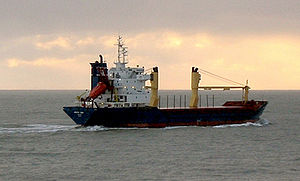 Logging truck "Arctic Sea" | |
| Flag |  [one] [one] |
| Class and type of vessel | Motor ship - timber truck |
| IMO Number | 8912792 |
| Call sign | 8PWS |
| Organization | Great Lakes Feeder Lines, Canada [1] |
| Manufacturer | Sedef Shipbuilding Industry Inc., Istanbul , Turkey |
| Launched | December 20, 1991 |
| Commissioned | January 3, 1992 |
| Main characteristics | |
| Displacement | 7167 tons |
| Length | 97.8 m. |
| Width | 17.34 m. |
| Height | 7.0 m. |
| Draft | 6.01 m. |
| Engines | B&W 6L35MC ( Denmark ) |
| Power | 3360 kW |
| Mover | 1 adjustable pitch screw, 4 blades |
| Speed | 13.2 knots |
| Crew | 15 people |
| Register tonnage | Deadweight 4706 t. Volume 2588 m³; 1905 m³. |

Content
History
The vessel was built in 1991 at the Sedef shipyard in Turkey by order of the USSR , originally received the name "Okhotsk" in honor of the village of the same name on Sakhalin . It is equipped with two cranes with a loading capacity of 25 tons.
During 2008 and the first half of 2009, the ship was engaged in timber transportation on the Finland - Algeria line . It belonged to Malta Arctic Sea Ltd (100% of its shares are owned by Solchart, Finland ) and went under the flag of Malta .
From June 26 to July 17, 2009, Arctic Sea, according to the requirements of the register, underwent a scheduled intermediate survey with docking [2] at the Pregol shipyard in Kaliningrad [3] .
Summer 2009 Events
In July 2009, the ship was stolen. As of 2009, the purpose of the abduction and other results of the investigation are unknown.
Timeline of events at sea and media reports
On July 20 and 21, the Arctic Sea , under the control of the Solchart management company, accepted the cargo and went on a regular flight from the port of Pietarsaari ( Finland ) [4] to the port of Bejaia ( Algeria ) [5] , with 15 crew members and cargo of 6,700 on board m³ of lumber , with the estimated date of arrival at the port of destination on 4 August .
On July 24, at a point with approximate coordinates of 57 degrees 31, 3 minutes north latitude and 17 degrees 37, 4 minutes east longitude, outside the territorial waters of a state between the islands of Eland and Gotland in the Baltic Sea, the vessel was attacked by a group of people who declared themselves representatives of the drug police . They searched the ship for 12 hours, and then left it [6] (or, according to another version, kept it under their control).
Later, at the beginning of the investigation, the pirates put forward their version of getting on board the ship: July 24 at 23:00 Moscow time in Swedish waters an inflatable boat approached the ship . Boat passengers asked for help, citing a technical malfunction. However, boarding the Arctic Sea, they were almost taken hostage by the crew. Subsequently, it turned out that this statement is a complete lie.
On July 28, the Arctic Sea, during the passage of the Pas de Calais, carried out the radio communication provided for in the protocol with the British coastal service. This was the last confirmed radio contact before the disappearance of the ship.
From 01:29:19 UTC on July 30, the location and condition of the Arctic Sea vessel is unknown. The coordinates of the Arctic Sea were last transmitted by AIS are located in the western part of the Bay of Biscay .
Vladimir Dushin, representative of the insurance company Renaissance Insurance, informed about the receipt of a demand for an ransom in the amount of $ 1.5 million from an unknown person on 3 August , threatened with a ship’s flooding and crew killing [7] .
The ship did not arrive at the port of destination Bejaia (Algeria) by the set deadline on August 4 . According to the Spanish coastal service, the Arctic Strait of Gibraltar also did not pass.
On August 9, the first reports of the disappearance of the vessel appeared in the media, originally published by Mikhail Voitenko on the website of the Maritime Bulletin - Sovfreht [8] .
On August 11, Director of the Solchart management company Viktor Matveev stated, referring to the report of the captain of the Arctic Sea , that as a result of the actions of unknown persons, the distress signal button had not worked and there were no signal buoys [9] .
The owner of the vessel turned to the government of the Russian Federation with a request to assist in the search [10] .
On August 12, the Kremlin’s press service announced that the Russian President had instructed the Minister of Defense to take measures to detect the Arctic Sea [11] .
On August 13, European Commission Representative Martin Selmeier [12] ( German Martin Selmayr) stated [13] [14] that radio signals received from the Arctic C indicate a re-attack on a ship off the coast of Portugal .
On August 14, the media, citing the coastal services of Cape Verde, reported that the cargo ship was spotted off the Cape Verde Islands and that the LAD “Ladny” was sent to intercept it [15] .
On August 15, Finnish police issued a statement [16] about the start of a joint international criminal investigation of the Arctic Sea by the Finnish, Swedish, and Malta services on suspicion of hostage-taking and extortion. The investigation will be carried out in cooperation with Interpol and Europol . The investigation will involve the Finnish National Bureau of Investigation, the Finnish Customs, the Coast Guard and the Security Police.
Viktor Matveev, director of the Solchart management company, denied receiving a buyback request from anyone [17] .
On August 17, Russian Defense Minister Anatoly Serdyukov reported to President Dmitry Medvedev that a cargo ship was found [18] at 05:00 GMT , 300 miles from Cape Verde , all crew members were alive and transferred to the Russian ship "Ladny" [19] .
On August 18, the Malta Maritime Administration issued a refutation of any allegations of disappearance of the Arctic Sea [20] , claiming that it constantly had information about the whereabouts of the vessel, but refrained from publishing them. The Maritime Administration of Malta also did not report the loss of the Arctic Sea in the official “Notices to Mariners” [21] .
According to Anatoly Serdyukov , during the operation to free the bulk carrier, 8 people were arrested, who captured him. “Eight people who were not crew members were taken into custody,” Serdyukov said. “These are citizens of Estonia, Latvia and Russia. These people boarded the Arctic Sea and, threatening with weapons, demanded that the crew unconditionally carry out all their orders, ”Serdyukov said. Then the Arctic Sea vessel moved along the route indicated by the invaders towards Africa, turning off the navigation equipment " [22] .
On August 20, the Estonian Security Police stated that six of the invaders were residents of Estonia [23] .
The ship was escorted to the Las Palmas area , where it was in neutral waters.
Investigation and Investigations
At the end of August 2009, it was reported that all eight accused of hijacking a bulk carrier did not plead guilty (the Moscow Basmanny Court on August 20, 2009 issued sanctions for the arrest of all eight suspects: Estonian citizen Yevgeny Mironov, two Russians - Dmitry Bartenev and Andrey Lunev, a citizen of Latvia Vitaly Lepin, who do not have citizenship of Alexei Buleev, Igor Borisov, Dmitry Savins, as well as Alexei Andryushin, whose citizenship is not established); during interrogation, upon indictment, they insisted that they were aboard the Arctic Sea by accident, fleeing a storm, and then the ship's captain refused them a request to go ashore at any European port [24] . A crew member, answering a question from journalists why they didn’t contact their relatives after they were delivered to Moscow, said: “We did not have the money or the means of communication for this. Phones remained on board the cargo ship. Personally, the first time I was able to contact my own, asking for a phone from a random passerby on the street. Thank you, he did not refuse. ” [25]
On September 8, Russian Foreign Minister Sergei Lavrov said that in the near future, the Russian authorities will conduct investigative actions on the ship, to which representatives of Malta will be invited [26] .
On September 14, director of the Solchart management company, Viktor Matveev, said [27] that the Russian Investigative Committee’s staff hindered access to the vessel by an authorized shipping agent and representatives of the Maltese Maritime Administration. The Maltese delegation was admitted to the ship on September 11 [28] . The ship agent of the management company did not receive access to the ship and was withdrawn on September 11. The owner of the vessel filed for bankruptcy.
On September 16, one of the crew members reported to the press that Russian investigators found on the ship a load of pine wood “instead of the more valuable mahogany declared in the documents” [29] . At the same time, the commercial term redwood (lit. English red wood - “mahogany”) means precisely pine wood [30] [31] and is not associated with the Russian term for “mahogany” valuable mahogany wood.
September 17, it was reported that Spain does not give consent to the entry of a cargo ship into its territorial waters; the ship with the cargo on board continued to be in the open sea 17 miles east of the island of Gran Canaria, part of the Canary Archipelago. Also, the Investigative Committee’s report to the Russian prosecutor’s office said: “Today, the Russian side received an official note from the Embassy of Malta in the Russian Federation that the Maltese side does not intend to send representatives to participate in the transfer of the vessel to the port of Las Palmas.” [32]
On September 23, the owner of the vessel’s operator, Viktor Matveev, claimed that the vessel was not allowed to enter the port, because military sailors still remain there [33] .
On September 24, authorities in the Spanish port of Las Palmas reported that Arctic Sea mooring was denied due to the presence of Russian military sailors on it, which complicates its legal identification: “Given that the ship does not have a national flag and cannot fulfill a number of provisions international requirements legislation, we consider Artic Sea not as a merchant ship, but as a floating object controlled by foreign navies ” [34] .
On November 19, 2010, the Russian Prosecutor General’s Office brought a criminal case of an attack on a ship to the court [35] .
The official Russian version
On August 25, 2009, on the situation with the vessel, the Ministry of Foreign Affairs of the Russian Federation issued comment No. 1272-25-08-2009, in which it was reported: [36]
The cargo ship was overtaken by a patrol ship of the Russian Navy Ladny on August 17 in the Atlantic Ocean, 300 miles south of the Cape Verde Islands. However, the captain of the Arctic Sea unexpectedly stated that this vessel was North Korean. On the same day, the Russian Embassy in Pyongyang appealed to the North Korean side to urgently verify the statement of the captain of the detained ship that it was a cargo ship owned by the North Korean ship owner, Chandin-2, heading from Havana to Sierra Leone with a load of palm lumber.
The North Korean side clarified the situation and informed us that the DPRK cargo ship “Chandin-2” at the time of detention of the suspicious ship could not be at the point with the specified coordinates, because it was in one of the Angolan ports.
Given this information, the command of the Russian Navy made a decision to conduct a search of the vessel, during which the assumption was confirmed that in reality it was the Arctic Sea. An inspection team boarded the Arctic Sea, finding on board a ship 15 crew members (Russian citizens) and 8 people suspected of hijacking a cargo ship. Some of the crew members and the alleged invaders were transferred aboard the patrol ship.
On August 18, the Russian Embassy in Cape Verde requested permission to call the Ladny patrol ship into the territorial waters of the Republic of Cape Verde in the area of Fr. Sal , and permission was obtained that day. On August 19, at about 12:00 local time, the ship arrived and embarked on a roadstead near Fr. Sal.
In order to transport 11 crew members and 8 detainees from the escort ship to Moscow for further investigative actions at the airport about. Sal on August 17 and on the night of August 18-19, arrived two military transport aircraft of the Russian Air Force Il-76 . On board were an investigation team and a unit of the military personnel of the Russian Federation.
The official permission was received by the Ministry of Foreign Affairs of the Republic of Cape Verde, and by 19:00 on August 19 all eight detainees and eleven crew members were transferred aboard the military transport aircraft of the Russian Air Force. On the same day, at 21:00 and 22:00 local time, the military transport planes of the Russian Air Force flew to Moscow, where they arrived in the morning of August 20.
On the night of August 20, the Ladny patrol ship also left Cape Verde, which sailed towards the Arctic Sea dry-cargo ship 250 miles southwest of Cape Verde, which was drifting in the Atlantic Ocean. On board the latter are four crew members to keep watch and several military personnel from the Ladny patrol ship for escort.
It was revealed that two of the suspects are Russian citizens, one is an Estonian citizen, one is a Latvian citizen and four are not citizens. The initial search of the vessel did not reveal any suspicious cargo on it. A more detailed search will be carried out at one of the ports along the Arctic Sea route.
In June 2010, a version was heard in a Russian court about involvement in the seizure of the vessel by the Estonian secret services, in particular their former employee Eerik Kross . The Estonian prosecutor said that this version is not confirmed, the chairman of the Commission for European Union Affairs in the Estonian Parliament, Marco Mihkelson , called this version “disinformation” [37]
January 13, 2012 Russia put on the international wanted list of the former head of Estonian intelligence Eerik Kross. He was charged in absentia with piracy in the case of the hijacking of a cargo ship “Arctic Sea” [38] .
Other opinions and versions.
Various official and other sources during the search for the vessel and later expressed alternatives to the Russian version and assumptions about the events related to the abduction of the vessel, the role of the Russian authorities and the nature of the cargo of the vessel itself: in particular, the Maritime Authority of Malta announced on August 18 that the vessel “did not disappear” [39] . The unusual circumstances of the alleged disappearance of the vessel were noted by the Commission of the European Union [40] and the media [41] .
On August 19, 2009, the former commander of the Estonian Armed Forces, Admiral Tarmo Kõuts ( Est. Tarmo Kõuts ) said (initially in an interview with the Estonian newspaper Postimees [42] , repeating in later interviews) that only the presence of cruise missiles on board a ship could explain strange behavior Russian authorities throughout the month of the epic; he also noted: “As a sailor with many years of experience, I can assure you that the official versions are implausible.” [43] On August 21 of the same year, Russian representative at NATO headquarters Dmitry Rogozin called the statement of the former Estonian admiral, EU representative for the fight against piracy, that a cargo ship could carry cruise missiles for Iran with "fantasies of a sailor from Estonia" [44] [45] .
The editor-in-chief of the Maritime Bulletin, Mikhail Voitenko , known as a specialist in the field of maritime shipping, was one of the first to report the vessel’s loss on August 8. He later suggested that the Arctic Sea, along with the transport of legitimate cargo, was simultaneously transporting weapons for one of the African regimes. According to him, soon after he expressed this point of view, he had to leave Russia and settle in Turkey, and then in Thailand in connection with threats received from unknown people. [46] Mikhail Voitenko believes that pirates cannot do this kind of large-scale action to seize the ship, at which it cannot be detected [47] .
On September 9, 2009, the BBC , citing a “senior source close to Israeli intelligence,” reported that Israel was involved in intercepting the Arctic Sea cargo ship; According to the Israeli media, on September 7 of the same year, Israeli Prime Minister Benjamin Netanyahu made a secret visit to Moscow and invited Moscow to independently stop the transportation in order to avoid public scandal [48] . On September 12 of the same year, Israeli Minister of Intelligence and Atomic Energy Dan Meridor confirmed that Israeli Prime Minister Benjamin Netanyahu paid a visit to Moscow on September 7, refusing to disclose the purpose and reasons for the strictest secrecy [49] [50] ; Earlier, the press secretary of the Prime Minister of the Russian Federation Dmitry Peskov claimed that he did not know anything about the meeting between the head of the Russian government and his Israeli counterpart [51] . In early October, Netanyahu’s visit was explained by the fact that the prime minister handed the Kremlin a list of Russian scientists who, according to the Israelis, helped Iran create a nuclear warhead [52] .
On September 14, 2009, conspiratorial versions of the background of the fire in the headquarters building of the GRU military unit of the General Staff of Russia in Tambov on September 13 [53] appeared in the media, linking the incident in which some “documents of special national importance” [54] were killed with the history of the Arctic cargo ship Sea [55] .
At the beginning of October 2009, The Financial Times quoted the opinion of former GRU officer and security expert Anton Surikov, who claimed [56] that there could be 2 attacks on the ship: the first off the coast of Sweden at night on July 24 in order to obtain evidence for the governments of Britain and the United States having weapons on board, the second - later, on August 1, organized by the governments of these countries, for further behind-the-scenes bargaining between the powers involved.
On October 12, the opinion of M. Voitenko was voiced:
<...> In the history of world shipping, not a single vessel captured by pirates and bandits has been dragged back and forth in tow under the guard of the military over the ocean for weeks to conduct “investigative measures”. For example, the ship was freed from Somali captivity - the ship crawls to the nearest port, the crew is immediately changed, necessary repairs are made, the ship is brought to a more or less normal state, equipped with everything necessary, and it continues the interrupted flight. In the case of the Arctic Sea, the Russian side, having released, so to speak, the ship, takes it under its jurisdiction, surrounds it with an iron curtain of secrecy and holds the ocean for more than a month, and with it four sailors from the crew - and to all but UPC, obviously, hold against them, sailors, will. Despite the cries of unhappy relatives and the calls of the public. <...>
In general, the Russian side wants to get rid of the ship and push it to the ship owner, not responsible for the consequences, losses, damage ... and ultimately - for their actions.
- Doesn't rust? Why no port wants to accept the Arctic Sea // Novaya Gazeta , No. 113 of October 12, 2009
Spain’s Supreme Court Prosecutor José Grinda González , known for investigating the Russian mafia’s activities in Western Europe, considers the Arctic Sea story to be evidence of the top-level illegal arms trade. [57]
Weapons or insolvency version of the arms trade with Iran
The version that the arms were transported on an Arctic Sea cargo ship for Iran may seem insolvent due to the fact that the Russian Federation and Iran have a maritime border, so illegal trade in arms, if it was, is easier and safer to organize through the Caspian Sea. However, as practice shows, shipping opportunities in the Caspian and port capacities of Russian and Iranian ports are extremely limited . Iranian ports in the southern Caspian are fishing ports or specialized platforms for receiving cargo from oil platforms, rather than general cargo areas necessary for processing engineering products (weapons) . Therefore, most of the Russian cargo turnover with Iran is carried out along the route along which the Arctic Sea .
The exceptions are Anzeli ports, through which a large part of the Russian export of timber and metal products to Iran goes [58] , and which is equipped with cranes with a lifting capacity of up to 120 tons [59] , as well as Makhachkala , which has a developed port facilities [60] .
In addition, there is the possibility of delivering weapons from a Russian military base in Armenia by land.
The fate of the ship
In February 2010, the ship was bought by the Canadian company Great Lakes Feeder Lines, which provides coastal transportation between Halifax , Montreal , Lake Ontario and other ports of Canada and the USA [1] . In April, the flag of Malta, under which the ship sailed earlier [61] , was changed to the flag of Barbados [1] .
Notes
- ↑ 1 2 3 4 Voitenko Mikhail. The Arctic Sea under the flag of Barbados was bought by a Canadian company, Solchart is selling the fleet . Marine Bulletin. Date of treatment May 3, 2010. Archived on April 5, 2012.
- ↑ Service Unavailable!
- ↑ In Kaliningrad, the missing vessel could be loaded with weapons // KP.RU - Kaliningrad
- ↑ LOOK / A ship that disappeared in the Atlantic was loaded in a Finnish port
- ↑ A cargo ship with a Russian crew disappeared without a trace in the Atlantic Archived on August 12, 2009. - Rosbalt
- ↑ A ship with Russians on board probably disappeared into the Atlantic . RIA Novosti (August 9, 2009). Date of treatment August 12, 2010. Archived on April 5, 2012.
- ↑ Unknown persons demanded a redemption from the insurer of $ 1.5 million for the Arctic Sea . RIA Novosti (August 18, 2009). Date of treatment August 12, 2010. Archived on April 5, 2012.
- ↑ A vessel with Russians disappeared without a trace in the Atlantic NEWSru August 9, 2009.
- ↑ “Arctic Sea” continued sailing without a “ panic button” // KP.RU
- ↑ Arctic Sea calls for salvation - Incidents - GZT.RU
- ↑ Medvedev instructed Serdyukov to find the Arctic Sea - Arctic Sea, Medvedev, Serdyukov - Rosbalt Archived on August 16, 2009.
- ↑ European Commission - Communication - Home
- ↑ EU doubts missing ship was victim of pirates | Reuters
- ↑ Missing cargo ship: crew reported second attack - Telegraph
- ↑ Arctic Sea seen off Cape Verde islands - media
- ↑ Ajankohtaista Archived on August 21, 2009. // poliisi.fi
- ↑ Varustamon johtaja ei vahvista lunnasvaatimusta - MTV3.fi - Uutiset - Kotimaa (fin.)
- ↑ http://www.mma.gov.mt/uploads/MV%20Arctic%20Sea%20(update%20as%20at%2017th%20August%202009).pdf (link not available)
- ↑ Dry cargo ship “Arctic Sea” found
- ↑ News Details // DI-VE
- ↑ Archived copy (inaccessible link) . Date of treatment August 20, 2009. Archived on May 5, 2009. (eng.)
- ↑ Arctic Sea cargo ship invaders taken into custody
- ↑ Kapo: Arctic Sea kaaperdajad on kuritegeliku taustaga | ERR Uudised Archived July 22, 2011. (est.)
- ↑ Accused of hijacking a bulk carrier Arctic Sea said it was the captain who kept them aboard NEWSru on August 28, 2009.
- ↑ Returning home, Arctic Sea sailors demanded a salary and explained why they didn’t contact NEWSru on August 31, 2009
- ↑ Lavrov promises to prove that the media are lying: "There were no missiles on the Arctic Sea." Investigators did not find them NEWSru September 8, 2009.
- ↑ 14 09 09 The number of questions that we still cannot answer increases every day - Solchart Archived on September 24, 2009.
- ↑ http://www.mma.gov.mt/uploads/090911%20Arctic%20Sea.pdf (inaccessible link) (eng.)
- ↑ Cargo of Arctic Sea does not correspond to what was stated in the documents - source . RIA Novosti (September 16, 2009). Date of treatment August 12, 2010. Archived on April 5, 2012.
- ↑ Arctic Sea: even the cargo turned red // KP.RU
- ↑ Timbersource - Scandinavian Redwood - Quality Supplier of Hardwood and Softwood Timber - Wood for Cabinet Makers, Furniture and Kitchens, Joinery, Flooring, Building and Civil ... Archived July 25, 2009 by Wayback Machine
- ↑ Malta authorities refused to participate in the transfer of the Arctic Sea to the owner Kommersant on September 17, 2009.
- ↑ Arctic Sea has not yet been allowed into port
- ↑ Они ушли на север Время новостей 25 сентября 2009.
- ↑ Заместитель Генерального прокурора России Виктор Гринь направил в суд уголовное дело о нападении пиратов на судно «Arctic Sea» , Генеральная прокуратура РФ (19.11.2010). Дата обращения 19 ноября 2010. (недоступная ссылка)
- ↑ Комментарий Департамента информации и печати МИД России в связи с ситуацией с сухогрузом «Арктик Си» На официальном сайте МИД РФ.
- ↑ Новый скандал разгорается между Россией и Эстонией . Эхо Москвы (11 июня 2010 года). Дата обращения 12 августа 2010. Архивировано 5 апреля 2012 года.
- ↑ Россия объявила в розыск бывшего главу эстонской разведки
- ↑ Hijackers Threatened to Blow Up Mystery Ship (англ.) , Reuters (19 августа 2009). Дата обращения 17 сентября 2009.
- ↑ Missing ship 'found' off Africa // BBC News , August 15, 2009
- ↑ Тайна Зеленого мыса , Lenta.ru (19 августа 2009). Дата обращения 22 августа 2009.
- ↑ Arctic Sea kaaperdajad võisid himustada relvi
- ↑ Was Russia's 'Hijacked' Ship Carrying Missiles to the Mideast? Time 31 августа 2009.
- ↑ Д. Косарев. Похищение в Европе // Российская газета. № 4980 (156) от 21 августа 2009
- ↑ Рогозин призывает не спекулировать по поводу груза Arctic Sea // Интерфакс
- ↑ «Arctic Sea»-Experte fürchtet um sein Leben 4 сентября 2009 (нем.)
- ↑ Летучий архангелец . Частный Корреспондент (17 августа 2009). Дата обращения 30 октября 2009. Архивировано 5 апреля 2012 года.
- ↑ Источник признал причастность Израиля к Arctic Sea Би-би-си 9 сентября 2009.
- ↑ Израиль признал тайный вояж своего премьера в Москву . Коммерсантъ (14 сентября 2009). Дата обращения 17 сентября 2009. Архивировано 5 апреля 2012 года.
- ↑ Netanyahu visited Russia - Israeli deputy PM (англ.) . Reuters (12 сентября 2009). Дата обращения 17 сентября 2009. Архивировано 5 апреля 2012 года.
- ↑ Пресс-служба Путина опровергла тайные переговоры с Нетаньяху NEWSru 9 сентября 2009.
- ↑ Times: Нетаньяху передал Кремлю список учёных из РФ, создающих бомбу Ирану NEWSru 4 октября 2009.
- ↑ Пять военнослужащих погибли при пожаре в части в Тамбове NEWSru 13 сентября 2009.
- ↑ При пожаре в части ГРУ в Тамбове сгорели секретные документы NEWSru 13 сентября 2009.
- ↑ «Конспиративная» версия: пожар в штабе ГРУ в Тамбове устроил Запад, чтобы уничтожить доказательства причастности ЦРУ к атакам 11/09 // NEWSru , 28 сентября 2009
- ↑ Vexed voyage (англ.) . The Financial Times (2 октября 2009). Дата обращения 5 октября 2009. Архивировано 5 апреля 2012 года.
- ↑ US embassy cables: Russia is virtual 'mafia state', says Spanish investigator // guardian.co.uk
- ↑ Каспийские порты и грузопоток Архивировано 14 октября 2012 года.
- ↑ Возможности портов Ирана
- ↑ ФГУП «Махачкалинский морской торговый порт»
- ↑ Елена Власенко. Arctic Sea уплывет в историю . Радио Свобода (06.05.2010). Дата обращения 8 августа 2010. Архивировано 5 апреля 2012 года.
Links
- Российский морской регистр судоходства, судно «Arctic Sea»
- В Атлантике пропал сухогруз с российским экипажем
- Сухогруз загадок: кем написан сценарий Arctic Sea?
- Russian maritime register of shipping. List of survey`s status. (eng.)
- http://amantula.livejournal.com/32851.html Независимый взгляд на историю с сухогрузом «Arctic Sea». Фотографии, комментарии, ссылки.
- Михаил Войтенко. Arctic Sea под флагом Барбадос куплен канадской компанией, Солчарт распродает флот . Морской Бюллетень. Дата обращения 3 мая 2010. Архивировано 5 апреля 2012 года.
- Владимир Фридлянд. Дети капитана Гранта: Пираты эстонского командора признаются . RUS.ERR.EE . — 12.06.2010. Дата обращения 15 ноября 2010. Архивировано 5 апреля 2012 года.
- Подборка публикаций в Живом Журнале в сообществе посвященном Арктик СИ (недоступная ссылка) . — 17.11.2010. Дата обращения 15 ноября 2010. Архивировано 25 октября 2010 года.