Clever Geek Handbook
📜 ⬆️ ⬇️

Steiner theorem (planimetry)

Steiner theorem - statement of Euclidean planimetry:

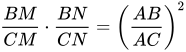
Two vertices are drawn through the vertex A of triangle ABC inside it, forming equal angles with sides AB and AC and intersecting side BC at points M and N. ThenBMCM⋅BNCN=(ABAC)2 {\ displaystyle {\ frac {BM} {CM}} \ cdot {\ frac {BN} {CN}} = \ left ({\ frac {AB} {AC}} \ right) ^ {2}} {\ frac {BM} {CM}} \ cdot {\ frac {BN} {CN}} = \ left ({\ frac {AB} {AC}} \ right) ^ {2}

An important special case of the theorem

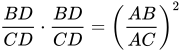
From the Steiner theorem , as a special case, we obtain the bisector theorem . Indeed, suppose that in the theorem stated above the points M and N coincide, forming a point D , then they are the base of the bisector dropped from the vertex A to the side BC . In this particular case, we haveBDCD⋅BDCD=(ABAC)2 {\ displaystyle {\ frac {BD} {CD}} \ cdot {\ frac {BD} {CD}} = \ left ({\ frac {AB} {AC}} \ right) ^ {2}} {\displaystyle {\frac {BD}{CD}}\cdot {\frac {BD}{CD}}=\left({\frac {AB}{AC}}\right)^{2}} . Extracting the square root of both parts, we haveBDCD=ABAC {\ displaystyle {\ frac {BD} {CD}} = {\ frac {AB} {AC}}} {\displaystyle {\frac {BD}{CD}}={\frac {AB}{AC}}} , which is the essence of the bisector theorem.

Literature

  • Ponarin I.P. Elementary geometry. In 2 volumes - M .: ICMNMO , 2004 .-- S. 32. - ISBN 5-94057-170-0 .

See also

  • Steiner curve
  • Huygens-Steiner Theorem
  • Marden's theorem
  • Steiner-Lemus Theorem
  • Steiner-Poncelet Theorem
  • Steiner point
  • Triangle
  • Steiner Ellipse
Source - https://ru.wikipedia.org/w/index.php?title= Steiner_ Theorem ( Planimetry )&oldid = 87867461


More articles:

  • North Azadegan
  • Sord Beach
  • Mirolyubov (Luginsky district)
  • Friends Will Be Friends
  • Krichunovo
  • Van-Obel quadrangle theorem
  • Knights of Columbus
  • Mamluk-Kipchak language
  • Asenapine
  • Shipulina, Ekaterina Valentinovna

All articles

Clever Geek | 2019