Travunia (or Trebinje [1] ; Serb. Travuniјa or Serb. Travuњa , Latin Terbounia ) is a historical Serbian region centered in Trebinje in today's eastern Herzegovina and southern Dalmatia (now part of Croatia ). Sometimes called Trebinje. The former name is Tribunius (the region between Dubrovnik and Kotor) [2] .
| Historical state | |
| Herbal grass | |
|---|---|
| Travuniјa | |
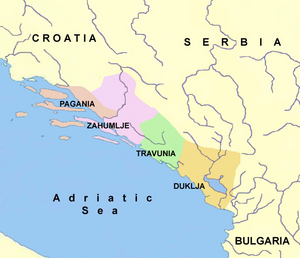 Grassland in the 9th century | |
←  ←   → → → →IX century - XII century | |
| Languages) | Serbian language |
| Religion | Orthodoxy |
| Dynasty | Beloevichi |
| Official language | |
Content
Sources of Herbs
Information about the first centuries of the existence of Slavic tribes in these lands is extremely scarce. Archaeological materials are scarce and difficult to date. Written sources are almost completely absent. For the first time, the name of the Serbs is mentioned in sources related to the revolt of Ludewit Posavsky ( IX century ), and in more detail in the middle of the X century the Byzantine emperor Konstantin Bagryanorodny tells about some information on the history of the Serbian tribes of Raska, Dukli, Travuniya, Zakhumya, Paganiya and Bosnia since their appearance in the Byzantine possessions [3] . But his data are fragmentary, and sometimes contradictory [4] .
Background
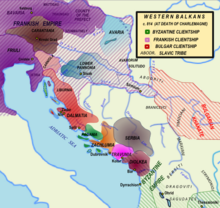
According to the Byzantine emperor Konstantin Bagryanorodny, Serbs appeared in the Balkans in the 1st half of the 7th century [5] . They occupied the territories of modern Serbia , Montenegro , Bosnia and Croatia [6] . After resettlement on the Balkan Peninsula, the first territorial associations of the Serbs, like most of the southern Slavs, had zhups . Zhupa usually occupied areas limited by the flow of rivers or mountains. Their centers were fortified settlements or cities. As the administrative territorial units of the упupa, they later became the solid foundation of the Serbian state [7] . However, the Byzantines called all of these lands "Slavonia." After the resettlement of the Slavs in the Balkans, in the Byzantine sources, information appears on the many clavinias from Thessaloniki to Constantinople, and later on the clavias located above cities on the Dalmatian coast [8] .
Some time after the resettlement to the Balkans, the Serbs formed several large communities, which then became state entities. Between the rivers Cetina and Neretva there was the principality of Neretva, which the Byzantines called Pagania. She owned the islands of Brac, Hvar and Mljet. The area between Neretva and Dubrovnik was called Zahumle. The lands from Dubrovnik to the Boka Kotor Bay were occupied by Travunia and Konavle. Further south, to the Boyana River, was Duklja, which later became known as Zeta. Between the rivers Sava, Vrbas and Ibar there was Raska [9] [10] , and between the rivers Drina and Bosna - Bosnia [11] .
As in other parts of the Balkan Peninsula, in the Serbian lands the spread of Christianity among the Slavic tribes began shortly after their resettlement. The initiator of Christianization in these lands was Byzantium, which hoped in this way to expand its political influence on the Slavs. Emperor Konstantin Bagryanorodny reports that the baptism of the Serbs began even under the emperor Heraclius (610–641), who sent priests from Rome to the Serbs [12] . According to some historians, the Byzantine attempts to spread Christianity in the Serbian lands had somewhat greater results than in Croatia. Christianity initially spread slowly, wide sections of the population with difficulty perceived it and often returned to paganism. However, part of the Slavic population remained committed to Christianity, especially in coastal areas bordering the Byzantine possessions [13] . Finally, a new religion was established in Serbian lands only in the second half of the 9th century under the emperor Vasily I, when the princely family was baptized in Raska. Presumably, this happened between 867 and 874 years [14] [15] . At the same time, some representatives of the Serbian nobility could be baptized earlier, while in some areas (especially in Pagania) and among the peasantry paganism reigned even in the 10th century [16] .
Soon after the resettlement of the Slavs on the Balkan Peninsula, political unions of neighboring zhups headed by princes or bani (in Bosnia) began to be created. The posts of zhupans, princes, and bans gradually became hereditary and assigned to certain wealthy and influential clans. The constant struggle and military clashes of these relatively small alliances led to the creation of more extensive territorial associations. All these political entities were under the supreme power of Byzantium. But their dependence on the empire was small and boiled down to paying tribute. Recognizing the supreme power of Byzantium, the Serbs were in fact politically independent [17] .
During the time of the Byzantine emperor Konstantin Bagrunorodnogo Travuniya annexed Conavlius [18] . In reports on the events of the 9th - 10th centuries, Travunia constantly appears as an independent state. The rulers of Travunia were in close contact with the rulers of Serbia, in particular, the “archon” of Serbia Vlastimir gave his daughter as a wife to the son of Zupan White. According to some researchers, in the political system of the Slavic lands Travunia was a rather weak link [19] . Travunia was subordinated to the Zeta Prince Vojislav. The first kings from the Nemanich clan also mentioned Travunia in their title. Together with Zahlumy, Travunia was annexed to Bosnia . In the fourteenth and fifteenth centuries in Travunia, the strong clans Sankovichi and Yablonovichi ruled .
Rulers of Travunia
- beg. IX century - Zhupan White (Veloye)
- ser. IX century - Prince Kraina Beloevich, son-in-law of Vlastimir of Serbia
- 2nd floor. IX century - knes Khvalimir Krainich
- beg. X century - knes Chuchimir Khvalimirovich
- 920-940 years - knesz Mikhail Visevich
Notes
- ↑ Bromley, Yu.V. et al. History of Yugoslavia . -M .: Publishing house of the Academy of Sciences of the USSR, 1963. - T. I. - S. 62.
- ↑ History of Yugoslavia. - Moscow: Publishing House of the Academy of Sciences of the USSR, 1963. - T. 1. - P. 38.
- ↑ Makov E.S. Serbian lands in the Middle Ages and Early Modern times // History of the Southern and Western Slavs / Matveev G.F., Nenasheva Z.S. .. - Moscow: Moscow University Press, 2008. - T. 1. - P. 61. - ISBN 978-5-211-05388-5 .
- ↑ History of Yugoslavia. - Moscow: Publishing House of the Academy of Sciences of the USSR, 1963. - T. 1. - P. 62.
- ↑ Chirkovich Sim. History of the Serbs. - M .: The whole world, 2009. - S. 15. - ISBN 978-5-7777-0431-3 .
- ↑ Makov E.S. Serbian lands in the Middle Ages and Early Modern times // History of the Southern and Western Slavs / Matveev G.F., Nenasheva Z.S. .. - Moscow: Moscow University Press, 2008. - T. 1. - P. 61. - ISBN 978-5-211-05388-5 .
- ↑ History of Yugoslavia. - Moscow: Publishing House of the Academy of Sciences of the USSR, 1963. - T. 1. - P. 63.
- ↑ Chirkovich Sim. History of the Serbs. - M .: The whole world, 2009. - S. 16. - ISBN 978-5-7777-0431-3 .
- ↑ Early feudal states in the Balkans of the VI — XII centuries / Litavrin G.G. - Moscow: Nauka, 1985 .-- S. 198.
- ↑ Chirkovich Sim. History of the Serbs. - M .: The whole world, 2009. - S. 18. - ISBN 978-5-7777-0431-3 .
- ↑ Leafing through pages of Serbian history / E.Yu. Guskova. - M .: Indrik, 2014 .-- S. 13. - ISBN 978-5-91674-301-2 .
- ↑ Early feudal states in the Balkans of the VI — XII centuries / Litavrin G.G. - Moscow: Nauka, 1985 .-- S. 193.
- ↑ Early feudal states in the Balkans of the VI — XII centuries / Litavrin G.G. - Moscow: Nauka, 1985 .-- S. 197.
- ↑ History of Yugoslavia. - Moscow: Publishing House of the Academy of Sciences of the USSR, 1963. - T. 1. - P. 63.
- ↑ Leafing through pages of Serbian history / E.Yu. Guskova. - M .: Indrik, 2014 .-- S. 13. - ISBN 978-5-91674-301-2 .
- ↑ Early feudal states in the Balkans of the VI — XII centuries / Litavrin G.G. - Moscow: Nauka, 1985 .-- S. 197.
- ↑ History of Yugoslavia. - Moscow: Publishing House of the Academy of Sciences of the USSR, 1963. - T. 1. - P. 64.
- ↑ Early feudal states in the Balkans Vi-XII centuries. //. - Moscow: Nauka, 1985 .-- S. 199.
- ↑ Early feudal states in the Balkans Vi-XII centuries. //. - Moscow: Nauka, 1985 .-- S. 200.
Sources
- Chronicles of the priest Duklyanin / Per. S.V. Alekseeva. - SPb .: Information Center "Petersburg Oriental Studies", 2015 - 288 p. - Series "Slavica Petropolitana".
- Orbini Mavro. Slavic kingdom / Per. Yu. E. Kuprikova. - M.: Olma Media Group, 2010 .-- 528 p. - ISBN 978-5-373-02871-4
Literature
- Chirkovich Sim. History of the Serbs. - M .: The whole world, 2009 .-- 448 p. - ISBN 978-5-7777-0431-3 .
- History of Yugoslavia. - Moscow: Publishing House of the Academy of Sciences of the USSR, 1963. - T. 1. - 736 p.
- Makova E.S. Serbian lands in the Middle Ages and Early New Time // History of the Southern and Western Slavs / Matveev G.F., Nenasheva Z.S .. - Moscow: Moscow University Press, 2008. - T. 1. - 688 p. - ISBN 978-5-211-05388-5 .
- Leafing through the pages of Serbian history / E.Yu. Guskova. - M .: Indrik, 2014 .-- 368 p. - ISBN 978-5-91674-301-2 .
- Early feudal states in the Balkans of the 6th-12th centuries / Litavrin G.G. - Moscow: Nauka, 1985 .-- 363 p.
- Sedov V.V. Slavs: historical and archaeological research. - Moscow: Languages of Slavic culture, 2002. - 624 p. - ISBN 5-94457-065-2 .
- The formation of early feudal Slavic peoples / Korolyuk V.D .. - Moscow: Nauka, 1981. - P. 289.
Links
- Srbi will change Byzantine, Khrvatsk and Bulgaria (Serb.) . Date of treatment July 14, 2014.
- Where did she climb Srbiјa od VII to the XII century (Serb.) . Date of treatment February 1, 2015.