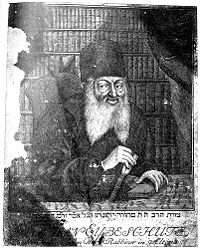
Jonathan Eybeschütz ( German: Jonathan ben Nathan Eybeschütz , Latin spelling - Eybeschuetz ; Ben Nathan Nata ; 1690 , Krakow , Commonwealth - 1764 , Altona , Prussia ) - rabbi, Kabbalist and expert in Talmud, was a rector of Prague and a renowned scholar . Suspected of secret relationships with the Sabbatians .
Career
At 18, he was considered a gaon (genius), already at 21 he became rector of the Prague Yeshiva, he had thousands of students and high authority.
Talmud Seal Incident
Eibeschutz was able to negotiate with the Catholic Cardinal Hassembauer and received permission to print the Talmud , but the cardinal stipulated that censorship cut out places incompatible with Christianity from the Talmud. Disputes arose in Jewish communities about this, and the Frankfurt rabbis sought permission to withdraw.
In 1725, the rabbis of Prague imposed a sherm on the Prague Sabbatians, this decision was supported by Eibesuc. In 1736 he became a dayan of Prague. In 1741 he became the rabbi of the city of Metz , and in 1750 he became the rabbi of Hamburg , Altona and Wandsbek .
Eibesiuc won the love and respect of the parishioners - both with his kindness and courtesy, and his knowledge.
Litigation with Jacob Emden
Jacob Emden , an Amsterdam rabbi, accused Eybeschutz of aiding Sabbatianism . The dispute was based on an amulet with Sabbatian symbols (the coded name of Shabtai Zvi ), which he gave to a pregnant woman in Altona. Emden made accusations, Ebeschutz began to claim that the amulet was fake, and declared the sherry Sabbathians, but Emden continued to publicly accuse him.
There were four letters in the amulet בבאא BBAA or בבאי BBAI , and Emdem noticed that after the replacement of letters quite common among Kabbalists, the name Shabtai was obtained. Eybeschutz claimed that it was about the four letters of the first words of the Torah BBET, but the scribe made a mistake.
The dispute has grown and engulfed almost all European communities. Most of the German rabbis stood on the side of the accusation; on the side of the defense were the rabbis of Poland and Moravia. The dispute was proposed to be judged by the King of Denmark, who stood up for Eibesuc and appointed re-election of the rabbis, in which Eibesuc defeated. Christian scholars also stood up for Eibesuc.
The Frankfurt, Amsterdam, and Mets rabbis demanded that Ebeschutz answer the charges, but Eibesciutz refused to appear for trial. The case was transferred to Vaad in four lands (the central board of Polish Jews), which concluded that Eybeszyutz was innocent.
In the dispute, both parties actively declared cherries to representatives of the opposite camp, which led to the fact that almost half of Europe was under the cherem; the power of the heream as a punishment became ludicrous.
Prague rabbi Yehezkel Landa stood up for Eibesuc, who declared the amulets to be forged and dropped the charges against him.
In 1760, new facts of the prosecution appeared. Sabbatianism was discovered in the Yeshiva of Prague among the students of Eibesuc, and then his own son Wolf declared himself a Sabbatian prophet (of the Francoist style ). Then the yeshiva was closed. Nevertheless, Eybeschutz was acquitted, but the dispute continued after his death.
Compositions
Eibesuc wrote about thirty works on halachah , which were recognized. From was also considered an outstanding connoisseur of the Talmud.
Ratings
According to popular belief, in the 19th century, Eybeschutz was not a Sabbatian, but sympathized with this movement in his youth, disappointed in adulthood.
Nevertheless, many scholars ( Gretz and Gershom Scholem ) consider him a Sabbatian who keeps his predilections secret, based primarily on his treatise Shem Olam.
In his early years, Eybeschutz became acquainted with the Sabbatian theorist Nehemiah Hayon , and the Moravian Sabbatian Yehuda Leib Prosnitz was one of his teachers, Prosnitz really appreciated Eibesuc, considering him a successful contender to become the Messiah.
The conflict between Emden and Eibesuc divided the Jewish community and anticipated the division of Jewish thought into two areas - the "Lithuanian" rabbinical tradition ( misnagdim ) and mystical Hasidism .
Literature
- “Eibenschutz Jonathan”, Electronic Jewish Encyclopedia
- Mikhail Nosonovsky. Jacob Emden vs. Jonathan Eibeshet
- Emden Ya'akov, Electronic Jewish Encyclopedia
- Moshe Perlmutter, R. Yehonatan Aibeshits ve-yahaso el ha-Shabtaut: hakirot hadashot 'al yesod ketav ha-yad shel s.va-avo ha-yom el ha-'ayin (Tel Aviv: 1947)
- Carl Anton, Period documents concerning the Emden / Eibeschuetz controversy. (Reprint 1992)
- Elisha Carlebach, The pursuit of heresy: Rabbi Moses Hagiz and the Sabbatian controversies (Columbia 1990)
- Gershom Scholem, Meḥḳere Shabtaʼut (1991)
- Sid Leiman / Simon Schwarzfuchs, New Evidence on the Emden-Eibeschiitz Controversy. The Amulets from Metz, Revue des Etudes Juives 165 (2006),
- Sid Leiman, "When a Rabbi Is Accused of Heresy: R. Ezekiel Landau's Attitude toward R. Jonathan Eibeschuetz in the Emden - Eibeschuetz Controversy in FROM ANCIENT ISRAEL TO MODERN JUDAISM Edited by Jacob Neusner
- Leiman, Sid (Shnayer) When a rabbi is accused of heresy: the stance of the Gaon of Vilna in the Emden-Eibeschuetz controversy in Me'ah She'arim (2001) 251-263
- Leiman, Sid (Shnayer) Z. When a rabbi is accused of heresy: the stance of Rabbi Jacob Joshua Falk in the Emden-Eibeschuetz controversy. Rabbinic Culture and Its Critics (2008) 435-456
- Moshe Carmilly-Weinberger, Wolf Jonas Eybeschütz - an “Enlightened” Sabbatean in Transylvania Studia Judaica, 6 (1997) 7-26
- Yehuda Liebes “A Messianic Treatise by R. Wolf the son of R. Jonathan Eibeschutz.” Qiryat Sefer 57 (1982/2) 148-178.