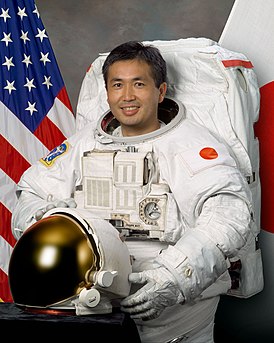
Koichi Wakata ( Japanese: 若 田 光 一 Wakata Ko: ichi , born August 1, 1963 ) is the fourth Japanese astronaut, a JAXA officer, a veteran of four NASA space shuttle missions, and a member of five expeditions to the International Space Station . The first Japanese commander of the thirty-ninth crew of the ISS .
| Koichi Wakata | |||
|---|---|---|---|
| 若 田光 一 | |||
 | |||
| A country |  Japan Japan | ||
| Specialty | flight specialist | ||
| Expeditions | 9 - STS-72 , STS-92 , STS-119 , MKS-18 , MKS-19 , MKS-20 , STS-127 , MKS-38 , MKS-39 | ||
| Date of Birth | August 1, 1963 (56 years old) | ||
| Place of Birth | Omiya (now within the city of Saitama , Japan ) | ||
| Awards |
| ||


Content
- 1 Biography
- 1.1 Careers at JAXA
- 2 Awards
- 3 Personal life
- 3.1 Family
- 3.2 Hobbies
- 4 notes
- 5 Links
Biography
Wakata was born on August 1, 1963 in the city of Omiya , Saitama Prefecture , Japan. In 1982 he graduated from public high school. In 1987, he received a bachelor of science degree in aeronautics from Kyushu University and a master's degree in applied mechanics from the same university in 1989 . In 2004, he received his doctorate in space rocket engineering [1] .
He began working as an engineer in 1989 at Japan Airlines , where he underwent a three-month training in the repair department of the city of Narita . From July 1991 to May 1992, he studied the integrity of the design of transport aircraft and, in total, flew on airplanes of various types for more than 1,100 hours.
JAXA Career
In 1992, Wakata was elected as a candidate for the NASDA astronaut squad. From March 1992 to August 1993 he passed one-year courses of general space training (as part of NASA's 14th set) at the Space Center. Johnson , qualified as a shuttle flight specialist [2] . Upon completion, he was appointed to the Computer Support Department of the Astronaut Department. December 12, 1994 was assigned to the crew of STS-72 as a specialist.
From January 11 to January 20, 1996, its first space flight lasting 8 days 22 hours made an Endeavor as part of STS-72 , during which it performed robotic operations to return the Space Flyer Unit satellite "Weighing about 3.5 tons launched in March 1995 and the launch and return operation of the OAST-Flyer research satellite launched earlier during this mission, Inder. Managing the MTKK manipulator, Koichi Wakata ensured the capture of satellites and their movement into the cargo compartment of the shuttle.
From 1996 to 1998, he worked at the Department of Aerospace Physics of the Astronaut Department. On June 2, 1997, he was assigned to the crew of Discovery STS-92 under the ISS-05-3A space station assembly program, becoming the first Japanese to visit the station.
The second space flight took place from October 11 to October 24, 2000, lasting 12 days, 21 hours, on the shuttle Discovery as part of STS-92 , in which, using the shuttle robot manipulator, he controlled the installation of the structures of the supporting segment Z-1 and the docking unit RMA-3 ISS.
From August 26 to September 6, 2002 he participated in training on the program of flights to the ISS station at the European Center of Astronauts in Germany.
In July 2006, he took part in the NASA mission for operations in extreme environments (NEEMO 10) [3] [4] .
In 2006, after training at the RGNII CPC them. Yu. A. Gagarin, for a long-term flight to the ISS and to study the Soyuz TMA spacecraft systems, was previously included in the ISS-16 main crew, but was later decommissioned. From January 16 to January 27, 2007 he participated in survival training as part of a conditional crew along with Salizhan Sharipov and Soichi Noguchi . February 13, 2007 was appointed flight engineer of the main crew of the 18th expedition.
Wakata completed the third space flight from March to July 2009 , becoming the first Japanese member of the long-term expedition crew aboard the ISS. Koichi Wakata arrived on STS-119 MTKK Discovery March 17, 2009 to replace astronaut Sandra Magnus as flight engineer for the ISS 18th crew and remained in this position for the 19th and 20th expeditions until Timothy Kopra arrived . On July 2-3, 2009, as a flight engineer, he participated in the docking of the Soyuz TMA-14 manned spacecraft from the aggregate compartment of the Zvezda service module to the Pirs docking compartment. [5] On July 31, 2009, Koichi returned to Earth on the Endeavor shuttle STS-127 .
The fourth space flight Wakata performed from November 7, 2013 to May 14, 2014. Koichi Wakata arrived in the Soyuz TMA-11M as a flight engineer of the 38th ISS crew , from March 10, 2014 became the commander of the ISS-39 expedition, he became the first Japanese astronaut to become the commander of the ISS expedition, and the third astronaut not from among Russian or American expedition commanders . May 14, 2014 Koichi returned to Earth on the Union TMA-11M . [6]
- Statistics [7]
| # | Launch ship | Start | Expedition | Landing ship | Landing | Raid | EVA | Time in outer space |
|---|---|---|---|---|---|---|---|---|
| one | Endeavor STS-72 | 11.01 . 1996 , 09:41 UTC | STS-72 | Endeavor STS-72 | 01/20 . 1996 , 07:41 UTC | 08 days 22 hours 00 minutes | 0 | 0 |
| 2 | Discovery STS-92 | 11.10 . 2000 , 23:17 UTC | STS-92 | Discovery STS-92 | 10.24 . 2000 , 20:59 UTC | 12 days 21 hours 42 minutes | 0 | 0 |
| 3 | Discovery STS-119 | 03/15 . 2009 , 23:43 UTC | STS-119, MKS-18 / MKS-19 / MKS-20 , STS-127 | Endeavor STS-127 | 07/31 . 2009 , 17:03 UTC | 137 days 15 hours 04 minutes | 0 | 0 |
| four | Soyuz TMA-11M | 11/7 . 2013 , 04:14 UTC | ISS-38 / ISS-39 | Soyuz TMA-11M | 05/14 . 2014 , 01:58 UTC | 187 days 21 hours 44 minutes | 0 | 0 |
| 347 days 08 hours 30 minutes | 0 | 0 | ||||||
Rewards
- Medal "For Space Flight"
- Medal "For Merit in Space Exploration" ( April 12, 2011 ) - for his great contribution to the development of international cooperation in the field of manned space exploration [8]
Personal life
Family
Married, one child [7] .
Hobbies
Hang gliding, baseball, tennis, skiing [7] .
Notes
- ↑ Biography of the Soyuz TMA-11M flight engineer, Koichi Wakata . The journal "Cosmonautics News" (11/07/2013). Date of treatment November 13, 2013.
- ↑ NASA . NASA Biography Koichi Wakata Neopr . NASA (2008). Date of treatment August 23, 2011.
- ↑ NASA. NASA Uses Undersea Lab to Prep for Future Space Exploration NASA (2006). Date of treatment September 22, 2011. Archived on August 29, 2012.
- ↑ Technologies for working on the Moon and Mars will be tested in an underwater laboratory . RIA Novosti (July 8, 2007). Date of treatment September 22, 2011. Archived on August 29, 2012.
- ↑ Union TMA-14 (2009). Archived on September 26, 2017.
- ↑ Union TMA-11M (2013). Archived August 4, 2017.
- ↑ 1 2 3 Statistics - Wakata Koichi spacefacts.de. Date of treatment December 31, 2017.
- ↑ Decree of the President of the Russian Federation of April 12, 2011 No. 437 “On awarding the medal“ For Merits in Space Exploration of “Foreign Citizens”