MIM-3 Nike Ajax ( English MIM-3 Nike Ajax , / ˈ n aɪ k i ˈ eɪ dʒ ɑː k s / ; in Russian-language literature it is usually indicated as “ Nayk-Ajax ”; originally SAM-A-7 ) - an American anti-aircraft missile system , one of the first anti-aircraft missile systems in the world. Adopted in 1953 (in production since 1951).
| MIM-3 Nike-Ajax | |
|---|---|
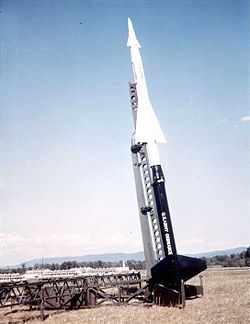 | |
| Type of | Medium-range air defense systems |
| Status | withdrawn from service |
| Developer |  Western electric Western electric |
| Years of development | 1946-1948 |
| Test start | 1948 |
| Adoption | 1953 |
| Manufacturer | Bell Labs , Douglas Aircraft |
| Years of production | 1952-1958 |
| Units produced | 13714 |
| Years of operation | 1953-1964 |
| Main operators | U.S. Army US National Guard |
| Other operators |      |
| ↓ All specifications | |
Content
History
The complex was developed by Western Electric Corporation since 1946, as a means of effective destruction of high-flying high-speed bombers. The first uncontrolled versions of the rocket passed fire tests in 1946, but a significant number of technical problems significantly delayed development. The main source of complexity was the solid fuel launch booster, consisting of 8 small solid propellant rocket engines arranged in a cluster pattern, with a ring around the rocket’s central body.
By 1948, problems with the accelerator were resolved by replacing it with a solid fuel launch stage located at the rear of the rocket. Tests of the rocket began in 1950, and in 1951 the first defeat was recorded by a guided projectile of an air target - a radio-controlled QB-17 .
Production of serial missiles began in 1952. In 1953, the first Nike-Ajax batteries were put into service and the complex went on combat alert .
Design
SAM "Nike-Ajax" used a command guidance system based on the use of two radars. Target detection was carried out by a separate radar station LOPAR (abbr. Eng. Low-Power Acquisition Radar ), the data from which was used to aim the target tracking radar TTR ( Eng. Target Tracking Radar ). The launched missile was continuously monitored by the beam of another radar - MTR ( Eng. Missile Tracking Radar ).
The data supplied by the TTR and MTR radars on the airborne position of the target and the missile was processed by a counting and resolving device operating on vacuum tubes and broadcast over the air to the missile. The device calculated the calculated point of the meeting of the rocket and the target, and automatically corrected the course of the projectile. Homing was absent: missile detonation was carried out by a radio signal from the ground at the calculated point of the trajectory. For a successful attack, the rocket usually rose above the target, and then fell to the calculated interception point.
A unique feature of the MIM-3 "Nike-Ajax" was the presence of three high-explosive fragmentation warheads . The first, weighing 5.44 kg, was located in the nasal section, the second - 81.2 kg - in the middle, and the third - 55.3 kg - in the tail. It was assumed that their detonation would create a more extended cloud of fragments and increase the effectiveness of the destruction of the aircraft. The real effectiveness of such a solution is unknown, but it was not repeated in further developments.
The effective range of the complex was about 48 kilometers. A missile could hit a target at an altitude of up to 21,300 meters, while moving at a speed of 2.3 Machs .
The technical drawback of the complex was the presence of only one rocket control channel. Also, initially, there was no effective connection between the individual Nike-Ajax batteries, as a result of which several batteries could choose the same target for tracking. This defect was corrected in the future by introducing Martin's AN / FSG-1 Missile Master system, which exchanged data between the solvers of individual batteries and coordinated guidance for various purposes.
Deployment
The deployment of the Nike-Ajax complex was carried out by the US Army in large quantities from 1954 to 1958. By 1958, about 200 batteries were deployed in the United States, comprising 40 “defensive areas.” The complexes were deployed near major cities, strategic military bases, industrial centers to protect them from air attacks. The number of batteries in the “defensive area” varied depending on the value of the facility: for example, two batteries covered the Barksdale airbase, while the Chicago area was protected by 22 Nike-Ajax batteries.
Each Nike-Ajax battery consisted of two parts: Battery Control Area - a central post where radars, calculating and resolving equipment, personnel buildings - and the Launch Area , the sector around which were located launchers, missile depots, fuel tanks. The Launch Area typically included 2–3 rocket stores and 4–6 launchers.
Initially, Nike-Ajax launchers were deployed on the surface. Subsequently, with the growing need to protect complexes from the damaging factors of a nuclear explosion, underground missile storages were developed. Each buried bunker stored 12 missiles, which were fed horizontally through a drop-down roof with hydraulic devices. A rocket raised to the surface on a rail carriage was transported to a horizontally lying launcher. After fixing the rocket, the launcher was installed at an angle of 85 degrees.
In the early 1960s, Nike-Ajax rockets began to be replaced by more advanced MIM-14 Nike-Hercules , which had a significantly larger range and were capable of carrying atomic warheads. By 1964, only parts of the National Guard continued to operate the Nike-Ajax, but they soon replaced them with the MIM-14 Nike-Hercules.
In addition to the United States, the complex was deployed to protect American and allied military bases in Western Europe and East Asia.
Performance Specifications
- Guidance System: Radio Command
- Missile mass: 450 kg (without accelerator)
- Accelerator mass: 660 kg
- Missile length: 6.4 m (without accelerator)
- Accelerator Length: 4.21 m
- Wing span: 1.37 m
- Rocket diameter: 0.30 m
- Maximum flight speed: 2.3 M
- Target hitting height: up to 21300 m
- Firing Range: up to 48 km
- Warhead: 3 high-explosive fragmentation (5.44 kg + 81.2 kg + 55.3 kg)
- Engine:
- Launch Accelerator - RDTT Allegheny Ballistics Lab. M5
- Thrust - 246 kN
- Operating time - 3 sec.
- March Stage - Bell LRE
- Thrust - 11.6 kN
- Launch Accelerator - RDTT Allegheny Ballistics Lab. M5
Comparative characteristic
| Name of rocket and country production | Engine | Mass-dimensional specifications | Flight technical specifications | Other | |||||||||||||
|---|---|---|---|---|---|---|---|---|---|---|---|---|---|---|---|---|---|
| Original | Russian | A country | Steps | Fuel | Feed system | Thrust on the ground, kgc | Working time, s | Length m | Diameter m | Gross weight | Fuel mass, kg | Payload mass, kg | Speed max., M / s | Height max. or along the trajectory, km | Range, km | Mass production | Note |
| Long-range missiles such as ground-to-ground | |||||||||||||||||
| V-2 (A-4) | V-2 | Liquid Oxygen + 75% Ethyl Alcohol | Pumping | 25,000 | 65 | 14 | 1.65 | 3000 | 9000 | 1000 | 1500 | 80 | up to 300 | Yes | Outdated design. Served as a prototype of many missiles | ||
| Wac corporal | Corporel | Nitric acid + aniline | Crowding out | 9070 | - | 12,2 | 0.762 | 5440 | - | 600 ÷ 800 | 1000 ÷ 14501 | 80 | 120 ÷ 240 | Yes | The range and speed run is achieved by installing a warhead of various weights | ||
| PGM-11 Redstone | Redstone | Liquid oxygen + alcohol | Pumping | 31880 | - | 18.3 | 1,52 | 20000 | - | - | 1800 | - | 320 (800) | Yes | It became a prototype for the development of missiles with a range of up to 2400 km | ||
| SM-65 Atlas | "Atlas" | First stage | Liquid oxygen + dimethyl hydrazine | Pumping | 2 × 45360 (2 × 54000) | - | - | - | 100000 ÷ 110000 | - | - | 6700 | 1280 | 8000 | Yes | At start all three engines work | |
| Second stage | Liquid oxygen | - | 61000 | - | 24 ÷ 30 | 2,4 ÷ 3 | 225,000 | - | |||||||||
| Upper atmosphere rockets | |||||||||||||||||
| General Electric RTV-G-4 Bumper | "Bumper" | The first stage of type A-4 | (see A-4 rocket data) | 26 kg (instrument weight) | 3000 | 420 | - | Made several copies ↓ | Used for research purposes | ||||||||
| Second Stage WAC Corporal | Nitric acid + aniline | Crowding out | 680 | 45 | 5.8 | 0.3 | 300 | - | |||||||||
| RTV-N-12 Viking | Viking | Number 11 | Liquid oxygen + alcohol | Pumping | 9070 | - | 12.7 | 1,2 | 7500 | - | 320 | 1920 | 254 | - | Issued 12 pcs. in various ways | Special research rocket. Has a detachable head | |
| Number 12 | Pumping | 9225 | 105 | 12.7 | 1.14 | 6800 | 2950 ÷ 2500 | 450 | 1800 | 232 | - | ||||||
| Aerobee | Aerobi | First stage | Powder | - | - | 2,5 | 1.9 | - | 265 | 117 | 68,4 | 1380 | 100 ÷ 145 | - | Issued about 100 pcs. different options | ||
| Second stage | Nitric acid + aniline | Balloon | 1140 | 45 | 6.1 | 0.38 | 485 | 283 | |||||||||
| Aerobee 150 | Aerobi | First stage | Powder | - | - | - | - | - | 265 | - | 55 - 91 | 2150 | 325 ÷ 270 | - | Yes | ||
| Second stage | Nitric acid + (aniline + alcohol) | Thirst | 800 | 53 | 6.37 | 0.38 | - | 500 | |||||||||
| Veronica agi | "Veronica" | Nitric acid + kerosene | Thirst | 4000 | 32 ÷ 35 | 6.0 | 0.55 | 1000 | 700 | 57 | 1400 | 120 | 240 | Prototypes | |||
| Anti-aircraft guided missiles | |||||||||||||||||
| Wasserfall | Wasserfall | Nitric acid + Visol | Balloon | 8000 | 40 | 7,835 | 0.88 | 3800 | 1815 | 600 ÷ 100 | 750 | 20 | 40 | Has not been finalized | |||
| MIM-3 Nike Ajax | Nike | First stage | Powder | - | - | - | 3.9 | - | 550 | - | up to 140 kg | 670 | 18 | thirty | Yes | Was in service in the US air defense system | |
| Second stage | Nitric acid + aniline | Balloon | 1180 (at an altitude of 3000 m) | 35 | 6.1 | 0,300 | 450 | 136 | |||||||||
| Matra SE 4100 | Matra | - | Balloon | 1250 | 14 | 4.6 | 0.400 | 400 | 110 | - | 500 | 4.0 | - | Prototypes | |||
| Oerlikon RSC-51 | Oerlikon | Nitric acid + kerosene | Balloon | 500 | 52 | 4.88 | 0.37 | 250 | 130 | 20 | 750 | 15 | 20 | Yes | |||
| Source of information: Sinyarev G. B., Dobrovolsky M. V. Liquid rocket engines. Theory and design. - 2nd ed. reslave. and add. - M.: State. publishing house of the defense industry, 1957. - S. 60–63 - 580 p. | |||||||||||||||||
Project Evaluation
The MIM-3 Nike-Ajax complex was the first mass-produced air defense system to be adopted by the world and the first anti-aircraft missile system deployed by the US Army. For the mid-1950s, the capabilities of the complex made it possible to effectively hit any existing type of jet bombers and cruise missiles.
Compared to the Soviet counterpart, the S -25 air defense system, the Nike-Ajax complex was structurally much simpler. It had only single-channel guidance, and the initial design did not even provide for interaction between individual batteries (a flaw later fixed). But on the other hand, MIM-3 "Nike-Ajax" was much cheaper than the S-25, and was deployed due to this in much larger quantities. By 1957, when the release of the first mass Soviet S -75 air defense system was just beginning, more than a hundred Nike-Ajax batteries were deployed in the United States.
Armed
- Greece
- Italy
- Netherlands
- USA - withdrawn from service in 1963
- Turkey
- Germany
Links
- SAM "Nike-Ajax" (Russian) Website "Bulletin of air defense"
- Andreas Parsch. Western Electric SAM-A-7 / M1 / MIM-3 Nike Ajax . Designation-Systems.net. Date of treatment July 25, 2012. Archived on August 8, 2012.