Diophantus of Alexandria ( dr. Greek Διόφαντος ὁ Ἀλεξανδρεύς ; lat. Diophantus ) is an ancient Greek mathematician who lived presumably in the 3rd century AD. e. Often referred to as the "father of algebra ." The author of “Arithmetic” is a book devoted to finding positive rational solutions of indefinite equations . Nowadays, “diophantine equations” usually mean equations with integer coefficients, the solutions of which are required to be found among integers.
| Diophantus of Alexandria | |
|---|---|
| Διόφαντος ὁ Ἀλεξανδρεύς | |
 | |
| Date of Birth | or |
| Place of Birth | |
| Date of death | |
| A country | |
| Scientific field | |
| Known as | "Father of algebra" |
Diophantus was the first Greek mathematician to consider fractions on an equal basis with other numbers. Diophantus was also the first among ancient scholars to offer developed mathematical symbolism , which made it possible to formulate the results he obtained in a rather compact form.
In honor of Diophantus, a crater on the visible side of the moon is named.
Biography
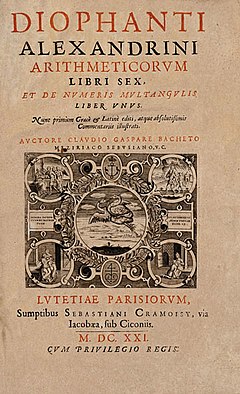
Almost nothing is known about the details of his life. On the one hand, Diophantus quotes Gypsicle ( II century BC ); on the other hand, Theon of Alexandria writes about Diophantus (about 350 CE), from which it can be concluded that his life proceeded within the boundaries of this period. A possible clarification of the life of Diophantus is based on the fact that his Arithmetic is dedicated to the "Most Honorable Dionysius." It is believed that this Dionysius is none other than Bishop Dionysius of Alexandria , who lived in the middle of the 3rd century. n e.
The Palatine anthology contains an epigram task:
The dust of Diophantus the tomb is at rest; marvel at her - and stone
The wise age will tell him wise art.
By the will of the gods, he lived a sixth part of his life as a child.
And half-past six I met with a gun on my cheeks.
Only the seventh minute passed, he became engaged to a girlfriend.
With her, having spent five years, a sage waited for his son;
Only half the life of his father's beloved son lived.
He was taken from his father by his early grave.
Twice two years, a parent mourned for grief,
Then I saw the limit of my sad life.
(Translation by S.P. Bobrov )
It is equivalent to solving the following equation:
This equation gives , that is, the age of Diophantus is equal to 84 years. However, the accuracy of the information cannot be confirmed.
Diophantus Arithmetic
The main work of Diophantus is Arithmetic in 13 books. Unfortunately, only 6 (or 10, see below) of the first 13 books were preserved.
The first book is preceded by an extensive introduction, which describes the notation used by Diophantus. Diophantus calls the unknown “number” ( ἀριθμός ) and denotes the letter ς , the square of the unknown - the symbol Δ Υ (short for δύναμις - “degree”), the cube of the unknown - the symbol Κ Υ (short for κύβος - “cube”). Special signs are provided for the following degrees of the unknown, up to the sixth, called the cube-cube, and for degrees opposite to them, up to minus the sixth.
Diophantus does not have an addition sign: he simply writes nearby positive terms in descending order of degree, with the degree of the unknown being written first in each term, and then the numerical coefficient. The deductible members are also written side by side, and a special sign in the form of an inverted letter Ψ is placed in front of their entire group. The equal sign is indicated by the two letters ἴσ (short for ἴσο от - “equal”).
The rule of bringing such members and the rule of adding or subtracting to both parts of the equation of the same number or expression is formulated: what later became known to al-Khorezmi as “algebra and almukabala”. The rule of signs has been introduced: “minus plus gives minus”, “minus to minus gives plus”; this rule is used when multiplying two expressions with subtracted members. All this is formulated in a general way, without reference to geometric interpretations.
Most of the work is a collection of problems with solutions (in the six surviving books there are only 189, along with four from the Arabic part - 290), skillfully selected to illustrate general methods. The main problem of Arithmetic is finding positive rational solutions of indefinite equations . Rational numbers are interpreted by Diophantus in the same way as natural numbers , which is not typical of ancient mathematicians.
Diophantus first explores systems of second-order equations from two unknowns; he indicates a method for finding other solutions, if one is already known. Then he applies similar methods to equations of higher degrees. Book VI examines problems related to right-angled triangles.
The Influence of Arithmetic on the Development of Mathematics
In the X century, arithmetic was translated into Arabic (see Kusta ibn Luke ), after which the mathematicians of the Islamic countries ( Abu Kamil and others) continued some research of Diophantus. In Europe, interest in Arithmetic increased after Rafael Bombelli translated and published this work in Latin, and published 143 problems from it in his Algebra (1572). In 1621, a classic, detailed commented Latin translation of Arithmetic appeared , made by Bachet de Meziriac .
The methods of Diophantus had a huge impact on Francois Viet and Pierre Fermat ; however, in modern times, indefinite equations are usually solved in whole numbers, and not in rational ones, as Diophantus did. When Pierre Fermat read Diophantus' Arithmetic published by Bachet de Meziriac , he came to the conclusion that one of the equations, similar to those considered by Diophantus, has no integer solutions, and noticed in the margins that he found "a truly wonderful proof of this theorem ... however, the margins of the book are too narrow to bring. " This statement is now known as Fermat's Great Theorem .
In the XX century, under the name of Diophantus, the Arabic text of four more books of Arithmetic was discovered. Having analyzed this text, I. G. Bashmakova and E. I. Slavutin hypothesized that its author was not Diophantus, but a commentator who was well versed in Diophantus’s methods, most likely Hypatius . However, a significant gap in the methodology for solving the problems of the first three and last three books is well filled with four books of Arabic translation. This forces us to review the results of previous studies. [2] .
Other works of Diophantus
Diophantus's treatise On polygonal numbers ( Περὶ πολυγώνων ἀριθμῶν ) is not fully preserved; in the remaining part, a number of auxiliary theorems are derived by methods of geometric algebra.
From the works of Diophantus On the measurement of surfaces ( ἐπιπεδομετρικά ) and on the multiplication ( Περὶ πολλαπλασιασμοῦ ), only fragments are also preserved.
The book of Diophantus Porism is known only for a few theorems used in Arithmetic .
See also
- Diophantine equation
- Mathematics in Ancient Greece
Notes
- ↑ Akyeampong E. K. , Gates H. L. Dictionary on African Biography, افریقی سوانحی لغت - New York City : OUP , 2012. - ISBN 978-0-19-538207-5
- ↑ http://www.jphogendijk.nl/reviews/sesiano.html
Literature
Works:
- Diophantine. "Arithmetic" and scholi / According to ed. Tannery (Greek texts)
- Diophantus of Alexandria . Arithmetic and a book about polygonal numbers. / Per. I.N. Veselovsky; Ed. and comment. I. G. Bashmakova. - M.: Science, GRFML, 1974 . - 328 p. - 17500 copies.
- Sesiano J. Books IV to VII of Diophantus' Arithmetica in the Arabic translation attributed to Qusṭā ibn Lūqā / Jacques Sesiano . - Heidelberg: Springer-Verlag, 1982. (Arabic text and English translation)
- Diophantine. “Arithmetic” - the publication in the series “ Collection Budé ” has begun (2 volumes have been published : Books 4–7).
Research:
- Bashmakova I. G., Slavutin E. I., Rosenfeld B. A. The Arabic version of the "Arithmetic" of Diophantus // Historical and mathematical research. - M., 1978. - Issue. Xxiii. - S. 192 - 225.
- Bashmakova I. G. Arithmetic of algebraic curves: (From Diophantus to Poincare) // Historical and mathematical research. - 1975. - Vol. 20. - S. 104 - 124.
- Bashmakova I. G. Diophantine and Diophantine equations. - M .: Nauka, 1972 (Reprint: M .: LCI, 2007). Per. On him. ID: Diophant und diophantische Gleichungen . - Basel; Stuttgart: Birkhauser, 1974. Transl. in English. Language: Diophantus and Diophantine Equations / Transl. by A. Shenitzer with the editorial assistance of H. Grant and updated by J. Silverman // The Dolciani Mathematical Expositions. - No. 20. - Washington, DC: Mathematical Association of America, 1997.
- Bashmakova I. G. Diophantine and Fermat: (On the history of the method of tangents and extrema) // Historical and mathematical research. - M., 1967. - Issue. VII. - S. 185 - 204.
- Bashmakova I. G., Slavutin E. I. The history of the Diophantine analysis from Diophantus to Fermat. - M.: Science, 1984.
- The history of mathematics from ancient times to the beginning of the XIX century. - T. I: Since ancient times. times before the start of the Nov. Time / Ed. A.P. Yushkevich . - M., Science, 1970.
- Slavutin E.I. Diophantus Algebra and its Origins // Historical and Mathematical Research. - M., 1975. - Vol. 20. - S. 63 - 103.
- Shchetnikov A.I. Can the book of Diophantus of Alexandria “On polygonal numbers” be called purely algebraic? // Historical and mathematical research. - M., 2003. - Issue. 8 (43). - S. 267 - 277.
- Heath th. L. Diophantus of Alexandria, A Study in the History of Greek Algebra. - Cambridge, 1910 (Repr .: NY, 1964).
- Knorr WR Arithmktikê stoicheiôsis: On Diophantus and Hero of Alexandria // Historia Mathematica. - 20. - 1993. - P. 180 - 192.
- Christianidis J. The way of Diophantus: Some clarifications on Diophantus' method of solution // Historia Mathematica. - 34. - 2007. - P. 289 - 305.
- Rashed R., Houzel C. Les Arithmétiques de Diophante. Lecture historique et mathématique . - De Gruyter, 2013.
Links
- John J. O'Connor and Edmund F. Robertson . Diophantus of Alexandria (English) - biography in the MacTutor archive.