The Presidential Office in Asmara is an Italian-built neoclassical building in Asmara in which the president of Eritrea lives and rules. The building is a bit like the White House in Washington .
| Sight | |
| Presidential Office | |
|---|---|
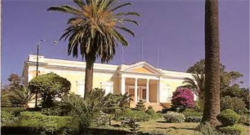 Presidential Office in Asmara | |
| A country |  Eritrea Eritrea |
| City | Asmara |
| Architectural style | |
| Build Date | 1897 |
Content
History
The former palace of the Italian governor was built in 1897 by Fernando Martini , the first Italian governor of Eritrea. The Italian government wanted to build an impressive building in Asmara, from where the Italian governors could demonstrate the commitment of the Kingdom of Italy “colonia primogenita” (the first daughter of the colony), as Eritrea was called [1] .
During the period of the Italian Empire, the building was improved as the center of Governatorato dell'Eritrea and was used as a temporary residence by the King of Italy / Emperor of Ethiopia, Victor Emmanuel III .
The palace was badly damaged during the Second World War , and in the 1950s it was turned into a National Museum by the Ethiopian authorities.
Today it is the residence of the President of Eritrea, Isaiah Afevork .
Design
Governor Fernando Martini wanted this to be a neoclassical-style colonnade at the entrance, surrounded by lush greenery. According to his plan, it was to become the largest and most beautiful building in Asmara, which in 1897 was declared the administrative center of this Italian colony.
The interior of the building was decorated with Italian marble and furnished with furniture imported from Italy and France . The main hall was decorated with a typical Renaissance staircase leading to the second floor provided for in the project. The main doors were trimmed with a special tree from Brazil .
See also
- Asmara
- Governor's Palace (Asmara)
- Cinema "Impero"
- Fiat Tagliero Building ( en: Fiat Tagliero Building )
Notes
- ↑ Ferdinando Martini. RELAZIONE SULLA COLONIA ERITREA - Atti Parlamentari - Legislatura XXI - Seconda Sessione 1902 - Documento N. XVI - Tipografia della Camera dei Deputati. Roma, 1902