Douarnenez ( fr. Douarnenez ) - a city in the north-west of France , is located in the Brittany region, the department of Finister , Camper County, the center of the eponymous canton . Located on the southern shore of the Gulf of Douarnene , 71 km south of Brest and 25 km northwest of Quimper . The name comes from the Breton words douar (land) and an enez (island).
| City | |||
| Duarnene | |||
|---|---|---|---|
| Douarnenez | |||
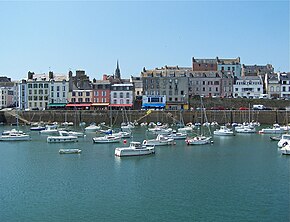 Port Douarnenez | |||
| |||
| A country |  France France | ||
| Region | Brittany | ||
| The Department | Finister | ||
| Canton | Duarnene | ||
| The mayor | Francois Cadic ( R ) 2017-2020 | ||
| History and Geography | |||
| Square | 24.94 km² | ||
| Center height | 0-86 m | ||
| Timezone | UTC + 1 , in summer UTC + 2 | ||
| Population | |||
| Population | 14,063 people ( 2016 ) | ||
| Density | 564 people / km² | ||
| Digital identifiers | |||
| Postcode | 29046, 29100 | ||
| INSEE Code | |||
| mairie-douarnenez.fr (fr.) | |||

Population ( 2016 ) - 5 627 people.
Content
History
The history of Duarnen is associated with two legends. The sunken city of Ker-Is is supposedly located at the bottom of the Gulf of Duarnen. Tristan, the protagonist of the epic about Tristan and Isolde , was forced to flee England and live in the court of the mythical king of Brittany. According to one version, he lived and died near Duarnen, and in the bay there is the island of Tristan (previously called the island of St. Tutuarn by the name of the monastery founded on it in the 12th century). In the written sources, Duarnene was first mentioned under 1118 , when the bishop of Quimper, Robert de Lokyuvan , gave the island of St. Tutuarn and his lands to the abbey of Marmoutier. Modern Duarnene emerged as a village belonging to the abbey; he received the rights of the city only in 1790. In 1945, the commune of Duarnen was expanded to include the villages of Ploare, Puldavid and Trebul.
The history of the fishing of Douarnenez dates back, at least, to the Gallo-Roman times, when, as archaeological finds show, salted fish along the rocks of Plomarch. From the end of the 18th century, sardines became the driving force of the local economy; the fishing industry was based on their collection and subsequent processing. By the beginning of the 20th century, the port had huge fishing and canning enterprises. The strikes in the 1920s in favor of improving working conditions for women working in fish factories were the main reason that Duarnen became one of the first municipalities in France where the communists came to power. Today, the production of canned fish continues, although most of the fish is imported from other ports. Duarnen is still the center of shipbuilding and repair work.
At the end of the 19th century, a railway was built linking Trebul with Kemper [1] . Passenger traffic functioned from 1884 to 1972 , freight traffic - until 1988 , after which the line was closed for unprofitability and dismantled.
From 1894 to 1946, a narrow gauge railway also operated , linking Duarnen with Pont Croix and Oderne . She was also taken apart.
At the end of the 19th century, a traditional Breton layer cake, kun-aman, appeared in Duarnen .
Attractions
- Tristan Island, which houses the Tristan Lighthouse, the Fort of Napoleon III and the old Gustave Raymond sardine factory
- Church of St. Jacques XIV-XV centuries
- Gothic Church of St. Hervey of the 16th century
- 17th Century Chapel of St. Michael
- 18th century St. Helena Chapel
Economics
The basis of the economy is fishing and fish processing. In the past, Duarnen was known for fishing and sardine production, but in recent years production has declined substantially. At the same time, the importance of Duarnen as a tourist center has grown, in particular, due to the proximity to Pointe du Ra .
Employment structure:
- agriculture - 1.4%
- industry - 16.7%
- construction - 4.6%
- trade, transport and services - 40.3%
- state and municipal services - 37.0%
The unemployment rate (2015) is 18.5% (France as a whole - 13.5%, the Finister department - 12.7%).
The average annual income per person, euro (2015) - 19 318 (France as a whole - 20 150, Finister department - 20 481).
Demographics
Population dynamics, people
Administration
Since 2017, the mayor of Duarnen has been a member of the Republican Party, François Cadic. In the 2014 municipal elections, the right-wing bloc led by Senator Philip Paul won the election, receiving 58.56% of the vote in the 2nd round. In October 2017, Philippe Paul resigned as mayor of Douarninay by virtue of the law on the impossibility of combining mandates, and his deputy, François Cadic, was elected the new mayor.
| Period | Surname | The consignment | Notes | |
|---|---|---|---|---|
| 1971 | 1995 | Michelle Masea | Communist party | teacher |
| 1995 | 1997 | Joseph Tretu | Different right | |
| 1997 | 2001 | Jocelyn Poitwen | Different right | |
| 2001 | 2008 | Monique Prevost | Different left | |
| 2008 | 2017 | Philippe Paul | Union for the Popular Movement / Republicans | senator |
| 2017 | Francois Kadik | Republicans | antique dealer | |
Twin Cities
- Falmouth , UK
Famous Natives
- Charles Danielo (1878-1953), politician and statesman, poet and writer
Links
Notes
Gallery
City center with chapel of St. Michael
Tristan Island
Church of Saint Jacques
Chapel of St. Helena
Church of St. Hervey