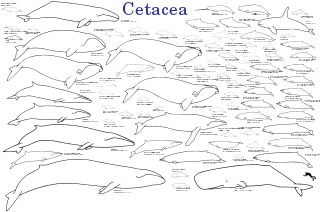
Cetaceans ( whales , dolphins , porpoises ) come from land ancestors, as evidenced by many of their signs:
- breathing atmospheric air with the help of the lungs,
- bones of fins (forelimbs) of cetaceans resemble bones of limbs of terrestrial mammals,
- tail movement and bending of the spine in a vertical plane is more characteristic of a galloping mammal than for swimming fish, usually curving in a horizontal plane.
The question of how terrestrial mammals evolved in marine mammals has long remained a mystery due to the lack of fossil remains of transitional species. However, thanks to the opening of the package in 1992, it became possible to clarify a number of issues and see the stages of the transition of land animals to marine ones.
Content
Cetacean Ancestors
Traditional views on the evolution of cetaceans consisted in the fact that their closest relatives and probably ancestors were mezzanine - an extinct squad of predatory ungulates that resembled wolves with hooves instead of claws and were a sister group of artiodactyls . These animals had teeth of an unusual conical shape, similar to cetacean teeth. In particular, because of this, scientists have long believed that cetaceans descended from a certain ancestral mesonichia. However, new molecular genetic data indicate that cetaceans are close relatives of artiodactyls, in particular hippos [1] . Based on these data, it is even proposed to include artiodactyls in the order of cloven-hoofed animals and the name Cetartiodactyla is proposed for a monophyletic taxon that includes these two groups. However, the largest age of the known fossils of the anthracoterium , the ancestors of the hippos, is several million years less than the age of Pakitset , the oldest known whale ancestor.
The recent discovery of the genus Pakicetus , the oldest known protokite species, confirms molecular data. The structure of the skeleton of the paciceta shows that the whales are not direct descendants of the mesonichids. On the contrary, the ancestors of the whales separated from the artiodactyls and switched to the aquatic way of life after the artiodactyls themselves separated from the ancestors common with mesonichids. Thus, the protokite species were early forms of artiodactyls, which retained some of the characteristics characteristic of mesonichids (conical shape of teeth) lost by modern artiodactyls. Interestingly, the earliest ancestors of all ungulate mammals were probably partly carnivores or scavengers.
The earliest cetacean animals: pacicetids or indochius?
Packets were ungulates, sometimes classified as early whales [2] [3] . They lived on the territory of modern Pakistan (hence the name “whale from Pakistan”) in the early Eocene , about 50 million years ago. It was an animal that looked like a dog, but with hoofs on its fingers and a long, thin tail. The device of the ear is related to paciceta whales: the paciceta auditory bull , like that of a whale, was formed exclusively from the tympanic bone . The shape of the ear area of the pacicet is very unusual and finds analogues only in cetaceans. Initially, it was assumed that the ear was adapted for life under water, however, further studies have shown that the pacicet's ears are suitable only for the air environment, and if the pacicet is really an ancestor of whales, the ability to hear underwater was the latest adaptation of an existing hearing aid [4] . According to Tevissen , Pakitset ’s teeth also resemble the teeth of fossil whales [5] .
Tevissen also found that a similar ear structure was observed in the fossils of a small deer-like animal Indochius . Indochius lived about 48 million years ago in Kashmir [3] . This small - the size of a domestic cat - herbivore possessed some features that bring it closer to whales and indicate adaptation to the aquatic environment. Among them, a thick and heavy bone shell resembling the bone shell of some modern semi-aquatic animals, such as hippos [6] [1] , which helps to reduce buoyancy and, as a result, allows you to stay under water. This suggests that Indochius , like a modern water deer , dived under water to hide from a predator [7] [8] [9] .
Ambulocetides and Remingtonocetides
The most remarkable of the ancient whales is the ambulocet , known from the Eocene of Pakistan . Outwardly, this mammal was like a three-meter crocodile. Ambulocet was a semi-aquatic animal: its hind legs are better suited for swimming than for walking on land. He probably swam, bending the body in a vertical plane, like modern otters , seals and whales . It is assumed that ambulocetides hunted like modern crocodiles, waiting in ambush of fish and animals that came to the watering hole.
Close relatives of the ambulocet were remingtonocetides . Representatives of this family were smaller in size, had a more elongated face and were better adapted to underwater life. It is assumed that they resembled modern otters in their way of life, hunting fish from ambush.
In representatives of both groups, the nostrils were located at the end of the muzzle, as in terrestrial mammals.
Protocetides
Protocetides form a large and diverse group, known for finds in Asia, Europe, Africa and North America. This family includes a large number of genera, some of them are quite well studied (for example, rhodocet , known from the tertiary deposits of Baluchistan ). All known protocetids had well-developed fore and hind limbs that could support the body on earth; they probably led an amphibiotic lifestyle, living both in the aquatic environment and on land. It is not yet clear whether protocetid had a caudal fin, like modern cetaceans, but it is obvious that they were well adapted to the aquatic lifestyle. For example, the sacrum - the part of the spine to which the pelvis is attached - in the Rhodocetus consisted of five separate vertebrae, while the vertebrae in the sacrum of terrestrial mammals are merged. At the protoketids, the nasal openings moved up the snout - this is the first step to the current cetaceans located on the crown of the nostrils. The version of the amphibian nature of protocetide is supported by the find of a pregnant Mayatset female [10] with a petrified fruit , her head turned to the outlet. This suggests that the birth of Mayatset took place on land - otherwise the cub had a chance to choke.
Features such as, for example, the presence of hooves at the ends of the fingers of the rhodocete speak of the origin of early whales from ungulates.
Basilosaurids and Dorudontids: Fully Marine Cetaceans
The basilosaurus (discovered in 1840 and initially mistaken for a reptile, which explains the “reptilian” name) and Dorodon lived about 38 million years ago and were purely marine animals. The basilosaurus was as large as the large modern whales, sometimes reaching 18 meters in length. Dorudontids were slightly smaller, up to 5 meters.
Despite all the similarities with modern whales, basilosaurids and dorudontids lacked a frontal-fat protrusion, the so-called melon, which allows the existing cetaceans to effectively use echolocation. The brain of basilosaurids was relatively small, from which it can be assumed that they led a solitary lifestyle and did not have such a complex social structure as some modern cetaceans. In connection with the transition to a purely aquatic lifestyle, basilosaurids exhibit degradation of the hind limbs - although they are well formed, they are small and can no longer be used for movement. However, perhaps they played a supporting role in mating. The pelvic bones of basilosaurids are no longer connected to the spine, as was the case with protocetid.
The appearance of echolocation
Toothed whales ( Odontocetes ) perform echolocation, creating a series of clicks at different frequencies. Sound impulses are emitted by the frontal fat pad (“frontal melon”), reflected from the object and recorded using the lower jaw. A study of squalodon skulls ( Squalodon ) suggests the primary occurrence of echolocation in this species. Squalodon lived from the beginning of the Middle Oligocene to the middle of the Miocene , about 33-14 million years ago, and had a number of signs similar to modern toothed whales. For example, a strongly flattened skull and extended jaw arches are most characteristic of modern Odontoceti . Despite this, the possibility of the origin of modern dolphins from squalodon is considered unlikely.
Early Dolphins
- See also " Dolphins - Development and Anatomy (English) "
Skeletal development
See also
- Inermorostrum xenops
Notes
- ↑ 1 2 University Of California, Berkeley (2005, February 7). UC Berkeley, French Scientists Find Missing Link Between The Whale And Its Closest Relative, The Hippo (link not available) . ScienceDaily. Date of treatment February 1, 2010. Archived May 22, 2009.
- ↑ Philip D. Gingerich , DE Russell. Pakicetus inachus , a new archaeocete (Mammalia, Cetacea) from the early-middle Eocene Kuldana Formation of Kohat (Pakistan ) // Univ. Mich. Contr. Mus. Paleont: journal. - 1981. - Vol. 25 . - P. 235-246 .
- ↑ 1 2 Northeastern Ohio Universities Colleges of Medicine and Pharmacy (2007, December 21). Whales Descended From Tiny Deer-like Ancestors (link not available) . ScienceDaily. Date of treatment December 21, 2007. Archived December 22, 2007.
- ↑ JGM Thewissen, EM Williams, LJ Roe and ST Hussain. Skeletons of terrestrial cetaceans and the relationship of whales to artiodactyls (English) // Nature: journal. - 2001. - Vol. 413 . - P. 277–281 . - DOI : 10.1038 / 35095005 .
- ↑ Whale Origins (inaccessible link) . Date of treatment July 25, 2009. Archived February 7, 2005.
- ↑ University Of Michigan (2001, September 20). New Fossils Suggest Whales And Hippos Are Close Kin (Link not available) . ScienceDaily. Date of treatment December 21, 2007. Archived December 15, 2007.
- ↑ Carl Zimmer. The Loom: Whales: From So Humble A Beginning ... (link not available) . ScienceBlogs (December 19, 2007). Date of treatment December 21, 2007. Archived December 21, 2007.
- ↑ Ian Sample. Whales may be descended from a small deer-like animal - Science - Guardian Unlimited (link not available) . Guardian Unlimited (December 19, 2007). Date of treatment December 21, 2007. Archived December 20, 2007.
- ↑ PZ Myers. Pharyngula: Indohyus (Inaccessible link) . Pharyngula . ScienceBlogs (December 19, 2007). Date of treatment December 21, 2007. Archived December 20, 2007.
- ↑ Gingerich PD, ul-Haq M, von Koenigswald W, Sanders WJ, Smith BH, et al. New Protocetid Whale from the Middle Eocene of Pakistan: Birth on Land, Precocial Development, and Sexual Dimorphism (link not available) . Plos one. Date of treatment February 4, 2009. Archived February 6, 2009.
Literature
- Sidorkin P. Whales: galloping to the sea // " Around the World ", January 2010, No. 1 (2832), rubric "Time Spiral".
Links
- BBC: Whale's evolution
- Evolution of Whales Adapted from National Geographic, November 2001, Revised 2006 Dr. JGM Thewissen
- The first whales with legs determined the swimming style of all whales