The church in the village of Kish ( Azeri. Kiş kilsəsi ) is a 12th century Christian church [1] in the village of Kish , 5 km north of Sheki in present-day Azerbaijan .
| Church | |
| Church in the village of Kish | |
|---|---|
| Azerb. Kis kilsəsi | |
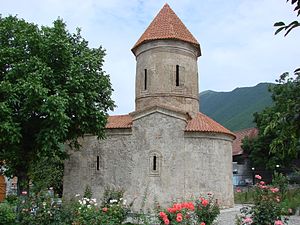 South side of the church | |
| A country |  Azerbaijan Azerbaijan |
| Village | Kish |
| Status | the museum |
| condition | recently renovated |
Content
History
According to the Armenian historian Movses Kagankatvatsi , in the I century AD er Saint Elisha , a disciple of the Apostle Thaddeus , arrived in a place named Gis, where he built a church and preached Christianity. The church soon became “the spiritual center and place of enlightenment for the people of the East.” Near the place of GIS, St. Elisha was killed by unknown persons near the pagan altar [2] .
According to Movses Kagankatvatsi, after the arrival of Mesrop Mashtots (361/362 - 440) to Gis, “the host that remained during the Cross stayed, after a few days, received a martyr's crown. In the place of their performance, bright signs and wondrous miracles appeared. It was often seen by the infidels, and having learned in this the sign of the great God, they collectively believed and accepted St. Epiphany. One of the converts who often saw this sign above the underground dwelling of the Cross built a quadrangular chapel and, having made cancer to boards, laid their relics there, making a vow, annually made their memory. At this place, many received healing, from which the believers became even more established and submitted to the faith. Having laid the foundation, they built the church of God over the dwelling of the Cross, calling it the ancient church of the town of Gis. After a long time, one of the noble princes, named Varaz Perozh, from the Aranshahik tribe, wanting to renew the old church, could not destroy the brick dome of the dome, because the Lord’s Cross and the relics of the martyrs lived there. ”Then,“ The history of the country of Aluank ”, at the end of VII, said at. Albanian Catholicos Ter-Eliazar "from the bishops of Shaq - he gained St. cross, hidden by sv. Mesrop in the village of Gis ... and determined that the Day of the Cross was celebrated in the village of Gis ” [3] .
In ancient times, the Sheki region was part of Albania . During the Catholicos of Ter-Abbas (551-595), Albania was divided into at least 7 bishops, one of which was Sheki's bishopric. According to Kartlis Tskhovreb, in 1117 the King of Georgia David the Builder “ subjugated Gregolisdze Asat [4] and Shota, and took the fortress Gish (Kish)”.
Georgian source - 1310, mentions a certain “ Church of the Holy Mother of God in Kish-Nukh ”. According to the “ Kartlis Tskhovreb ”, the religious center of this region was the bishop of Gish, who occupied the 35th place in the church hierarchy of Georgia and whose head, Bishop Gisheli, was the shepherd of Eliseni and Shakkhi [5] .
By the time the Russians came to the Caucasus, Kish was one of the villages whose population continued to recognize itself as Udins [6] . According to Robert Husen , it appears that the Udi language prevailed in the region until the 19th century. According to the Azerbaijani ethnographer Rashid Bek Efendiyev , in the XIX century Christians did not live in Kish and around the village. The Tugish Armenians, having moved to the city of Nuha, became the owner of the church, plastered the wall and covered the roof with metal sheets [7] . Although many Armenians settled here, fleeing from the Turkic-Mongol invasions, even more Armenians settled in the region after the arrival of the Russians at the beginning of the XIX century [8] .
Architecture
The church is located on a hill overlooking the river Kish. In terms of the church has an elongated shape, which ends with an apse of a circular outline. Inside the elongated room, in front of the apse, a domed square stands out, decorated with two arched ledges in front of the north and south walls. The depth of the northern and southern ledges is 30 cm, which essentially deprives them of practical significance. The drum of the dome is round both inside and outside [9] . It is decorated with six narrow windows [10] . The church is made of hewn stone squares - wider [10] .
West side. Entrance to the church
Northeast side
Drum dome church
Research
In 2000–2003, the Norwegian Ministry of Foreign Affairs financed a joint project of the Azerbaijan University of Construction and Architecture and the Norwegian humanitarian enterprise on archaeological research and restoration of the church in Kiš . The excavation was led by Dr. Vilayat Karimov of Baku University, and by archaeological adviser J. Björnard Sturfiel, director of the Thor Heyerdahl Research Center in Islesbury, England.
In September 2000, archaeological excavations on the church grounds were visited by Thor Heyerdahl [11] . Heyerdahl appointed Bjönnar Sturfiela the chief archaeologist of the Scandinavian team, which included two other Norwegian archaeologists and two Swedish archaeologists [12] .
Radiocarbon analysis of various objects found at the work site showed that the cult site found under the altar of the church dates back to around 3000 BC. Oe., while the existing church building was erected around the XII century (in 990-1160 years AD.) [1] .
An analysis of the burials on the territory of the church relating to the construction of the building showed that they date from 980-1060. The location of the graves (head to the west and feet to the east) allowed scientists to assume the Christian nature of the burial. The location of the grave in relation to the foundation (the lowest grave made the builders build a small niche at the base of the foundation of the wall for the apse ) allowed scientists to assume that the grave already existed at the time of the church construction [1] .
The existing church building cannot be dated from the time of St. Elisha , but archaeological finds show that the church is located in the area used for the administration of religious rites since ancient times. It is unlikely that St. Elisha built a church in the modern sense of the word. If such a historical figure really existed, then he most likely erected only an altar or used the existing pagan structure.
Bjönnar Sturfiel told Azerbaijan International that there is clear evidence that this church was built as Diophysite . Excavations have shown that the church has traces of two periods of use, with two different respective levels of sex. According to Sturfiele, the architecture of the apse of the original church building points to Dyophysite Christology , and since the Georgian Orthodox Church was the only Dyophysite church in the Caucasus during the Late Middle Ages , it is reasonable to assume that the church was originally built as Georgian , and later occupied by monophysites [1] . Bjönar Sturfiel notes that Farida Mamedova ’s view that the church in the village of Kish was founded at the end of the 1st century AD. e., not worthy of scientific attention, is not confirmed by archeology, and the earliest church buildings in the world date only to the 3rd century [1] .
- Archaeological finds from the church. Exhibited inside the church
Crockery, dated end IV - the beginning of the III thousand to. n O., found in a tomb under the altar of the church
Dishes from the tomb of the X-XI centuries.
- Burials X-XI centuries. on church grounds
Notes
- ↑ 1 2 3 4 5 J. Bjornar Storfjell. The Church in Kish. Carbon Dating Reveals its True Age (English) // Azerbaijan International: Journal. - Spring 2003. - No. 11.1 . - P. 33—39 .
- ↑ Vilayat Kerimov, Bjnar Sturfiel. Kish B., 2003, str. 165
- ↑ Z. I. Yampolsky. Ancient Albania III — I centuries. BC er - Baku. 1962. C. 232-233.
- ↑ D.L. Muskhelishvili notes that " ... the rulers of this area (Sheki and Kabala) from the end of the 12th and the 13th centuries. there were “didebuli” (grandees) from the Grigoisdze clan. The latter were obviously the direct descendants of the owners of the fortress Gishi (Kish), Grigolisdze Asat and Shota, who were conquered by David Stroitel in 1117, ” see D. L. Muskhelishvili, From the Historical Geography of Eastern Georgia (Shaki and Gogoren), Tbilisi 1982, p. 61
- ↑ D.L. Muskhelishvili, From the Historical Geography of Eastern Georgia (Shaki and Gogoren), Tbilisi, 1982. P. 66.
- ↑ Igor Kuznetsov . Udi
- ↑ Rəşid bəy Əfəndiyev. Nuxa qəzasında olan asarü-ətiqələr haqqında, səh.3, Bakı, 1925Original text (Azerb.)Nuxanın şimal-qərbində mövcud olan Kiş dərəsində bir qala bürcləri dəxi vardır. Orada həvarilər zamanından qalma bir xristian kəlisəsi mövcuddur. Kəlisənin divarları daş və əhəngdir. Kəlisə üç qulaq (müsəlləs) üstü tağlı bir tikilidən ibarətdir. İşbu müsəlləs şəklində olan bəsit bir tikilinin qaidsində qapısı vərayesində ufacıq bir yarıq halında pəncərəsi vardır. O ətrafda xristian milləti yox və erməni dəxi yoxdur. Lakin şəhərə sükunət edən Zuğ (زوغ- Tuğ?) Bu minvalı zahirisini asari-ətiqəlik halından çıxarmışlar. Bunun ətrafı həfriyyat edilmiş olsa gözəl nəticələr verməsi şübhəsizdir.
- ↑ Robert H. Hewsen. “Ethno-History and the Armenian Influence upon the Caucasian Albanians”, in: Samuelian, Thomas J. (Hg.), Classical Armenian Culture. Influences and Creativity, Chicago: 1982, 27-40.
- ↑ Salamzade, Mamed-zade, 1987 , p. 77.
- ↑ 1 2 Salamzade, Mamedzade, 1987 , p. 79.
- ↑ An interview with J. Bjornar Storfjell. The Kish Church. Digging Up History. Norwegians Help Restore Ancient Church (Eng.) // Azerbaijan International: magazine. - Winter 2000. - No. 8.4 . - P. 18-19 .
- ↑ J. Bjørnar Storfjell. Thor Heyerdahl. Thor Heyerdahl's Final Projects (English) // Azerbaijan International: magazine. - Summer 2002. - No. 10.2 . - P. 25 .
Literature
- Salamzade A.R. , Mamedzade K.M. Architectural Monuments of Sheki, Ed. M.A. Useinov. - B .: Elm, 1987. - 140 p.
See also
- Trinity Church (Sheki)
- Sheki kingdom