Rabiya Kadir ( Uygh . رابىيە قادىر , Rabiye Qadir) is an entrepreneur , a well-known Uyghur dissident and human rights activist , president of the World Uyghur Congress (WUK).
| Rabia Kadir | |
|---|---|
| رابىيە قادىر , Rabiye Qadir | |
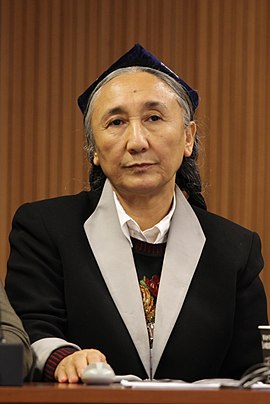 Rabia Kadir, 2011 | |
| Birth name | Rabia Kadir |
| Date of Birth | |
| Place of Birth | |
| Citizenship |  China (deprived in 1997 ) China (deprived in 1997 ) |
| Occupation | Entrepreneur, President of the World Uyghur Congress (since 2006) |
| Education | higher |
| Religion | Sunni Islam |
| The consignment |  World Uyghur Congress World Uyghur Congress |
| Main ideas | Uyghur nationalism , non-violence |
| Awards | Laureate of the Norwegian International Human Rights Foundation “Raft” (2004) |
Content
Biography
Born in 1947 in the city of Altai ( East Turkestan ), in a family of entrepreneurs. She married Sidik Ruzi in 1965 and moved to Aksu . In 1981 , she moved with her family to Urumqi , where she began to run a small business selling Uyghur ethnic clothing. After the collapse of the USSR, like many Uighurs, it switched to cross-border trade with the former Soviet republics, having founded the wholesale and trading company Akida Industry and Trade Co. Soon became one of the five richest people in China, her company conducted trading operations in the eastern regions of China, Kazakhstan and Russia. Her family owns large trade and business centers in Urumqi , such as the Akida Trade Center, Kadeer Trade Center [1] .
Rabiya Kadir also did charity work, supporting the Uyghur community in every way [2] .
Mother of eleven children [3] .
Kadir became a member of the Xinjiang government in 1987 and a delegate to the People’s Political Advisory Council of China in 1992.
Imprisonment
Witnessing the events in Gulja in 1997 , Kadir says she failed in her repeated attempts to convince Beijing that radical policy changes are needed with respect to the Uighurs. Feeling that she had no choice, she openly criticized the government in her speech to parliament, and was immediately removed from the People’s Consultative Assembly; authorities deprived her of a passport.
In 1999, she sent newspaper clippings to her husband, Sidik Ruzi, who lived in the United States and was an active opponent of Chinese policies towards the Uyghur people. Rabia Kadir was detained in August 1999 when she was heading to meet with a delegation of the US Congress in Urumqi . She was detained by the PRC authorities on charges of “disclosing state secrets,” and was convicted on March 10, 2000 in Urumqi by an intermediate court of people, “undermining state security” [2] [4] [5] .
Kadir spent two years in solitary confinement , but was not tortured. She suggests that this happened because the guards knew about her international reputation. In 2004, her term was reduced by a year.
Release, advocacy
In 2004, she received the Rafto Prize for the fight for human rights while in prison. [6]
On March 14, 2004, Kadir was released, nominally for medical reasons, and sent to the United States in custody on the eve of the visit of US Secretary of State Condoleezza Rice to the region. On March 17, Kadir in the United States joined his family [7] .
In April 2007, one of her sons, Ablikim, was sentenced to 9 years in prison and 3 years in political custody, charged with "inciting and participating in separatist activities." In November 2006, Alim, another of her sons, was sentenced to 7 years in prison and fined $ 62,500. Kahar Abdurekhim, another of her sons, was fined $ 12,500 for tax evasion. In June 2006, Alim, Ablikim, and Kahar were formally charged with undermining state security and economic crime, shortly after Kadir was elected president of the American Uyghur Association. [8]
On June 5, 2007, at a conference on democracy and security in Prague, Kadir personally met with President George W. Bush [9] . On September 17, 2007, the United States House of Representatives adopted resolution 497, requiring the Chinese government to release the imprisoned children of Rabiy Kadir and Canadian citizen of Uyghur descent Husseinjan Jalil and change his policy towards the Uyghur people [10] [11] .
"10 conditions of love"
Jeff Daniels made a documentary about Kadir in 2009, titled "10 Conditions of Love." This film was shown at the Melbourne International Film Festival. The organizers of the film festival refused the Chinese consulate in Melbourne, demanding that the film be withdrawn from the screening, and Rabiya Kadir was not invited to the film festival. Some Chinese producers, in support of the PRC, did not participate in the film festival. The site of the festival was hacked and information about the festival was replaced by the Chinese flag and anti-Qadir slogans. Qin Gang, a spokeswoman for the Chinese Foreign Ministry, said that China “strongly opposes any foreign government offering her a platform for her anti-Chinese schismatic activities.” However, Daniels said it was good that “people were able to see the other side of the story” and criticized pressure from the Chinese government [12] [13] [14] .
The documentary was supposed to be shown at the Kaohsiung Film Festival in Taiwan in October 2009, the Chinese government invited the Kaohsiung government to "not stir up water." The festival website was also hacked [15] [16] [17] [18] . It was later announced that the film would be shown at the film festival as originally planned. State Council Prime Minister Den Yi said that the government will protect freedom of speech [19] .
Notes
- ↑ Chan, Royston . China to demolish Kadeer buildings in restive Urumqi , Reuters (September 8, 2009). Date of treatment October 11, 2014.
- ↑ 1 2 Profile: Rebiya Kadeer . BBC News (March 17, 2005). Date of treatment January 4, 2010. Archived April 4, 2012.
- ↑ Chu Miniter, Paulette Taking a Stand for China's Uighurs . Far Eastern Economic Review (March 2007). Archived on April 4, 2012.
- ↑ McGeown, Kate (June 24, 2005). Fighting the cause of China's Uighurs . BBC News .
- ↑ Millward (2007), p. 360.
- ↑ Esposito; Voll; Bakar (2007), p. 208.
- ↑ News Release Issued by the International Secretariat of Amnesty International . Amnesty International.
- ↑ International Religious Freedom Report 2007 , US Department of State , September 14, 2007, accessed Sep 28, 2007
- ↑ President Bush Visits Prague, Czech Republic, Discusses Freedom . White House . June 5, 2007.
- ↑ GovTrack: H. Res. 497: Text of Legislation . GovTrack.us.
- ↑ House of Representatives calls on the PRC to release Rebiya Kadeer's children and Uyghur-Canadian Hu Archived July 10, 2009 on Wayback Machine . ObserveChina. September 18, 2007.
- ↑ McGuirk, Rod (July 26, 2009). Hackers put China flag on Australian film Web site . Associated Press .
- ↑ Uighur premiere a sell-out in Australia . Agence France-Presse . July 27, 2009.
- ↑ Tran, Mark (July 26, 2009). Chinese hack Melbourne film festival site to protest at Uighur documentary . The Guardian .
- ↑ Only mainstream opinion welcome on cross-Strait relations: official Archived November 2, 2012 on Wayback Machine . Xinhua . September 22, 2009.
- ↑ Taiwan city screens film about Uighur activist Archived October 15, 2012. . Jakarta Post . September 22, 2009.
- ↑ Child, Ben (September 22, 2009). Chinese hackers strike again in protest over Uighur activist film . The Guardian .
- ↑ Cui Hacker attacks website over Kadeer film . China Daily ' (September 22, 2009). Archived on April 4, 2012.
- ↑ Documentary on Kadeer will screen at film festival . Taipei Times . September 28, 2009.
Links
- Esposito, John L .; Voll, John Obert; Bakar, Osman (2007). Asian Islam in the 21st Century. Oxford University Press US. ISBN 978-0-19-533302-2 .
- Millward, James A. (2007). Eurasian Crossroads: A History of Xinjiang. New York: Columbia University Press. ISBN 978-023113924.