Rutherford 's formula is the formula for the differential effective cross-section of scattering of nonrelativistic charged particles into a solid angle Ω in the Coulomb field of another stationary charged particle or nucleus (target). Empirically confirmed by E. Rutherford in 1911 in experiments on the scattering of α-particles on a thin gold foil of submicron thickness. In the system of the center of inertia of the incident and scattering particles, it is written as follows:
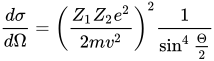
Where and - charges of the incident particle and target, - mass and velocity of the incident particle, - two-dimensional scattering angle, - elementary charge, - differential cross section, - solid angle.


Rutherford Scattering
In physics , Rutherford scattering is a phenomenon described by Ernest Rutherford in 1909 [1] , which led to the development of the Bohr-Rutherford planetary model . Rutherford scattering is also called Coulomb scattering because it is based solely on the forces of electrostatic interaction , and the minimum distance between particles depends only on the field potential . Rutherford's classical scattering is the scattering of α particles on the nuclei of gold atoms (bombardment of a gold plate with α particles), which is an example of the so-called “ elastic scattering ”, since the energy and speed of a scattered particle is the same as that of an incident one.
Rutherford also analyzed the inelastic scattering of α particles by protons (nuclei of the hydrogen atom ), this process is not a classical scattering of Rutherford, although he observed it earlier than the classical one. When an α particle approaches a proton, non-Coulomb forces arise, which, together with the energy of the incident particle on a light target, change the experimental results. These effects allow us to make assumptions about the internal structure of the target. A similar process was used in the 1960s to study the internal structure of a nucleus called deep inelastic scattering .
The initial discovery was made by Hans Geiger and Ernest Marsden in 1909 - the Geiger-Marsden experiment - led by Rutherford, in which they bombarded an alpha particle with a target consisting of several ultrathin (less than one micron thick) layers of gold foil. During the experiment, the atom was assumed to be an analogy to pudding with raisins (according to the Thompson model of the atom ), where negative charges (raisins) are distributed over a positively charged ball (pudding). If the Thompson model of the atom is correct, then the positively charged pudding will be more extended than the nucleus of the atom in the Bohr-Rutherford model, and will not be able to create large Coulomb repulsion forces, as a result of which the α particles will deviate by small angles from their original velocity vector.
However, the experiment showed that 1 out of 8000 particles is reflected at angles of more than 90 ° when the bulk of the particles passes through the foil with little or no deviation. Based on this, Rutherford concluded that the bulk and charge of matter is contained in a tiny positively charged space (core) surrounded by electrons. When a positive α-particle flies very close to the nucleus, it experiences the forces of Coulomb repulsion and is reflected at large angles. The small size of the atomic nucleus is explained by the small number of α-particles reflected in this way. Using the method described, Rutherford showed that the size of the nuclei is smaller than (how much "less" Rutherford could not clarify based solely on this experiment).
Differential Section
The differential section formula established by Rutherford in 1911:
All particles passing through the ring on the left fall into the ring on the right.
Learn more about calculating the maximum kernel size.
In the collision of an α-particle with the nucleus, all kinetic energy α-particles are converted into potential energy , as a result of which the particle stops. At this moment, the distance from the α-particle to the center of the nucleus ( b ) is the maximum possible radius of the nucleus itself. This is obvious from experiment: if the radius of the spherical core exceeds b , then the particle cannot interact with it as a point charge by means of only Coulomb forces.
Equating the kinetic energy of a particle to the potential of an electric field:
According to the law of conservation of energy:
Where:
- E is the total energy of the particle;
- K is the kinetic energy of the particle ;
- P is the potential energy of a particle in a Coulomb electric field where r is the distance from the particle to the center of the nucleus.
- K is the kinetic energy of the particle ;
- E is the total energy of the particle;
Assuming the particle is flying out of infinity:
At the time of maximum approximation to the core (when the speed became zero):
Therefore, equating both equations with respect to total energy:
In the Geiger-Marsden experiment:
- m (α-particle mass) = 6.7⋅10 −27 kg
- q 1 (α-particle charge) = 2 × (1.6 (10 −19 ) C
- q 2 (gold core charge) = 79 × (1.6⋅10 −19 ) C
- v (initial velocity of the α-particle) = 2⋅10 7 m / s
Substituting these values into the resulting equation for the maximum radius of the nucleus, we obtain ≈27 · 10 −15 meters (the radius measured by modern methods is ≈7.3 · 10 −15 meters). More precisely, the radius of the nucleus of a gold atom could not be obtained in this experiment, since the energy of the α-particle was only enough to approach 27 fm (27 femtometers = 27 · 10 −15 meters), while for the collision it was necessary to approach 7.3 fm.
Other Applications
At present, the scattering principle is widely used in backscattering spectroscopes to determine heavy elements in the lattices of lighter atoms, for example, to find inclusions of heavy metals in semiconductors. It is known that this technology was first used on the Moon for soil analysis by the Surveyor 4 apparatus, and later, Surveyor 5-7 apparatuses performed similar analyzes.
Notes
- ↑ E. Rutherford, “The Scattering of α and β Particles by Matter and the Structure of the Atom,” Philos. Mag., Vol 6, pp. 21, 1909
Links
- E. Rutherford, The Scattering of α and β Particles by Matter and the Structure of the Atom , Philosophical Magazine . Series 6, vol. 21 . May 1911
- Geiger H. & Marsden E. (1909). "On a Diffuse Reflection of the α-Particles." Proceedings of the Royal Society, Series A 82: 495-500. doi: 10.1098 / rspa.1909.0054. [1] .
- Educational and methodical materials I. Kupala