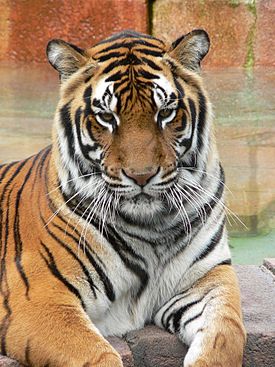
Bengal tiger [1] [2] ( lat. Panthera tigris tigris or Panthera tigris bengalensis ) - a subspecies of the tiger , lives in Pakistan, Eastern Iran, Northern and Central India, Nepal , Bhutan , Myanmar and Bangladesh , as well as in the vicinity of the mouth of the rivers Indus , Rabbi, Sutlidge, Ganges . A Bengal tiger population is smaller than 2,500 individuals, with the prospect of a decrease.
| Bengal tiger |
 |
| Scientific classification |
|---|
| No rank : | Bilateral symmetrical |
|
| International scientific name |
|---|
Panthera tigris tigris ( Linnaeus , 1758 ) |
| Security status |
|---|
Endangered speciesIUCN 3.1 Endangered : 136899 |
|
The Bengal tiger is the most numerous of the tiger subspecies - with 1706 individuals in India, 200 in Bangladesh, 140 in Pakistan, 155 in Nepal, 24 in Iran and 67 in Bhutan and 5 in Russia. Completely exterminated in Afghanistan.
The Bengal tiger is the national animal of Bangladesh - historical Bengal . Panthera tigris is also considered a national animal in neighboring India and China.
Content
Its color varies from yellow to light orange fur, and stripes from dark brown to black, the belly is white, and the tail is predominantly white with black rings. The mutation of the Bengal subspecies - the white tiger, has dark brown or reddish-brown stripes on white fur. Less common are absolutely white tigers, without stripes.
The total body length, including the tail, among males usually ranges from 270 to 310 cm, but can reach 330 cm, animals were reported to reach 370 cm, while females from 240 to 265 cm, but can reach 310 cm. The length of the tail is usually from 85 to 110 cm, and the height at the withers is from 90 to 110 cm and, accordingly, can reach 115 cm. The Bengal tiger has the largest fangs from the cat family, which can exceed 8 cm. [3]
The average weight of males is 221.2 kg, in northern India , Nepal - an average of 235 kg, and can reach a maximum of 275 kg, and in some cases 300-320 kg. The average weight of females is 139.7 kg and can reach a maximum of 193 kg. The record weight of a male killed in northern India in 1967 was 388.7 kg. This is officially the highest rate in nature among all subspecies of tigers.
The roar of a Bengal tiger can be heard at a distance of 3 km.
A small population was bred by foreign scientists in the mid-70s to decorate zoos. Under natural conditions, a white skin would only prevent the beast from hunting in the summer. Experts explain the rare color with insufficient pigment content. However, the black stripes were not affected. White tigers differ from their counterparts with a red skin and blue eyes.
Previously, tigers attacked people in many places of their Indian range. Most likely, this behavior is caused by the fact that tigers sometimes attack the Indian porcupine . The needles penetrate deeply into the skin of an unsuccessful predator and do not exit, causing sharp pain. Such a hunter is no longer able to catch large frisky prey and chooses small game, sometimes people. [4] At present, about 500 Bengal tigers live in the vast swampy area formed by the common Ganges and Brahmaputra rivers . Since measures are being taken in India to protect these animals, in some places individual tigers consider humans to be accessible prey due to the densely populated territories bordering nature reserves (when other victims are accessible, old or weakened animals often do this). For the inhabitants of the islands of the delta, cannibal tigers are not the only danger, but still cause them the greatest fear. Several cases of attacks were recorded in Bandhavgarh National Park (in the central part of the country).
- ↑ Sokolov V.E. Rare and endangered animals. Mammals: Ref. allowance. - M .: Higher school, 1986. - S. 347. - 519 p., [24] p. silt - 100,000 copies.
- ↑ Fisher D., Simon N., Vincent D. Red Book. Wildlife at risk / trans. from English, ed. A. G. Bannikova . - M .: Progress, 1976. - S. 112. - 478 p.
- ↑ Ravens Vasily. Fangs of a Bengal tiger (neopr.) . (inaccessible link)
- ↑ Igor Akimushkin . Animal world. Mammals, or animals. - M .: "Thought", 1998. - S. 131-132.