
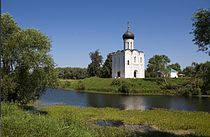
Old Russian architecture - architecture , which became widespread in the Eastern Slavic principalities from the moment of the initial birth of Russian statehood in the 9th century to the Batu invasion .
Until the end of the 10th century, Russia did not have monumental stone architecture, but there were rich traditions of wooden construction, some forms of which later influenced stone architecture. Significant skills in the field of wooden architecture (see Russian wooden architecture ) led to the rapid development of stone architecture and its originality. After the adoption of Christianity begins the construction of stone churches, the principles of construction of which were borrowed from Byzantium. The Byzantine architects summoned to Kiev imparted to the Russian masters an extensive experience of Byzantium construction culture.
Content
General characteristics
Urban and rural buildings
Temples, Churches and Monasteries
The large churches of ancient Russia, erected before the adoption of Christianity in 988 , were the first examples of monumental architecture in the East Slavic lands. The architectural style of the Old Russian state was established under the influence of the Byzantine . The early Orthodox churches were mostly made of wood.
The first stone church of the Old Russian state was the Tithe Church in Kiev , whose construction dates back to 989. The church was built as a cathedral not far from the princely tower. In the first half of the XII century, the church suffered significant repairs. At this time, the south-western corner of the temple was completely rebuilt, a powerful pylon supporting the wall appeared in front of the western facade. These activities were most likely the restoration of the temple after a partial collapse due to an earthquake.
St. Sophia Cathedral in Kiev, built in the XI century is one of the most significant architectural structures of this period. Originally, the Sophia Cathedral was a five-nave cross-domed church with 13 chapters. From three sides it was surrounded by a two-tier gallery, and from the outside - even wider single-tier. The cathedral was built by Constantinople builders, with the participation of Kiev masters. At the turn of the XVII - XVIII centuries, it was externally rebuilt in the style of Ukrainian Baroque . The temple is listed as a UNESCO World Heritage Site .
Fortress and defensive buildings
In the history of ancient Russia fortifications played a huge role. They were constantly changing and improving depending on the historical situation and the nature of the enemy attacks. The development of military tactics and siege weapons [1] had a significant impact on the architecture of the fortifications. With the development of the economy and productivity in Russia, the number of fortifications grew. They were built by the same craftsmen who created both buildings that became cultural monuments and ordinary residential buildings.
Most of the fortifications and fortresses in the Old Russian state were wooden. According to the historian Tikhomirov, in the absence of firearms and the weak use of siege weapons, such protection was quite sufficient [2] . For the Russian fortifications of that time such parts as the moat, the city walls, the visor and the bulk shaft are characteristic. Fortresses, as a rule, were built on a natural elevation, most often on a promontory at the confluence of one river into another. This situation caused the city fortifications and fortresses to be called "Vyshgorod" in many Slavic lands. Sometimes defenses were built near steep and steep ravines, which made them inaccessible from various sides [3] . In the wooded and swampy areas of Northern Russia, the fortress was located on low hills. They used swampy lowlands and swamps as covers. For such fortresses, a high shaft is typical, such as in Dmitrov [3] .
The main type of city fortifications were city walls [4] . They were installed on shafts and consisted of townhouses - wooden log cabins filled with earth. In some fortresses, the log houses were left empty, fitting for housing and economic needs [4] . At the top of the walls there was a wide platform, the outer side of which was covered by a “visor” or “fence”. There were gaps in them for shooting at the enemy - “wells”. The walls were reinforced with "towers" - with towers, sometimes on a stone foundation. There were also gates in the walls, the number of which depended on the size of the fortress or city [5] . The term "open the gate" meant the surrender of the city. In the capitals of the principalities there was a desire to designate large main gates, such as the Golden Gate in Kiev or Vladimir, which were monumental buildings of a tower character [5] . In the threatened places, the fortress walls were supplemented with a moat, the bridges over which were built on poles [6] .
Major cities and fortresses consisted of internal fortress, Detinets and external fortifications. As the city grew beyond the fortress walls, new walls were formed, forming a new belt of fortifications called the fortress. Support and renewal of the city walls were an important part of the life of the old Russian city. This was headed by a specially appointed person - "Gorodnik", and the population paid a fee - "city" [7] .
See also
- List of ancient Russian architectural structures of the pre-Mongol period
- Russian wooden architecture
Notes
- ↑ DR GZS, 1985 , p. 167.
- ↑ Tikhomirov MN , 1956 , p. 233.
- ↑ 1 2 Tikhomirov MN , 1956 , p. 234.
- ↑ 1 2 DR MSG, 1985 , p. 168.
- ↑ 1 2 Tikhomirov MN , 1956 , p. 236.
- ↑ Tikhomirov MN , 1956 , p. 237.
- ↑ Tikhomirov MN , 1956 , p. 241.
Literature
- Ancient Russia. City, castle, village. - M .: Science , 1985. - 429 p.
- Zagraevsky S.V. Typological formation and basic classification of the old Russian church architecture . - Saarbrucken, 2015. - 150 p. - ISBN 978-3-659-80841-8 .
- Krasovsky M.V. The course of the history of Russian architecture. Part I. Wooden architecture . - Petrograd: Partnership R. Golike and A. Vilborg, 1916. - 408 p. Reprint : Krasovsky M.V. Encyclopedia of Russian Architecture: Wooden Architecture. - SPb. : Satis Derzhava, 2005. - 384 p.
- Kuza A.V. Small Towns of Ancient Russia. - M .: Science , 1989. - 168 p. - ISBN 5-02009473-0 .
- Rappoport P.A. Ancient Russian architecture. - SPb. : Stroyizdat, St. Petersburg Branch , 1993. - 289 p. - ISBN 5-274-00981-6 .
- Rappoport P.A. Architecture of Ancient Russia . - L .: Science , 1986. - 160 p.
- Rybakov B. A. The Craft of Ancient Russia. - M .: Publishing House of the Academy of Sciences of the USSR , 1948.
- Rybakov B.A. Decorative and applied art of Russia X-XIII centuries. - Aurora , 1971. - 118 p.
- Tikhomirov MN Old Russian cities . - M .: State Publishing House of Political Literature , 1956. - p. 233.
- Fedorov G. B. In the footsteps of ancient cultures. Ancient Russia. - M .: State publishing house of cultural and educational literature , 1953. - 403 p.