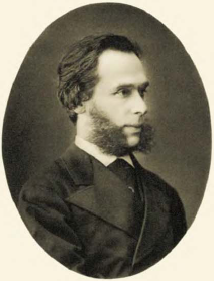
Egor Abramovich Peretts ( January 25 [ February 6 ] 1833 , St. Petersburg - February 19 [ March 3 ] 1899 , St. Petersburg ) - Russian statesman, participant in the development of reforms of the 1860s - 1870s . Secretary of State in 1878 - 1882 , later a member of the Council of State . The author of "Diary of E. A. Peretz - Secretary of State", which has become a valuable source for studying the domestic policy of Russia at the end of Alexander II and the beginning of Alexander III . Actual Privy Councilor (1883).
| Egor Abramovich Peretz | |||||||
|---|---|---|---|---|---|---|---|
 | |||||||
 | |||||||
| Predecessor | D. M. Solsky | ||||||
| Successor | A. A. Polovtsov | ||||||
| Birth | January 25 ( February 6 ) 1833 St. Petersburg | ||||||
| Death | February 19 ( March 3 ) 1899 (66 years old) St. Petersburg | ||||||
| Father | Abram Izrailevich Peretz | ||||||
| Mother | Carolina de Lombor | ||||||
| Education | St. Petersburg University (1854) | ||||||
| Religion | Lutheran | ||||||
| Awards | Order of St. Stanislaus III Art. (1860) Order of St. Stanislav II Art. (1861) Order of St. Vladimir III Art. (1864) Order of St. Stanislav I Art. (1868) Order of St. Anne I Art. (1874) Order of St. Vladimir II Art. (1876) Order of the White Eagle (1878) Order of St. Alexander Nevsky (1880) Order of St. Vladimir I Art. (1895) | ||||||

Childhood and Youth
Born in the family of a banker, a ship contractor and a commercial farmer, adviser Abram Izrailevich Peretts . The parental home was open to many famous people. Abram Izrailevich maintained a wide range of contacts, including in high society, among his close friends were the head of the II branch of His Imperial Majesty’s Chancellery M. M. Speransky and Minister of Finance E. F. Kankrin . Being a Jew, A. I. Peretz in 1813 accepts Lutheranism , which may have been associated with his marriage [1] .
Egor Peretz received a good home education, continued at the St. Petersburg gymnasium, which allowed him to successfully enter the law faculty of St. Petersburg Imperial University , which he graduated in 1854 .
Public Service
Chancellery of His Imperial Majesty (1855–1868)
In 1854, the sons of the commerce of advisers were granted the right to enter the public service as clerical officers of the second category. January 20 ( February 1 ), 1855 E. A. Peretts was accepted into the service in the II branch of His Imperial Majesty’s Own Chancellery over the state with the rank of college secretary . February 29 ( March 12 ), 1855 he was accepted into the state. Starting as a junior official, Peretz successfully progressed through the service line, he managed to manage the writing department of the 2nd Division, to be the clerk of the Committee to consider the draft of the new “Military Charter of Punishments,” a member of the Committee to oversee the printing house of the department.
In 1862, an important stage in Peretz’s career began. He was appointed a member of the Commission established by the State Council for the preparation of judicial statutes, which was involved in the preparation of judicial reform . In June-August 1862, Peretz was on a business trip, studying the foreign experience of the functioning of the judicial system. Peretz’s work on the preparation of judicial reform was noted in 1864 by the Order of St. Vladimir of the III degree.
In 1865, Peretz became a senior official of the Own E.I. Chancellery, and accordingly, the volume and responsibility of his work grow. The main areas of its application were activities in the technical committee of the department of inconsistent fees of the Ministry of Finance , the Special Commission of A. A. Nepokoichitsky for the development of the “Military Charter of Punishments”, the Committee for the consideration of the draft “Military Court Charter” led by Grand Duke Konstantin Nikolaevich , the Commission to consider proposals for the transformation of the prison, the Commission JM Solski to review the draft of the new provisions and state institutions of the Caucasus governorship , the Commission's AB Lobanov-P stovskogo for the development and drafting of the law on certain civil rights of dissenters and others. For comments on the draft "Military court statute," Peretz was awarded in 1867 a special favor of Alexander II of . During his service in the E. I. V. Chancellery, Peretz grew up in ranks to become a real state adviser .
State Chancellery (1869-1878)
On January 1 (13), 1869 , E. A. Peretts was transferred to the service of the State Chancellery as an acting state secretary of the Law Department. He distinguished himself when working in the Commission of S. N. Urusov to consider draft provisions on urban public administration and economy, earning another highest gratitude.
On January 1 (13), 1871 , Peretz was approved by the State Secretary of the Department of Laws of the State Council and promoted to Privy Councilor . A year later, on January 1 (13), 1872 , he became the state secretary of his imperial majesty. In the same year he was appointed to the Commission of A. E. Timashev on the application of the new “City Position” to the cities of the western provinces. Since 1873, Peretz managed the affairs of the Special Presence for military service. By the definition of the Governing Senate of January 24, 1873, a resolution was approved by the St. Petersburg noble parliamentary assembly of December 21, 1872, on the inclusion in the third part of the noble genealogy of the book of Privy Councilor Yegor Abramovich Peretz, with his wife Sofia Alexandrovna, son Alexander Georgi and daughter Mary, according to his personal merits [2] .
For work on the review of laws on universal military service, Peretz was awarded in 1874 the Order of St. Anna of the I degree. Subsequently, he was a member of the Commission under the Ministry of Justice for the introduction of the mortgage system and the Special Meeting led by F.P. Litke on the issue of providing families of killed, wounded and missing military ranks.
Peretz left the impression of the most active employee of the then Secretary of State D.M. Solsky , who was replaced in 1875 during his 3.5-month vacation.
Secretary of State (1878-1882)
On July 7 (19), 1878 , Secretary of State D.M. Solsky was appointed State Controller, and the duties of Secretary of State were assigned to E. A. Peretts. In addition to the constant work on organizing the clerical work of the State Council , for which the State Chancellery was responsible, including ensuring the work of the Commission shortly before the formation of the prison and the Commission, which appeared in October, on the introduction of world judicial institutions in the Baltic provinces, Peretz became the chairman of the Commission for preliminary consideration according to the draft regulations on officers and officials of the military and naval reserve.
In 1879, the Council of State fulfilled the judicial function by forming the Supreme Criminal Court in the case of A.K. Soloviev , who committed an unsuccessful attempt on the emperor Alexander II . The president of the court was Prince S.N. Urusov . This case, as well as the terrorist explosion in the Winter Palace on February 5 (17), 1880 , forced the Secretary of State to worry about the security of the premises of the State Council, located on the ground floor of the Winter Palace, in particular, to block access to the basement under the Council Hall.
E. A. Peretts believed that the role of the State Council in the system of government of the Russian Empire was one of the key. He advocated the need for a detailed discussion in the State Council of all legislative assumptions, so that ministers in their activities would be more careful and take more deliberate steps. Peretz considered the key role of the clerical apparatus within the framework of the Gossvet. His statement is known that, thanks to the processing of journals of meetings of the State Council in the Chancellery, "it can be assumed that almost Solons are sitting on the Council; with public meetings, the illusion will completely disappear ” [3] . Peretz himself has always been an exact executor of the highest will, which is why he enjoyed the trust of both Emperor Alexander II and the Chairman of the State Council of Grand Duke Konstantin Nikolaevich .
After the accession to the throne of Emperor Alexander III , which followed the assassination of Alexander II on March 1 (13), 1881 , a number of significant changes followed in the work of the State Council and the State Chancellery. On July 13 (25), 1881 , Grand Duke Konstantin Nikolayevich was dismissed from the post of chairman of the State Council, and the next day the emperor appointed Grand Duke Mikhail Nikolayevich to this post. Following this, a number of structural changes were made: the Special on Military Service presence was closed (September 1882) and the Main Committee on the Rural Structure (May 1882). On January 23 ( February 4 ), 1882 , a decree was signed on the reorganization of the II branch of His Imperial Majesty’s own Chancellery into the Codification Division under the State Council, with E.P. Staritsky being appointed the head manager. Together with the II branch, the printing house, which since then has been called the State Printing House, has passed under the jurisdiction of the State Council.
As for the Secretary of State himself, his fate was decided. A. A. Polovtsov , who succeeded Peretz in this post, recorded the following words of Alexander III:
I sat in the Council of State, being the Grand Duke, and even then I was horrified by the direction that business received thanks to the efforts of the State Chancellery. I did not have confidence in Peretz and therefore succeeded him; I hope that you will give the matter a different direction and change the composition of the State Chancellery.
On January 1 (13), 1883 , Peretz was dismissed from the post of Secretary of State with the simultaneous appointment of a member of the Council of State and retaining the title of Secretary of State of the Emperor.
Member of the Council of State (1883-1899)
Upon dismissal from the post of Secretary of State, Peretz was appointed a member of the State Council for the Department of Laws, in which for the next 16 years he was one of the most active members. In 1885 - 1886 he was the chairman of the Commission for the final development of the provision on the special advantages of civil service in the remote regions of the empire. In 1889, he participated in the proceedings on the responsibility of the former Minister of Railways K.N. Posiet and Baron K.G.Shernval for the collapse of the imperial train in Borki. From 1895 until his death, he headed the Commission for the revision of the "Charter of the civil service" and other decrees relating to this service.
Personal life
He was married to his niece, Sofya Alexandrovna Grevenitz , the daughter of her sister.
In 1882, Peretz bought Priyutino estate near St. Petersburg as a summer cottage.
In February 1899, E. A. Peretz died and was buried at the Volkovsky Lutheran cemetery in St. Petersburg.
Diary of E. A. Peretts
The diaries of E. A. Peretts cover the period from September 1880 to January 1883, a turning point connected with the last months of the reign of Alexander II and the serious changes in domestic politics that took place at the beginning of the reign of Alexander III. In particular, Peretz’s diary describes in detail the meeting on March 8 (20), 1881 , at which the fate of the constitutional draft of M. T. Loris-Melikov was decided. It describes the subsequent events related to the resignation of prominent figures of the previous reign and the adoption of fundamental decisions on further steps in domestic politics (questions about the addition of redemption payments, the abolition of the poll tax, etc.) [4]
The diary was published in 1927 by the outstanding archaeographer A. A. Sergeev with a preface by A. E. Presnyakov .
Literature
- Almanac of modern Russian statesmen . - SPb. : Type of. Isidore Goldberg, 1897. - S. 62-63.
- Peretz E.A. Diary of E.A. Peretts (1880-1883). - M.-L., 1927. - 171 p.
- Fedorchenko V.I. Imperial House. Outstanding Dignitaries: Encyclopedia of Biographies. T.2. - M., 2003 .-- S. 224-225.
- Mikhailovsky M.G. State Council of the Russian Empire. Secretary of State. E. A. Peretz // Bulletin of the Federation Council. 2008. No. 2. - S. 26-38.
Notes
- ↑ Berdnikov L. Sharp Peretz. // Lechaim. 2008. No. 4.
- ↑ The coat of arms of Peretz is included in Part 13 of the General Tombstone of the noble families of the All-Russian Empire, p. 149 . Date of treatment November 22, 2012. Archived December 3, 2012.
- ↑ Cit. by: Mikhailovsky M.G. State Council of the Russian Empire. Secretary of State. E.A. Peretts. // Bulletin of the Federation Council. 2008. No. 2. - S. 26-38.
- ↑ Nikitin S. A. Source study of the history of the USSR. XIX century. - M., 1940. - S. 123-124.