Vasily Semenovich Svarog (real name Korochkin; March 5 (17), 1883 , Staraya Russa - December 31, 1946 , Moscow ) - Russian and Soviet artist.
| Vasily Semenovich Svarog | ||
|---|---|---|
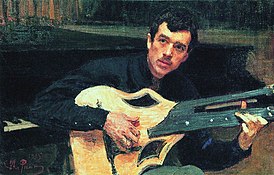 I.E. Repin. Portrait of the artist V. S. Svarog (1915) | ||
| Birth name | Vasily Semenovich Korochkin | |
| Date of Birth | March 5 (17), 1883 | |
| Place of Birth | Staraya Russa , Novgorod province | |
| Date of death | December 31, 1946 (63 years old) | |
| A place of death | Moscow | |
| Genre | portrait , landscape | |
| Study | TSUTR Stieglitz , Petersburg | |
| Style | realism | |
| Awards |
| |

Content
- 1 Biography
- 2 Yesenin
- 3 works are
- 4 Music
- 5 Awards
- 6 Memory
- 7 notes
- 8 Literature
- 9 References
Biography
Vasily Semenovich Korochkin was born on March 5 (15), 1883 in the city of Staraya Russa, Novgorod Province (now Novgorod Region ) in the family of a peasant Semyon and the washerwoman Olga Vasilievna Korochkin. Vasily had two sisters: Anna (later - a village teacher) and Nadezhda (in the future - a seamstress). At the age of two, he lost his father; mother raised children.
The desire for drawing was observed by Vasily Semenovich from an early age. Noticing it, a drawing teacher at the old Russian city school Chistyakov raised money among the residents of the city by subscription so that a talented child could continue his art education after graduating from the school.
In 1896 , at the age of thirteen, Vasily Semenovich entered the Stieglitz Central School of Technical Drawing in St. Petersburg and successfully completed it four years later. It was during training that the artist’s pseudonym “Svarog” appeared.
In the third year of study, before the next exam, he received the task to paint a picture on the theme “God of heavenly fire Svarog ” - a deity in the mythology of Western Slavs. Well, our Vasya went to fantasize - he painted the sun, stars, lightnings, flashes of the northern lights, dawns, rainbows, and in this sparkling environment - the face of the deity. The picture was a success, but the examiners said: “Korochkin, did you look in the mirror when you wrote Svarog? It looks exactly like you. ” From that day, we jokingly began to call him Svarog. He is used to this nickname. [one]
- Since 1900, Svarog has been collaborating with the St. Petersburg illustrated magazines "Picturesque Review", "Magic Lantern", "The Sun of Russia".
- In 1911, V. S. Svarog was awarded the first prize in a competition organized by the editorial board of the journal “The Sun of Russia” for a series of drawings for Leo Tolstoy 's work “The Living Corpse”.
- In 1915, V.S. Svarog met Yuri Repin and painted his portrait, which enthralled his father, the famous artist Ilya Repin . This work allows Svarog to get closer to the master, to attend his portrait sessions.
- In 1916, on the recommendation of Repin, he joined the Association of Wanderers and exhibited his work at traveling exhibitions.
- In 1916, Svarog painted “Portrait of a Mother” (oil on canvas). The painting was awarded the first prize at the Spring Traveling Exhibition.
- In 1918, Svarog took an active part in decorating Petrograd for the celebration of the first anniversary of the October Revolution . The artist himself said that he "worked especially intensively, since great events required every great effort of forces." At this time, he creates portraits of Karl Marx , Friedrich Engels , V.I. Lenin , M.S. Uritsky , V.V. Volodarsky .
- From 1919 to 1922, in connection with a serious illness of his mother, Svarog spends in Staraya Russa. Here he organizes the People’s House, creates an art studio, amateur choir and orchestra circles, an amateur opera house where the Mermaid by Dargomyzhsky, Aleko Rachmaninov, Faust Gounod and others were staged. During this period, Svarog created many paintings dedicated to the city and its inhabitants - “Portrait of Vasya Ushakov”, “Children” (exhibited at the Tretyakov Gallery), “Portrait of Valentina Kazarina”, “Rogachevka” and others.
- In 1923 he joined the Association of Artists of Revolutionary Russia .
- In 1925, V. S. Svarog received a silver medal at the World Exhibition in Paris for the album January 9, for which he performed 11 large drawings.
- After the Great October Revolution, the work of Svarog takes on a vivid political orientation. The artist himself calls his genre "political composition." Some paintings were based on personal impressions, others based on newspaper reports:
- “Hero Pilots in the Kremlin before the Flight” (1934)
- "Meeting Chelyuskintsev on Red Square" (1934)
- "Portrait of V.V. Kuybyshev on the podium" (1935)
- "The First of May - Pioneers" (1937)
- "Sedovtsy on Red Square" (1940)
- "Portrait of Tchaikovsky" (1940)
- "Portrait of Mayakovsky" (1940)
- “Comrades K. E Voroshilov and A. M. Gorky in the dash of the Central House of Artists” (1932)
- Volkhovstroy
- Kuznetskstroy
- Dneprostroy and others
- "Meeting Chelyuskintsev on Red Square" (1934)
- Carried away by music, V. Svarog created a number of works united by this topic:
- "Still Life with a Guitar" (1934)
- The Torban (1939)
- portrait of guitarist Shaumyan (1928)
- watercolor portrait of the Spanish guitarist Andres Segovia (1927)
- The Torban (1939)
- Svarog painted portraits of the leaders of the party and government - V. I. Lenin , I. V. Stalin , K. E. Voroshilov , V. V. Kuybyshev .
- In 1940, the Political Directorate of the Moscow Military District united professional military artists in the Studio of Military Artists named after M. Grekov on the basis of the Isomaster Amateur Red Army Art. The studio was tasked with the cultural and political education of soldiers, displaying the heroic military path of the army. V. Svarog was appointed the leader, who created a number of paintings on military subjects:
- Council of Commanders
- Smolny in October
- "Capture of the Winter"
- “Boat trip of the wives of commanders”
- Smolny in October
- Since 1941 - in evacuation. First in Nalchik , then in Tbilisi . On May 25, 1942, an exhibition of paintings was held in Tbilisi. The newspaper " Dawn of the East " wrote:
Creative reports of artists. On Monday, May 25, at 12 o’clock. of the day, the Stalin Prize laureate, Honored Art Worker I.E. Grabar and artist V. S. Svarog will make creative reports in the Art Gallery of Georgian Artists. On that day, the gallery will open an exhibition of their paintings made in Tbilisi and Nalchik in 1941 and 1942.
- In 1942, Svarog completed his last painting - the multi-figure composition "Stepan Razin."
- In October 1942 , returning from evacuation to Moscow , at the Samarkand station, crossing paths with suitcases, V. Svarog tripped and hit his left temple with a rail. On October 10, he was taken to Moscow in serious condition. V. Svarog recovered, but could not return to painting.
December 31, 1946 Vasily Semenovich Svarog died. The artist was buried at the Novodevichy cemetery . The tombstone on the grave of V. S. Svarog was made by his student, People's Artist of the USSR N. V. Tomsky .
In 1948, through the efforts of the artist’s friends and his wife Larisa Semenovna Svarog, a posthumous exhibition of his works was held. It presented paintings, portraits, sketches from the expositions of the State Tretyakov Gallery , the State Historical Museum , the Central House of the Soviet Army , the museums of A. S. Pushkin , M. Gorky, the USSR Academy of Arts and regional museums.
Yesenin
The name of Vasily Svarog is associated with the name of Sergey Yesenin . On December 28, 1925, the artist was also in the Angleterre Hotel and got into Yesenin's room at the moment when he was removed from the loop. V. Svarog at this moment created posthumous portraits of S. Yesenin.
Works are
In the Tretyakov Gallery :
- "Portrait of a mother"
- Self Portrait [2]
- "Guitarist"
- " I. V. Stalin and members of the Politburo among children in the Central Park of Culture and Rest named after M. Gorky " (1939) [3] "
In the Russian Museum :
- Mayakovsky
- "Reinforcers"
The largest repository of paintings (about 200 paintings) is located in Staraya Russa.
Music
Vasily Svarog sang well. While in Staraya Russa, he performed complex parts on the stage of the Old Russian opera - the miller in Dargomyzhsky ’s Mermaid , Mephistopheles in Guno’s Faust , Mazepa in Tchaikovsky ’s Mazepa , Karas in Gulak-Artemovsky ’s Zaporozhets Danube , Aleko in Aleko Rachmaninov . In addition, Svarog played the guitar. Svarog said:
Firstly, I am an artist, but I equally passionately love music and singing. I can not imagine life without these three arts. If I ever be deprived of one of them, if the balance is disturbed, I will probably cease to be an artist.
Rewards
- Order of the Red Banner of Labor (07.16.1943)
- Medal "For Valiant Labor in the Great Patriotic War" (1946)
Memory
- One of the streets in Staraya Russa is named after the artist.
Notes
- ↑ Sokolov V.A. Artist Svarog. - L .: Lenizdat, 1986. - p. 20
- ↑ Self-portrait (1926) (inaccessible link) . Date of treatment August 5, 2009. Archived November 14, 2007.
- ↑ Tretyakov Gallery (unavailable link) . Date of treatment August 5, 2009. Archived on October 5, 2016.
Literature
- Sokolov V.A. Artist Svarog. - L .: Lenizdat, 1986. - 189 p., Ill.
- Old Russian Museums ./ [Compiled by G. N. Arkhipov]. - L .: Lenizdat, 1982. 142 p., Ill.
- Vyazinin I.N. Staraya Russa in the history of Russia. Novgorod. Publishing house "Cyrillic", 1994. - S.263-266.
- Klimova M. Vasily Semenovich Svarog 1883-1946. State Publishing House "Art", Moscow, 1952.