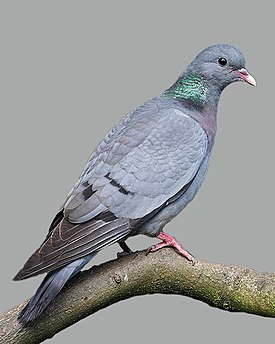
Clintukh [1] ( lat. Columba oenas ) is a pigeon , a close relative of the inhabitant of large cities of the gray pigeon , but in contrast to it preferring a variety of light forests and old parks, rather than rocky cliffs (in the wild) and the centers of settlements. A cautious bird, during the breeding season, hides in the foliage of trees and becomes silent when a human or large animal appears. Breeds in temperate latitudes of Europe and Western Siberia , as well as in northeastern Africa . Depending on the area of habitat, settled, migratory or partially migratory species. Common, but in many places a small bird.
| Clintuh |
 |
| Scientific classification |
|---|
| No rank : | Bilateral symmetric |
|
| International Scientific Name |
|---|
Columba oenas ( Linnaeus , 1758 ) |
| Security status |
|---|
Least concernIUCN 3.1 Least Concern : 22690088 |
|
Content
Appearance
The length of the body is 32–34 cm, the weight of the male is 303–365 g, the weight of the female is 286–290 g. [2] , the wingspan is 63–70 cm. [3] It resembles two common Eurasian species in color - however, on average it is somewhat smaller than both and has a shorter tail. All three species are distinguished by a bluish-gray color of plumage and a purple-greenish metallic sheen on the neck. Compared to wild sizar, the color of a clintukh is more monotonous, with weakly pronounced stripes on the wings and without a white spot on the back. If you look at a bird soaring from below, then you can see that the underside of the wing is gray — much darker than that of the blue-and-white pigeon and wood pigeon, and its tone hardly differs from the same dark belly. Wood pigeon looks much more massive than the other two species, and also stands out with a white spot on the sides of the neck. On the chest of a clintukh, a pinkish-wine hue is developed, more pronounced than that of the blue-necked pigeon, but occupying a smaller area than that of the wood pigeon. The iris is dark brown, the leathery ring around the eye is bluish-gray, the red beak at the base is yellow at the end, with a white ceres . The legs are red. [3] [4] [5]
Males and females look almost the same: the female has a slightly less bright plumage and a darker beak. Young birds are even dimmer with a brownish tinge. Metallic ebb on the neck of young animals is not pronounced. Two subspecies of clintukha are distinguished, with a lighter eastern form: C. o. oenas Linnaeus, 1758 from Europe, Iran , the Caspian coast and northeastern Kazakhstan , and C. o. yarkandensis Buturlin, 1909 from the republics of Central Asia and western China. [2]
Voice and behavior
Quite quiet bird. The voice of a male is cooing, a long series of monotonous and deaf two-syllable sounds with an accent on the first syllable "guhu-guhu". [4] The flight is energetic; during takeoff, a sharp whistling of wings is emitted, similar to that of a brown pigeon (in other Russian species of pigeons such sound is not pronounced). During reproduction, it behaves covertly, hiding in the dense foliage of trees and silencing at the approach of animals and humans. It feeds right there in the immediate vicinity of the nest on the ground. On the flight even more cautious, usually stops on landscapes inaccessible to other animals. [five]
Area
The main area of distribution is a strip of forests and forest-steppe in Western Eurasia to the east to the headwaters of the Irtysh and the Salair ridge , as well as a small area in north-west Africa along the Mediterranean coast from Morocco to the east to Tunisia , to the south to the Atlas Mountains . In Europe, it nests almost everywhere, but is absent in the highlands, Scandinavia north of 64 ° C. sh. and north-west Russia north of Lake Ladoga and the Nizhny Novgorod region . In the Urals, nests to the north to 58 °. w., east to north to 62 ° c. sh. The southern solid border east of the Volga runs between the 51st and 53rd parallels: in the Uralsk region, the lower reaches of the Ilek , Kostanay and the Kokchetav region . It nests to the south in places in the Front and Central Asia , including Turkey , northern Syria , and Caspian regions of Iran . [6]
Habitats
In the nesting period, it prefers deciduous and mixed light forests with old, hollow trees; rarely chooses deaf high-level floodplain forests. Often settles on the border of forest areas and open spaces: on small wooded islets, on large areas of clearings, along the edges of fields, meadows, along highways, in the steppe zone in forest belts and pegs. Sometimes it nests in old parks within the city if there are suitable conditions for this (trees with large hollows). [2] [3] [7] As a rule, it does not rise above 500 m above sea level, but in some regions it is found in mountainous areas up to 100 m and higher: for example, in the Atlas Mountains it lives in mixed oak-pine and cedar forests on an altitude of 1000–2300 m. [2]
Migrations
In Western and Southern Europe, Western Asia and Africa predominantly sedentary, in the rest of the range migratory or partially migratory birds, with the percentage of migratory birds increasing from south to north. [2] In Northern and Eastern Europe, as well as in Siberia and Central Asia, it is a typical migratory species. It winters in the central and southern regions of Europe (especially numerous in the Iberian Peninsula [8] and in the south of France [2] ), south of the Black and Caspian Seas. It returns to the places of nesting places early - in March-April, and in the strip of steppes many birds appear in February. Autumn departure in August-September, some birds leave their nesting sites in October. On flight, it keeps in flocks or in small groups, without forming any drill order. [3] [9]
Breeding season in April-October. [2] Breeds in pairs, but sometimes when there are several hollow trees standing nearby, small free colonies are formed. Mating is usually preceded by mating behavior of the male, who coos, sitting on a branch in the shade of the foliage near the future nest, or takes off, his wings emitting a loud whistle. [9] The nest is arranged in the hollow of an old tree or another suitable niche with a diameter of 180-290 mm [10] - a rocky crevice, a bank of a cliff, in the voids between the roots, a hare hole. Willingly occupies hollows, carved hollowed out, as well as artificial hollows. The nest itself is most often a loose structure of grass and twigs 120-190 mm high, with a tray diameter of 100-140 mm and a tray depth of 20-70 mm. [10] Sometimes the bedding is not done at all, and the eggs are laid directly on the dust of the hollow tree.
In the year one or two clutches, the first of which is in April or May, and the second in June. As with other species of pigeons, the laying consists of two, less often one egg of white color without a pattern. Sizes of eggs: (36-37) x (26-29) mm. [10] Both birds hatch in turn for 16–18 days, but the female spends most of the time in the nest. [2] [3] The second bird usually feeds nearby or coos quietly while sitting on the nearest branch. At this time, the birds are difficult to see - as a rule, they are not visible in the dense foliage of the foliage, moreover, they immediately fall silent when a stranger approaches. [9] In the event of a danger, both birds leave the nest, and in the event of the death of the female, the male fully takes care of the offspring. [11] Nestlings appear blind and helpless. Both parents warm and feed the offspring - first with “pigeon milk” (characteristic of the family nutrient fluid produced in the goiter), and then with the seeds of plants. Nestlings leave the nest and begin to fly in 18–30 days [2] (Russian data 25–27 days [3] ), but they are fed by their parents for several days before they become completely independent. The average life expectancy is about 3 years [12] , and the maximum known age - 12 years 7 months - was noted in Switzerland . [13]
Mainly herbivorous bird. It feeds on seeds of wild herbs ( quinoa , sorrel , mari ), seeds of pine , beech nuts, acorns , grain of sowing crops, flowers of violet , buttercup and bed-bed . [2] To a much lesser extent eats animal feed - insects and mollusks , which are primarily important for the female in the spring. [3] Food always collects from the surface of the earth (according to the observation of Dementiev and Gladkov , birds do not take grain even from standing mounds of wheat ears [9] ). In spring and summer, he visits meadows, planted fields and forest glades, most often in the immediate vicinity of the nest. Sometimes to places of feeding and for drinking water flies far enough, for several kilometers. [3] On the flight and in winter visits agricultural land.
- ↑ Russian spelling dictionary of the Russian Academy of Sciences. Ed. ed. V. V. Lopatin.
- ↑ 1 2 3 4 5 6 7 8 9 10 Baptista et al, P.114
- ↑ 1 2 3 4 5 6 7 8 Ryabitsev, P.298
- ↑ 1 2 Mullarney et al, p.200
- ↑ 1 2 Dementiev, Gladkov, P.30-31
- ↑ Stepanyan, p.252
- ↑ Zavyalov et al, p.189
- ↑ Stock Dove (Columba oenas) (Neopr.) . Birdguides.com). The appeal date is July 14, 2009. Archived April 4, 2012.
- ↑ 1 2 3 4 Dementiev, Gladkov, P.28-29
- ↑ 1 2 3 Mikheyev, 1975
- ↑ Buturlin, 1940
- ↑ Stock Dove Columba oenas (Neopr.) . BTO BirdFacts . BTO (British Trust for Ornithology). The appeal date is July 14, 2009. Archived April 4, 2012.
- ↑ European Longevity Records (Unc.) . The European Union for Bird Ringing. The appeal date is July 14, 2009. Archived August 19, 2011.
- L. Baptista, P. Trail, H. Horblit. 1997. Family Columbidae (Pigeons and Doves) in del Hoyo, J., Elliott, A., & Sargatal, J., eds. Vol. 4. // World bird guide = Handbook of the birds of the world. - Barcelona: Lynx Edicions, 1997. - ISBN 84-87334-22-9 . (eng.)
- Killian Mullarney, Lars Svensson, Dan Zetterström, Peter J. Grant. Birds of Europe = Birds of Europe. - United States: Princeton University Press, 2000. - p. 200. - 400 p. - ISBN 978-0-691-05054-6 . (eng.)
- S. A. Buturlin. Birds. Wildlife of the USSR . - M. —L .: Detizdat, 1940.
- G.P. Dementiev, N.A. Gladkov. Birds of the Soviet Union. - Soviet science, 1951. - T. 2. - p. 25-33. - 480 s.
- E. V. Zavyalov, G. V. Shlyakhtin, V. G. Tabachishin, N. N. Yakushev, E. Yu. Mosolova, K. V. Ugolnikov. Book III - The composition of avifauna // Birds of the north of the Lower Volga region. - Saratov: Publishing house of the Saratov University, 2007. - 328 p. - ISBN 978-5-292-03687-6 .
- A. V. Mikheev. Biology of birds. Field guide to bird nests. - M .: Topikal, 1996. - 460 p. - ISBN 978-5-7657-0022-8 .
- V.K. Ryabitsev. Birds of the Urals, Urals and Western Siberia: Reference guide. - Ekaterinburg: Publishing house Ural. University, 2001. - p. 297-299. - 608 s. - ISBN 5-7525-0825-8 .
- L.S. Stepanyan. Synopsis of the ornithological fauna of Russia and adjacent territories. - Moscow: Academkniga, 2003. - 808 p. - ISBN 5-94628-093-7 .