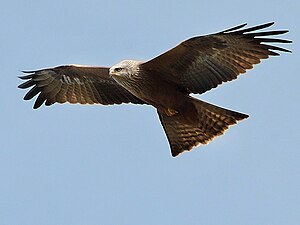
Flying is the main mode of movement for most species of birds , helping them search for food, migrate and escape from predators. Flight is the most specific form of bird movement, which determined the main features of the organization of this class. The ability of birds to fly caused a number of adaptations to ensure flight, takeoff and landing, orientation in space and navigation.
The flight characteristics of birds largely depend on the size of the bird and its ecological niche . Although certain biological adaptations (for example, minimization of body weight) are characteristic of all flying birds, others (for example, the shape of the wings ) are characteristic only of certain groups.
Content
Research History
The beginning of bird flight research was laid by Aristotle in his work On the Parts of Animals , in the fourth book. He believed that speed is proportional to the force that acts on the body, therefore, “propulsion” is constantly necessary for movement, which moves the body, and at the same time remains motionless. To explain the movement of flying objects, Aristotle was forced to introduce the concept of the transfer of the “propulsion” function to parts of the air. The concepts of inertia, acceleration, and aerodynamic drag were not yet known, so in fact the physics of flight remained unexplained.
Only two millennia later, the next significant step in the study of bird flight was made by Leonardo Da Vinci in his work “ Code of Flight of Birds ”. His notes described in detail what is necessary not only for a uniform flight, but also for take-off and landing, with gusts of wind and in other situations.
His images in detail showed the stages of movement of different parts of the body of birds. He also introduced the concept of air pressure and its changes around the wings. Birdwatching made him think that the main thrust in flight is created by the end parts of the wing [1] . However, the works of Leonardo Da Vinci on the flight of birds have long remained little known - they were published only in the middle of the 20th century [2] .
In the work of Giovanni Alfonso Borelli, “On the Movement of Animals,” published in 1680, the anatomy of birds is described in detail from a mechanical point of view, and a model has been put forward that explains the formation of lift. Borelli also refuted the idea of Aristotle about the role of the tail of birds in regulating the direction of flight.
The following stages in the development of knowledge about the flight of birds are associated with the formation of hydrodynamics. So, Christian Huygens in the XVII century measured the dependence of aerodynamic drag on speed, and his student Gottfried Leibniz actually introduced the concept of the law of conservation of energy.
In 1738, Daniil Bernoulli in his work “Hydrodynamics” published the law he derived, which linked the pressure of a fluid with its speed (now known as the Bernoulli law ), based on which Leonard Euler derived a set of differential equations that describe the motion of a fluid. These equations first gave a quantitative description of the flight, although they did not give plausible results due to the lack of viscosity in them. Only in 1843 in the work of Jean-Claude Barre De Saint-Venant , and, independently, in the work of 1845 by Rafael Stokes, the Euler equations were supplemented by viscosity and were called the Navier-Stokes equations .
The first attempts to apply these principles in order to copy the flight of birds and create aircraft heavier than air were made by George Cayley at the beginning of the XIX century . In his works of the period 1809 - 1810, he published the first quantitative calculations regarding the flight of birds and derived the form of least resistance for a given volume. He also made the first attempts to create artificial aircraft, which, however, ended in failure.
These attempts were continued by Otto Lilienthal, who also examined in detail the flight of birds and made his own aircraft based on it, but his experiments ended in death due to injuries sustained during an aircraft accident.
In the 1880s , Etienne Jules Maret even further advanced in the study of bird flight, having shot the first films of bird flight, and constructed very complex experimental installations for measuring forces and air pressure at various points around the bird - in particular, he obtained an empirical dependence of aerodynamic drag from the surface.
At the beginning of the 20th century, with the creation of airplanes, the main direction of hydro- and aerodynamics shifted from the study of birds to the study of apparatus with fixed wings. Theories were created for these devices, and although it was believed that they could be applied to birds, there were practically no experimental studies.
Only in the 1960s did the study of bird flight begin to study the birds themselves [3] [4] .
By that time, the functional anatomy of these animals was already known in detail, although a number of details were discovered much later. Then it became possible to use X-ray photography to visualize in flight bones and contractions of individual muscles [5] . The energy expenditures during flight were also measured. The studies were not limited to laboratory ones; the development of radars made it possible to measure the flight speed in natural conditions and study the strategy of bird behavior in various situations.
Evolution
Currently, the scientific community is dominated by the hypothesis that theropods are the ancestors of birds [6] , but the mechanism of the emergence of the ability to fly is still one of the unresolved issues of paleontology [7] [8] .
There are three main hypotheses:
- "Arboreal" or "from trees down" ( Eng. Arboreal or trees down , Marsh , 1877 [9] ), according to which the ancestors of birds first learned how to plan down from trees, and then developed the ability to real flight due to muscle strength;
- “Ground” or “from the earth up” ( English cursorial or ground up , Williston , 1879 [10] ), according to which the ancestors of the birds were small dexterous dinosaurs who developed a feather for other needs, and then began to use it to raise it into the air and flight;
- “Running with the help of wings” , a variant “from the ground up”, according to which the wings developed to form a downward force, which made possible better contact with the surface, and as a result - higher speed of running and the ability to run on vertical surfaces.
Until now, it remains unknown whether the first known bird, Archaeopteryx , had the ability to fly. On the one hand, archeopteryx had brain structures and sensory structures of the inner ear, which birds use to control their flight [11] , and its feathers were located like the feathers of modern birds.
On the other hand, Archeopteryx did not have a shoulder mechanism, with the help of which modern birds carry out fast waving movements; this may indicate that the first birds were not capable of flapping flight, but could plan [12] . Findings of most of the fossil remains of archeopteryx in coastal areas without dense vegetation also led to the hypothesis that these birds could use their wings to run on the surface of the water, like lizards basiliscus ( lat. Basiliscus ) [13] .
Thus, the structure of the skeleton of Archeopteryx testifies to its terrestrial way of life, while feathers and wings indicate its ability to fly [14] .
Wood theory, from trees down.
It is the first hypothesis proposed by Marsh in 1877 . It was created following the example of flying vertebrates, such as flying squirrels , woolly wings . According to the hypothesis, protoptics like the archeopteryx used claws to climb trees, from which they later took off with the help of wings [15] [16] .
However, more recent studies have questioned this hypothesis, citing evidence that the first birds did not know how to climb trees. Modern birds that have this ability have significantly curved and stronger claws than those leading a land-based lifestyle; the claws of birds of the Mesozoic era , like those of theropod-related dinosaurs, were similar to the claws of modern land birds [17] .
Nevertheless, the recent discovery of four-winged dinosaur fossils, according to the “from trees down” hypothesis, is an expected link in the evolution of birds and again revived interest in this hypothesis [18] .
Terrestrial theory, from the earth up.
Feathers were fairly widespread among coelurosaurs , including the early tyrannosaurus Dilong [19] , and modern birds are most often assigned by paleontologists to this group [20] , although some ornithologists attribute them to related groups [21] [16] [22] .
The functions of these feathers could be thermal insulation or sexual demonstration. The most common version of the flight “from the ground up” claims that the ancestors of the birds were small ground predators (like the modern California cuckoo ), and used their forelimbs to maintain balance, and later these feather-covered limbs developed into wings that could support the bird in flight.
Another version of the hypothesis involves the development of flight from sexual behavior : to attract the attention of the opposite sex, a long feather and stronger limbs developed, which were first used as a weapon , and then proved to be suitable for flapping flight. Also, due to the fact that many remains of the archeopteryx are found in marine sediments, it was suggested that the wings could help these birds move on the surface of the water [13] .
Wing Run
The “running with wings” hypothesis is based on observing young chummies and claims that the wings gained their aerodynamic functions as a result of fulfilling the bird’s need to quickly run on steep surfaces (such as tree trunks), or escape from predators, or, conversely, attack unexpectedly . This required a force that presses the bird to the surface [23] [24] [25] .
However, the first birds, including Archeopteryx , did not have a shoulder mechanism by which modern birds create lift; because of this, this hypothesis is subjected to considerable criticism [12] .
New Alternative Theories
In 2007, the Russian paleontologist , an employee of the Paleontological Institute of the Russian Academy of Sciences, E. N. Kurochkin proposed a compromise hypothesis of the origin of the flight, which he formulated, combining individual elements of the “ground” and “tree” hypotheses with new research and evidence. From the “ground” hypothesis, the author left only the development of long legs as a key adaptation that freed the forelimbs from supporting function.
Also, in contrast to the “tree” hypothesis, the transition of birds' ancestors to trees was not due to climbing trunks, but because of jumping onto lower limbs, using support on them. At the same time, the front limbs retained freedom of movement and could make waving movements to maintain balance when descending from the trees.
The anisodactyl paw, the most common in birds, when three fingers are forward and one back, giving reliable support for 4 fingers apart, was the basis for the reduction of a long tail from a series of vertebrae, which served as early birds to maintain balance. Such an evolutionary theory eliminates the need for a planning stage on the way to flapping flight [26] .
Loss of ability to fly with certain species of birds
Some species of birds, primarily those living on isolated islands where land-based predators are absent, have lost the ability to fly. This is evidence that, despite the great advantages of flying, it requires high energy costs, and therefore, in the absence of predators, it may become unnecessary [27] .
Loss of ability to fly often leads to an increase in the size of birds: the mass of individual species of penguins reaches 40 kg, cassowary , African ostriches - 80-100 kg. Some species of extinct flightless birds, such as epiornis and moa , apparently reached a mass of 250-500 kg [27] .
Flight Adaptations
1. wing (accessory wing)
2. terminal phalanx of the thumb
3. basal phalanx of the thumb
4. thumb
5-6. carpometacarpus
7. outer ulna
8. outer radius
9. radius
10. ulna
11. humerus
12. coracoid process
13. shoulder blade
Wing
Wing skeleton
The forelimbs of birds - wings - are the main parts of the body, adapted for flight. Each wing has a main surface, with which it cuts the air, consisting of three bones: the humerus , ulnar and radial .
The limb hand , which evolutionarily consisted of five fingers, was reduced to three fingers (fingers II, III and IV or II, II, III, depending on the numbering scheme [28] ), and its purpose is to attach the first-order fly feathers , one of the two main groups of fly feathers , which determine the shape of the wing.
The second set of fly feathers is located behind the carpal joint of the ulna and has the name of the second-order fly. The remaining feathers are called hiding and are divided into three sets. Sometimes the wing has rudimentary claws , although in most species they disappear by the time the bird reaches maturity (for example, in chicks of goacin ). But they are preserved in such birds as the secretary bird , palamedei , ostriches and some other bird species as a common, but not characteristic feature. The claws of the fossil archeopteryx resemble the structure of the claws of goacins.
Giant petrels and albatrosses also have a mechanism for fixing the joints of the wings in one position to reduce the load on the muscles during a soaring flight [29] .
In flight, the wings are set in motion by powerful flying muscles, which account for 15 to 20% of the total weight of the bird [30] . The wing raises the subclavian muscle , and lowers the pectoralis major ; both muscles are attached to the sternum .
Feathers of Wings
The main feathers used for flight and giving the wings and tail of birds their outer shape are fly feathers . The fly wing is usually divided into two or three main groups: the first feathers (primary), the second (secondary) and sometimes the third order.
The feathers of the 1st order are attached with the help of tendons to the bones of the hand, 2nd order - to the ulna, 3rd - to the humerus. For most species of birds, 1st order fly feathers are most responsible for the ability to fly: even the complete removal of other feathers from the wings does not affect the range and speed of flight, but a noticeable shortening of the 1st order fly feathers, especially distal ones , practically deprives the birds of their ability to fly [29] [31] . Most of the feathers are covered with the so-called covering plumage, which protects it and closes the gaps near the bases. If the bird loses half of the feathers, a flapping flight is possible, however, cutting the tips of the feathers makes it impossible.
Wing Shape
Форма крыла является важным фактором, определяющим тип и характеристики полёта, к которому способна птица. Разные формы крыльев отвечают разным компромиссным решениям для создания нужных характеристик, таких как скорость полёта, затраты энергии и манёвренность.
Форма крыла в двумерной горизонтальной проекции может быть приблизительно описана двумя параметрами: удлинением и нагрузкой на крыло. Удлинение крыла — это отношение размаха крыльев к средней ширине крыла (или квадрат размаха крыльев, разделённый на площадь крыльев). Нагрузка на крыло — отношение массы птицы к суммарной площади крыльев [32] .
Воздух обтекает передний край крыла, а также выпуклую верхнюю поверхность. Это приводит к ускорению его движения и создаёт область пониженного давления, в то время как давление на нижнюю вогнутую поверхность крыла остаётся практически постоянным. Данная разница давления над крылом и под ним создаёт подъёмную силу.
Большинство видов птиц могут быть сгруппированы в несколько общих типов по форме крыльев. В частности, обычным делением является разделение на эллиптические крылья, крылья для скоростного полёта, крылья с относительно большим удлинением, и крылья для парящего полёта, описанные ниже.
- Эллиптические крылья
Эллиптические крылья короткие и округленные, с небольшим удлинением, которое позволяет птицам маневрировать в ограниченном пространстве, например в условиях густой растительности. Такие крылья характерны для лесных хищных птиц (например, ястреба ) и многих воробьинообразных , особенно немигрирующих видов (мигрирующие виды птиц имеют длинные крылья для продолжительных перелётов). Также эта форма крыльев обычна у видов, которые избегают хищников за счёт быстрого взлёта, например, фазанов и куропаток [28] .
- Крылья для скоростного полёта
Крылья для скоростного полёта короткие и заострённые, имеют высокую нагрузку на крыло и обеспечивают высокую частоту взмахов для наибольшей возможной скорости за счёт значительных затрат энергии. Такой тип крыльев характерен для небольших птиц и характеризуются очень большой относительной длиной кисти крыла.
Этот тип крыльев характерен для птиц, способных развивать большую скорость полёта, таких как сапсан , стрижи и большинство утиных . Подобная форма крыльев характерна и для птиц группы чистиковые , хотя и для другой цели — чистиковые используют крылья для ныряния и «полёта» под водой. Птицы с такими крыльями являются рекордсменами по скорости — иглохвостый стриж ( Hirundapus caudacutus ) развивает скорость до 170 км/ч [29] , а сапсан — до 300 км/ч. Сапсан является самым быстрым животным на земле.
- Крылья с относительно большим удлинением
Крылья с относительно большим удлинением являются очень длинными и стройными, и обычно они характеризуются низкой нагрузкой на крыло и используются для медленного полёта, почти парения. Такие крылья характерны для буревестников , крачек , козодоеобразных и птиц, которые способны переходить на динамическое парение над волнами для сохранения энергии, что распространенно среди морских птиц .
Особым случаем этого типа являются крылья гигантских буревестников и альбатросов , наиболее приспособленных к продолжительному парению. Эти крылья характеризуются наименьшей относительной длиной кисти, около 25 % от длины крыла, и наибольшим числом маховых перьев второго порядка — 40.
Эти птицы также имеют типичный для них механизм закрепления суставов крыльев и отличия в строении маховых перьев кисти [29] [33] .
- Крылья для парящего полёта
Крылья для парящего полёта относительно широкие и характерны для больших сухопутных птиц, таких как орлы , грифы , пеликаны и аисты . Глубокие бороздки на концах крыльев между маховыми перьями уменьшают силу сопротивления воздуха, а относительно короткий размер позволяет подниматься с поверхности земли без потребности в значительном разгоне.
Относительно подобны им крылья цапель и ибисов , которые используют их для медленного машущего полёта [29] .
Хвост
В основе хвоста птиц лежат кости 5—7 позвонков и пигостиль , к которому крепятся рулевые перья хвоста. Число рулевых перьев хвоста различно у разных видов птиц, от их полного отсутствия у поганковых до 22—24 у пеликанов , уток и лебедей .
Рулевые перья хвоста способны раздвигаться, существенным образом увеличивая площадь. Также хвост может двигаться в двух направлениях с помощью шести пар мышц. Хотя у большинства птиц перья хвоста приблизительно одинаковой длины и образовывают плоский раскрытый хвост, форма хвоста может быть различной.
Например, у сороки , фазанов , олуш , некоторых голубей и кукушек центральные перья длиннее, что придаёт хвосту округлую форму. У некоторых фаэтонов , щурок , поморников , некоторых рябчиков и птиц-секретарей центральные перья намного длиннее.
Наоборот, у деревенской ласточки , фрегатов и некоторых крачек центральные перья намного короче, образовывая вилкообразный хвост.
Хвост принимает участие в стабилизации полёта и маневрировании за счёт как подъёмной силы, так и силы сопротивления.
Длинные жёсткие хвосты, особенно с длинными центральными перьями, наиболее приспособлены для создания аэродинамического сопротивления, способствуя стабильности полёта.
В то же время, вилкообразные хвосты создают подъёмную силу почти без силы сопротивления, обеспечивая манёвренность при быстром полёте.
Морские птицы часто имеют очень короткие хвосты, так как при медленном полёте им не требуется манёвренность.
У лесных птиц хвосты должны создавать высокую стабильность и иметь стойкость к столкновениям, для чего наиболее удобными являются длинные прямые хвосты [29] .
Прочие адаптации к полёту
Хотя крылья и перья являются основными адаптациями к полёту, потребности полёта вызвали многие другие изменения в организме птиц.
Перья летающих птиц отличаются от перьев многих нелетающих птиц и оперённых динозавров наличием микроскопических крючков, которые сохраняют перо целостным и предоставляют ему необходимую для полёта прочность.
Из всех позвоночных наиболее развит мозжечок [28] у птиц, что служит важной адаптацией к координации сложных движений и ориентации в трёхмерной среде. С полётом связано усиление роли зрения по сравнению с другими органами чувств.
Скелет птиц имеет ряд пустотелых костей, что заметно уменьшает его массу. Кроме того, у птиц отсутствует целый ряд костей, которые ещё существовали у археоптерикса , в частности, исчез длинный хвост. Челюсти с зубами были заменены лёгким клювом , в целом кости черепа стали более тонкими и легкими. Также в скелете появился киль , большая кость, к которой крепятся мышцы крыльев. Адаптациями к полёту считаются также срастание большей части позвонков, наличие пигостиля , к которому крепятся рулевые перья хвоста, и др.
С полётом связана перестройка мышечной системы, в частности, увеличение размеров больших грудных мышц — опускателей крыла. Их масса составляет от 10 до 25 % массы тела птицы [28] .
Важной адаптацией, предназначенной для обеспечения высоких затрат энергии и, соответственно, высокой скорости метаболизма , является появление однонаправленного тока воздуха в лёгких — двойного дыхания . Воздух, попадая в воздушные мешки , проходит через лёгкие птиц при каждом вдохе и выдохе в одном и том же направлении, что позволяет (благодаря использованию принципа противотока ), эффективно извлекать из него кислород (в выдыхаемом птицами воздухе около 12 % кислорода, в то время как у млекопитающих около 16 %) [28] . Воздушные мешки обеспечивают эффективное охлаждение тела при интенсивной работе мышц во время полёта.
Работу дыхательной системы птиц определяет в том числе и положение бедренной кости. Бедренные кости птиц малоподвижны, поэтому при перемещении по земле они практически не смещаются из горизонтального положения. Именно такая фиксированная позиция кости позволяет поддерживать брюшной воздухоносный мешок на вдохе [34] .
Наличие четырёхкамерного сердца и двойного дыхания обеспечивают теплокровность птиц и очень высокую интенсивность их метаболизма . Частота дыхательных движений у мелких птиц в покое составляет около 100 в минуту и в полёте, видимо, может возрастать. Частота пульса в покое — до 400—600, а в полёте — до 1000 ударов в минуту [28] .
Физика полёта
Аэродинамика полёта птиц сложна и на сегодняшний день известна лишь в общих чертах. Связано это с тем, что в полёте происходят изменения положения маховых перьев и изменения площади крыла, кистевая и основная части крыла двигаются с разной скоростью и под разными углами и т. п. [35]
Аэродинамика машущего птичьего крыла сильно отличается от аэродинамики самолетного крыла. Создаваемая крылом сила имеет основную составляющую, ортогональную вектору скорости набегающего потока ( подъёмная сила ), и небольшую, направленную по вектору скорости потока ( аэродинамическое сопротивление ). Поэтому для компенсации силы тяжести вектор скорости должен иметь большую горизонтальную составляющую. В вертикальном полете крыло совершенно бесполезно, при пикировании птицы просто складывают крылья. В горизонтальном полете необходима компенсация горизонтальной составляющей аэродинамической силы (сила сопротивления) для сохранения скорости полёта, то есть создание вертикальной составляющей вектора скорости набегающего потока в системе координат крыла. Машущее крыло можно условно разделить на три части — центральную, не совершающую машущих движений, и две концевых, имеющие большие вертикальные составляющие скорости и, как следствие, существенную горизонтальную составляющую аэродинамической силы. При этом при движении крыла вниз сила направлена вперед, при движении вверх — назад. Изменением угла атаки этих частей крыла модуль вектора аэродинамической силы может быть уменьшен до нуля (при движении вверх). Перемещение центра давления машущего крыла приводит к возникновению моментов по тангажу , для компенсации которых необходимо горизонтальное оперение (хвост). В отличие от самолетов, вертикального оперения птицы не имеют, так как наличие двух крыльев позволяет создавать любые моменты сил [36]
Аэродинамика машущего крыла в режиме зависания существенно сложнее из-за равенства нулю модуля вектора скорости набегающего потока. В этом случае вертикальная составляющая аэродинамической силы создается за счет горизонтальной составляющей скорости крыла относительно неподвижного тела птицы.
Этапы полёта
The aerodynamic picture of the flight of birds is complex, and its character in individual groups and species is very diverse. The structural features of the wings, the length and proportions of the feathers, the ratio of the body weight of the bird to the area of its wings, the degree of muscular development are decisive factors that determine the characteristics and flight characteristics of birds.
Takeoff
The take-off strategy can vary significantly, primarily depending on the size of the bird. Small birds require a relatively small or even zero initial speed, which is generated by jumping.
In particular, this behavior was demonstrated by the example of a starling and quail , which are capable of generating 80-90% of the flight speed due to the initial jump [37] , reaching acceleration up to 48 m / s².
Moreover, starlings often use the energy of the branch on which they sit, although they are not able to regulate the strength of the jump depending on its thickness [38] .
Other small birds, such as hummingbirds , whose legs are too small and thin to jump, begin to flap their wings still on the ground, reaching a lifting force of up to 1.6 bird weight [39] .
Large birds are not able to take off, and they need an initial speed for flight. Most often, this speed is achieved by taking off against the wind. In addition, often birds are forced to jog on the surface of the earth or water.
Some large birds, such as eagles, use rocks, upper branches of trees or other elevations to obtain speed due to fall, seabirds are often able to achieve this effect due to take-off from the crest of the wave [40] .
Landing
When landing birds reduce the vertical and horizontal components of speed. To do this, it is enough to increase the lifting force of the wing (even large birds lift prey into the air whose weight exceeds the weight of the bird). To this end, birds increase the angle of attack of the wings up to the blade , orient the body vertically and widely spread their wings and tail to increase the oncoming air resistance. At the same time, they stretch their legs forward to absorb the fit. In this case, the bird’s body participates in two movements - along a circle in a vertical plane due to aerodynamic force directed orthogonally to the speed vector of the flapping wing and accelerated fall under the influence of gravity.
At certain points in time, under the influence of these forces, both components of the velocity pass through zero. By choosing the magnitude of the aerodynamic force, these moments of time can be combined, that is, the speed of the body of the bird to zero. In this case, the wing should make a circular motion in a vertical plane at a constant speed, that is, it moves upward relative to the body of the bird, as shown in the photo.
Feet allow you to absorb shock when landing. However, the effectiveness of cushioning with legs varies greatly among different bird species. In birds that spend most of the time in the air, such as hummingbirds , swifts, and swallows , their legs are weak and not functional for this purpose; on the contrary, in black grouse and partridges, their legs are strong, able to fully absorb the slow flight of these birds.
The mechanism for using the legs also varies. Large birds usually put their legs forward, increasing air resistance and preparing for a collision with the surface. Small birds usually involve branches on which the bird is about to land.
In addition to cushioning, most birds are forced to use additional mechanisms. So, most birds of prey always land against the wind. Moreover, almost always their wings are spread apart, and the accessory wing is fully deployed. Most large birds, such as a jay , before landing move below the landing site (branches or rocks), and a few meters up to the target they rise up without wings flapping. This approach allows reaching almost zero speed even in the absence of wind.
Reducing speed is not so important for waterfowl and some seabirds, which are able to dampen speed against water with their wide legs. The legs do not need to have membranes for braking - birds such as storks , herons and cranes have legs ideal for these purposes. Although these birds are capable of landing on the horizontal surface of the earth, they often do this rather awkwardly [41] .
Flight Types
Bird flight is usually divided into two main types [42] :
- active or waving
- passive, or soaring
Birds usually use more than one type of flight, but combine them. The flap of the wings is followed by the phases when the wing does not make movements: it is a gliding flight, or hovering. Such a flight is typical mainly for birds of medium and large sizes, with sufficient body weight [42] .
The underdeveloped wing muscles are observed in birds with a large wing surface, mainly using soaring flight. On the contrary, birds with a small wing surface have developed strong muscles [42] .
Waving Flight
Flapping flight consists of two separate types of movement: working stroke and reverse. During the working stroke, the wing moves forward and downward, and the reverse stroke returns the wing to its initial position. In this case, the inner part of the wing primarily generates lift, while the brush generates traction, which pushes the bird forward. During the working stroke, the first-order fly feathers brought together form a dense streamlined wing surface. On the contrary, during the return stroke, the first-order fly feathers of many, especially small, birds turn around their axis, providing air movement between them. Large birds or long-winged small birds completely or partially bend their wings, bringing them closer to the trunk [43] .
Flapping flight is diverse and in most cases depends on the size of the bird, its biological characteristics and environmental living conditions. It is customary to distinguish several types of flapping flight:
- clapping ( chicken during take-off)
- vibration flight ( swifts and hummingbirds )
- waved ( swallows )
- trembling ( kestrel )
- others.
Hovering Flight
Soaring is called a flight without the active expenditure of energy from the side of the bird, which is carried out either due to loss of speed or altitude, or due to the use of air movement to generate energy [29] .
For birds using soaring flight, large body sizes and small heart sizes are characteristic due to the lack of enhanced muscular function. The wings of such birds are usually long, have an equally long shoulder and forearm, and a short hand. There is a development of the supporting surface of minor flywheels, the number of which in vultures reaches 19–20, and in albatrosses 37 [29] . In terrestrial species, the wings are usually wide, while in marine species they are narrow.
Distinguish between soaring dynamic and static.
Static soaring
The static soaring of birds is based on the use of flow flows or air thermal flows.
- Using Upstream
Obstacles to the wind, such as hills , rocks , forest belts and others, cause air to move in a vertical direction. Many species of birds are able to use such updrafts.
For example, when observing the kestrel flight, it was found that with a wind speed of 8.7 m / s the birds always kept at a height of 6.5 ± 1.5 m above the windward side, maintaining the angle of attack of the wings between 6 ° and 7 ° [44] .
- Use of thermal air currents
Another type of soaring is associated with the use of thermals by birds - the flow of ascending air, which occurs as a result of heating the air near the surface of the earth. Thermals most often occur over flat and even surfaces, at one point.
This method is used by many large birds, holding in the central part of the thermal due to whirling in place. Such behavior is characteristic of many birds of prey , in particular vultures , kites , buzzards . This method is also used by storks , pelicans and other birds that are not predatory. Birds that use air thermal currents have a slight elongation of the wing (approximately 15: 1), which allows them to fly fast, unlike, for example, albatrosses. Such an elongation of the wing allows you to circle in a smaller radius, and helps to stay within the thermal range [29] .
Dynamic hover
Another atmospheric phenomenon is the difference in wind speed at different distances from the surface, especially noticeable over the ocean. With a strong wind (7 points on the Beaufort scale ), its speed is 15 m / s at a height of 10 m, but only 10 m / s at a height of 1 m. Dynamic soaring is characteristic of large ocean birds. Albatrosses and many other seabirds actively use this difference. For this, the bird periodically rises and falls, gaining horizontal speed in the faster upper layers of air and vertical in the lower layers, due to a higher flight speed than that of the surrounding air [29] .
- Hovering over the waves
Seabirds also use two more soaring mechanisms associated with the presence of waves. The first type is similar to the dynamic soaring described above and is associated with the occurrence of ascending air currents in front of the wave.
So, a typical wave with a height of 1 m and a width of 12 m is capable of forming an upward flow of air at a speed of 1.65 m / s. Many birds, such as albatrosses , fulmar , gulls and pelicans , constantly fly on the windward side of the wave when flying, taking advantage of these streams. The movement occurs parallel to the crest of the wave. When the wave ends, the bird moves by inertia, looking for a new wave. Less commonly, birds can move with the wave [29] .
Another way to get energy from the waves is that behind the wave there is always a stretch of calmer air. Birds, such as albatrosses and petrels , often fly above them, constantly rising and lowering and actually using the dynamic soaring mechanism [45] .
Flight Energy Conservation Methods
Flapping flight can be extremely costly, exceeding 2–20 times the main bird exchange [29] . Therefore, birds have developed several mechanisms to reduce energy costs for this type of flight.
- Intermittent Flight
One of the means of saving energy during a flight is intermittent flight, in which several strokes alternate with free flight. However, there are several means by which this mechanism can theoretically conserve energy. In large and medium-sized birds, during breaks, the wings are tightly pressed to the body, which reduces the strength of the resistance. According to estimates, the total energy saving during the finch flight is up to 35% [29] . If the bird keeps its wings open during the break, the flight consists of a phase of acceleration during flapping flight, and then planning during the break. Such a flight increases lift and allows you to save up to 11% of energy [29] . Birds can use both tricks depending on the flight speed. In addition, the optimal frequency of wing flaps from the point of view of muscle use may be more than necessary for the flight, which is why intermittent flight provides the opportunity to use the muscles in the optimal mode. This type of flight is especially characteristic of finch birds.
Intermittent flight is characteristic of some groups of birds. So, it is the main characteristic of the flight of woodpeckers , which, depending on the species, flap their wings from 30% to 93% of the flight time, the rest is paused [29] . The common magpie also spends up to 60% of the flight in a state of pauses in the waving [29] . Intermittent flight in some species can occur even while hovering in place with no wind and with it, and the bird manages to maintain its position relative to the ground.
- Flying an Ordered Group
During flight, ascending jets of air form at the ends of the wings of the birds. Birds of the rear orders use this jet, as if pushing them forward. Thus, part of the aerodynamic load is assumed by the pack leaders and the most powerful birds flying at the head of the wedge [29] . When flying in a V-shaped group, each bird is in the zone of the ascending flows of the previous one, which saves energy. The greatest effect is achieved for large birds, and only for them the benefits exceed the cost of maintaining an accurate distance. According to estimates, the wedge system allows birds to reduce energy consumption during the flight by 25% [29] .
Hang Up
Hanging in place
Hanging in place relative to the surrounding air ( English hovering ) is a difficult task. Most birds are either completely incapable of it or are capable only for a very short period of time. In fact, hummingbirds are the only group of birds adapted to this, while their body weight varies between 2 and 8 g.
Slightly larger in size nectaries , having a mass of 10 to 20 g, are able to hang in place only if there is no other convenient way to get to the flower. With this hovering, hummingbird wings are almost invisible to the human eye, and the wings of nectaries, which move much more slowly, are visible as a transparent disk around the bird. If necessary, these birds are able to move slowly in any direction [29] .
When hovering in place, the bird's body is in an almost vertical position, its axis is an angle of 40-50 ° with a horizontal plane. At the same time, the wings move almost horizontally, describing the eight. With each movement forward and backward, the wing moves slightly downward and rises upward at the extreme points.
The angle of movement is about 130 °, approximately the same forward and backward. At the same time, the wing brush turns almost 180 ° when the direction of movement changes, constantly holding a positive angle of attack. The frequency of movement is 36–39 Hz for the hummingbird Chlorostilbon lucidus and 27–30 Hz for the black Jacobin ( Florisuga fusca ), the maximum speed is 20 m / s [29] . In this case, hummingbirds are able to lift a load of 80-200% of their own body weight [46] .
Hanging against the wind
Distinctive are hovering relative to the surface due to flight against the wind with wind speed ( English windhovering ). This behavior is characteristic of many birds of prey and birds that specialize in hunting and fishing: petrels , osprey , terns , skuas , some kingfishers . A stationary state relative to the surface helps the bird to focus on the surface of the earth or water and look for prey. However, this flight mode is optimal only if there is a certain wind speed, otherwise it requires significantly more effort from the bird.
When the head hangs, it remains exceptionally stationary relative to the ground. So, in the case of kestrel, the oscillations are up to 6 mm, and the oscillations do not correlate with the flapping of the wings. In this case, the bird manages to quickly respond to changes in wind speed that are not able to change the position of the head [29] .
Maneuvering and flight speed
Maneuvering during flight is achieved by changing the resulting gravity and aerodynamic forces of the wing. Of great importance for the flight speed of birds is the tailwind, which contributes to an increase in flight speed.
The speed of birds during seasonal migrations is usually higher than during off-season flights. Gray cranes, silver gulls, large sea gulls fly at a speed of 50 km / h, finches, siskins - 55 km / h, killer whales - 55-60 km / h, wild geese of various kinds - 70-90 km / h, sviyazi - 75-85 km / h, waders of various species - an average of about 90 km / h. The highest flight speed is observed for the black swift - 110-150 km / h [42] . The hollows showed amazing endurance: they are able to fly at a speed of about 100 km / h over more than 6500 km [47] . Наибольшая скорость пикирующего полета наблюдается у сокола-сапсана — до 320 км/ч.
Высота полёта
Энергетика и аэродинамика организма птиц, видимо, позволяют машущий полёт вплоть до высоты 5—6 км, что, кстати, совпадает с границей вечных снегов во многих географических зонах. Несколько видов птиц гнездятся на таких высотах, хотя к машущему полёту прибегают очень ограниченно — в основном перемещаются по земле или парят в восходящих потоках воздуха. Например, тибетская ложносойка , черношейные журавли , горные гуси , колибри рода Chalcostigma . Примерно до тех же высот поднимаются гуси в ходе сезонных миграций; они перелетают Гималаи на высотах до 5500—6000 м. Такой перелёт осуществляется на пределе физических возможностей этих птиц и выполняется с учётом многочисленных условий, позволяющих экономить энергию [48] . Многие грифы (например кондоры ), хотя и практикуют в основном парящий полёт, но тоже гнездятся до 5000 м и совсем без машущего полёта на больших высотах обойтись не могут.
Рекордсменом высокогорности, по-видимому, является альпийская галка , замеченная альпинистами на высоте 8200 метров. Впрочем, даже она не набирает эту высоту сразу от уровня моря. Но подавляющее большинство птиц чаще всего летает вдоль поверхности земли, даже во время миграции не поднимаясь выше 1,5 километра.
Парение в восходящих потоках воздуха позволяет птицам подниматься существенно выше, в очень редких случаях — до высот, на которых поддержание жизнедеятельности невозможно (свыше 10 км). Так, в 1973 году африканский сип столкнулся с гражданским самолётом над африканской республикой Кот д'Ивуар на высоте 11 277 м [49] ; очевидно, что указанная высота была обусловлена параметрами восходящего потока, а не физическими возможностями птицы; вне локально повышенной плотности воздуха, на высотах, превышающих 10 км, теплокровные животные нежизнеспособны .
В средствах массовой информации встречаются утверждения, что в 1967 году стая из 30 лебедей-кликунов была замечена на высоте более 8,2 км в районе Северной Ирландии , а серых журавлей встречали пересекающими хребет Гималаи на высоте около 10 км. Однако эти факты не подтверждены достоверными источниками.
Notes
- ↑ Леонардо да Винчи. Избранные естественно-научные произведения. М, 1955. С. 605.
- ↑ Соболев Д. А. ИДЕЯ ПОЛЁТА В ТРУДАХ ЛЕОНАРДО ДА ВИНЧИ, Вопросы истории, естествознания и техники, № 3 2005.
- ↑ Herzog, K. Anatomie und Flogbiologie der Vogel. — Gustav Fischer Verlag, 1968.
- ↑ Sy, M. Functionell-anatomische Untersuchungen am Vogelflugel (нем.) // Jornal fur Ornitologie : magazin. — 1936. — Bd. 84 , Nr. 2 . — S. 199—296 .
- ↑ Mechanical power output of bird flight (англ.) // Nature. - 1997. - Vol. 390 . — P. 67—70 .
- ↑ Prum, Richard O. Prum. Who's Your Daddy (англ.) // Science. — 2008. — December ( vol. 322 , no. 5909 ). — P. 1799—1800 . — ISSN 0036-8075 . — DOI : 10.1126/science.1168808 . — PMID 19095929 .
- ↑ Brush, AH Taking Wing: Archaeopteryx and the Evolution of Bird Flight (англ.) // The Auk : journal. — 1998. — July.
- ↑ Shipman, P. Taking Wing: Archaeopteryx and the Evolution of Bird Flight. — Simon & Schuster, 1999. — ISBN 0684849658 .
- ↑ OC Marsh. Notice of new dinosaurian reptiles from the Jurassic formation (англ.) // American Journal of Science and Arts : journal. — 1877. — P. 514—516 .
- ↑ Williston, S. Are birds derived from dinosaurs? (неопр.) // Kansas City Rev. Sci.. — 1879. — Т. 3 . — С. 347 — 360 .
- ↑ Alonso, PD, Milner, AC, Ketcham, RA, Cokson, MJ and Rowe, TB The avian nature of the brain and inner ear of Archaeopteryx (англ.) // Nature : journal. — 2004. — August ( vol. 430 , no. 7000 ). — P. 666—669 . — DOI : 10.1038/nature02706 .
- ↑ 1 2 Senter, P. Scapular orientation in theropods and basal birds, and the origin of flapping flight (англ.) // Acta Palaeontologica Polonica : journal. - 2006. - Vol. 51 , no. 2 . — P. 305—313 .
- ↑ 1 2 Videler, JJ Avian Flight. — Oxford : Oxford University Press, 2005. — ISBN 978-0198566038 .
- ↑ Курзанов С. М. Авимимиды и проблема происхождения птиц. Труды совместной советско-монгольской палеонтологической экспедиции, № 31. М.: Наука, 1987. 95 с.
- ↑ Feduccia, A. The Origin and Evolution of Birds, 1999, Yale University Press, isbn=9780300078619
- ↑ 1 2 Feduccia, A. Explosive Evolution in Tertiary Birds and Mammals (англ.) // Science. — 1995. — February ( vol. 267 , no. 5198 ). — P. 637—638 . — DOI : 10.1126/science.267.5198.637 . — PMID 17745839 . Архивировано 20 марта 2008 года.
- ↑ Glen, CL, and Bennett, MB Foraging modes of Mesozoic birds and non-avian theropods (англ.) : journal. — 2007. — November ( vol. 17 ). Архивировано 8 декабря 2012 года.
- ↑ Курочкин Е. Н., Богданович И. А. К проблеме происхождения птиц: компромиссный и системный подходы. Известия РАН, Серия Биологическая, 2008 № 1 с. 15—17, УДК 568.2(591.174)
- ↑ Prum, R., and Brush, AH The evolutionary origin and diversification of feathers (англ.) // The Quarterly Review of Biology : journal. — University of Chicago Press , 2002. — Vol. 77 . — P. 261—295 . — DOI : 10.1086/341993 . Архивировано 15 октября 2003 года.
- ↑ Mayr, G., B. Pohl & DS Peters (2005). «A well-preserved Archaeopteryx specimen with theropod features». Science , 310 (5753): 1483—1486.
- ↑ Feduccia, A. The Origin and Evolution of Birds . — Yale University Press, 1999. — ISBN 9780300078619 .
- ↑ Feduccia, A. (1993).
- ↑ Dial, KP Wing-Assisted Incline Running and the Evolution of Flight (англ.) // Science : journal. - 2003. - Vol. 299 , no. 5605 . — P. 402—404 . — DOI : 10.1126/science.1078237 . — PMID 12532020 .
- ↑ Morelle, Rebecca Secrets of bird flight revealed (Web). Scientists believe they could be a step closer to solving the mystery of how the first birds took to the air. . BBC News (24 января 2008). Дата обращения 25 января 2008. Архивировано 14 августа 2011 года.
- ↑ Bundle, MW and Dial, KP Mechanics of wing-assisted incline running (WAIR) (англ.) // The Journal of Experimental Biology : journal. — The Company of Biologists , 2003. — Vol. 206 . — P. 4553—4564 . — DOI : 10.1242/jeb.00673 . — PMID 14610039 .
- ↑ Курочкин Е. Н., Богданович И. А. К проблеме происхождения полёта птиц // Материалы конференции «Современные проблемы биологической эволюции» к 100-летию Государственного Дарвиновского музея, 17—20 сентября 2007, Москва. С. 17—19
- ↑ 1 2 Кэрролл Р. Палеонтология и эволюция позвоночных В 3-х т. Пер. с англ. — Мир, 1993. — Т. 2. — 283 с. — ISBN 5-03-001819-0 .
- ↑ 1 2 3 4 5 6 Baumel JJ (1993) Handbook of Avian Anatomy: Nomina Anatomica Avium. 2nd Ed. Nuttall Ornithological Club. Cambridge, MA, USA
- ↑ 1 2 3 4 5 6 7 8 9 10 11 12 13 14 15 16 17 18 19 20 21 John Videler. Avian Flight. — Oxford University Press , 2005. — ISBN 978-0-1985660-8.
- ↑ Птичье царство // Древо познания : коллекционный журнал. — Marshall Cavendish, 2002. — С. 157—162, 197—202 .
- ↑ Brown, RE and Cogley, AC Contributions of the propatagium to avian flight (неопр.) . — 1996. — Т. 276 . — С. 112—124 .
- ↑ Savile, DBO Adaptive radiation of avian wing (англ.) // Evolution . — Wiley-VCH , 1957. — Vol. 11 . — P. 212—224 .
- ↑ Boel, M. Scientific studies of natural flight (неопр.) // Transaction of the American Society of Mechanical Engineers. — 1929. — Т. 51 . — С. 217—252 .
- ↑ Получены новые данные, опровергающие гипотезу о происхождении птиц от динозавров — Наука и техника — Биология — Орнитология — Компьюлента
- ↑ Птицы: полет . Дата обращения 10 октября 2009. Архивировано 14 августа 2011 года.
- ↑ Виноградов И. Н. Аэродинамика птиц-парителей. — М. , 1951. — 128 с.
- ↑ Earls KD Kinematics and mechanics of ground take-off in the starling Sturnis vulgaris and the quail Coturnix coturnix (англ.) // J Exp Biol. : journal. - 2000. - Vol. 203 , no. 4 . — P. 725—739 . — PMID 10648214 .
- ↑ Bonser RHC, Norman AP, Rayner JMV Does substrate quality influence take-off decisions in common starlings? (англ.) // Functional ecology : journal. — 1999. — Vol. 13 . — P. 435—439 . (inaccessible link)
- ↑ Tobalske BW, Altshuler DL, Powers DL Take-off mechanisms in hummingbirds (неопр.) . — 2004. — С. 1345—1352 .
- ↑ Taking Off Bird Flight . Paul and Bernice Noll's Bird Choices . Дата обращения 27 августа 2009. Архивировано 31 января 2012 года.
- ↑ Landing Bird Flight . Paul and Bernice Noll's Bird Choices . Дата обращения 27 августа 2009. Архивировано 14 августа 2011 года.
- ↑ 1 2 3 4 Гладкова Н. А., Михеева А. В., Жизнь животных, т. 5 Птицы, М.: Просвещение, 1970
- ↑ Slow Flapping Flight of Birds . Paul and Bernice Noll's Bird Choices . Дата обращения 27 августа 2009. Архивировано 14 августа 2011 года.
- ↑ Videler, J., Groenwold, A. Field measurements of hanging flight aerodynamics ain the kestrel Falco tunnunculus (англ.) // The Journal of Experimental Biology : journal. — The Company of Biologists , 1991. — Vol. 102 . — P. 1—12 .
- ↑ Pennycuick, CJ Gust soaring as a basis for the flight of petrels ans albatrosses (англ.) // Avian Sciance : journal. — 2002. — Vol. 2 , no. 1 . — P. 1—12 .
- ↑ Chai P., Millard D. Flight and size constraints: hovering performance of large hummingbirds under maximal loading (англ.) // J Exp Biol. : journal. - 1997. - Vol. 200 , no. 21 . — P. 2757—2763 . — PMID 9418032 .
- ↑ Julia Rudy. Обнаружена самая быстрая перелётная птица . Membrana (28 мая 2011). Дата обращения 28 мая 2011. Архивировано 14 августа 2011 года.
- ↑ The trans-Himalayan flights of bar-headed geese (Anser indicus)
- ↑ Mark Carwardine. Animal Records . — Sterling Publishing Company, Inc, 2008. — С. 256. — ISBN 1402756232 .
Literature
- Якоби В. Э. Морфоэкологические приспособления к скоростному полёту у птиц // Механизмы полёта и ориентации птиц: Сборник статей / Отв. ed. С. Е. Клейненберг ; АН СССР, Ин-т морфологии животных им. А. Н. Северцова. — М. : Наука , 1966. — 224 с.
- Виноградов И. Н. Аэродинамика птиц-парителей / Всесоюз. добровольное о-во содействия авиации. — М. : Изд-во ДОСАРМ, 1951. — 128 с.
- Videler, JJ Avian Flight. — Oxford : Oxford University Press, 2005. — ISBN 978-0198566038 .
- Carrol L. Henderson. Birds in Flight: The Art and Science of How Birds Fly. — Voyageur Press, 2008. — ISBN 978-0760333921 .
- David E. Alexander. Nature's Flyers: Birds, Insects, and the Biomechanics of Flight. - The Johns Hopkins University Press, 2004 .-- ISBN 978-0801880599 .
- Otto Lilienthal. Der Vogelflug als Grundlage der Fliegekunst . - 1889, 2003. - ISBN 3-9809023-8-2 .
- Lilienthal O. Birdflight as the Basis of Aviation . - 1911. (English)
- Lilienthal O. Flight of birds as the basis of the art of flying. - M., 2002 (Russian)
Links
- Flying animals - article from the Great Soviet Encyclopedia .