The pests of plants belonging to the orchid family include more than 32 species belonging to 4 classes , 7 orders . Also known are more than 90 fungi , bacteria, and viruses that cause orchid diseases: leaf spotting, root rot, young shoots , tuberidia , leaves, and flowers [1] .
Timely identification of pests and diagnosis of pathogens, knowledge of their biology and the nature of their damage to plants, an effective system of combating them are an integral part of the complex of work on cultivating plants of the orchid family.
Causes of plant damage can be: violation of quarantine rules, agricultural technology errors, failure to comply with plant requirements for hygro- and thermal conditions. The species composition of pathogens and the nature of their relationships are greatly influenced by the floristic composition of orchids, environmental conditions and conditions for growing plants: substrate, fertilizer system, aeration , irrigation, lighting and ongoing protective measures.
Pests

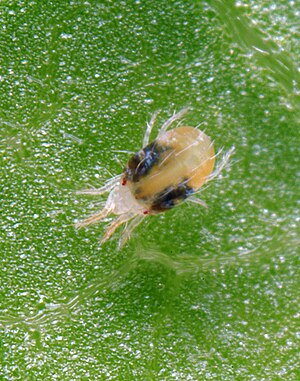
- Herbivorous mites
- Spider mites ( Tetranychinae ).
The following species are most commonly found on orchids: Tetranychus urticae , Tetranychus turkestani , Tetranychus cinnabarinus . Adult individuals of Tetranychus urticae and a similar Tetranychus turkestani are yellowish in color, larvae, proto- and deuteronyms are yellow-green. In Tetranychus cinnabarinus, adults are reddish-brown or burgundy, eggs and larvae are reddish, proto-and deutrophy are yellow-green.
Populate the lower surface of the leaves and buds of cymbidium , catazetum , tunia , eulophia and other plants. They feed on plant cell juice.
Signs of defeat. The presence of small white dots on the leaves (mainly on the underside) and the presence of a thin cobweb surrounding the plant (or part thereof). The leaf discolors, becomes gray, later - brown.
Spider mites develop in sheltered soil at temperatures above 12 ° C. The sum of the effective temperatures of the full development cycle is 120 ° C. Ticks give up to 20 generations per year, the development of one generation lasts 12-20 days. At 20 ° C, ticks complete development in 20 days, at 25 ° C in 10, at 32 ° C in 6-6.5 days. The optimum temperature is 28-32 ° C and relative humidity of 40-50%.
Control measures. Spraying plants with axex at a concentration of 0.08% or isophene - 0.05, omite - 0.1% and other acaricides . The development of ticks is restrained by spraying cold water on the lower surface of the leaves 3-4 times a day. A predatory mite phytoseyulus ( Phytoseiulus persimilis ) is used at the rate of predator: prey - 1: 70 or 1: 100. At the same time, relative humidity of 70–80% is maintained in the protected ground [1] .
In apartments, the most harmless preparations of the avermectin group are: actofit , fitoverm , vermitek . These drugs do not affect eggs and those that do not eat, waiting for molting, larvae and tick protonymphs. At a temperature of +20 ° C, at least 3 treatments with an interval of 9-10 days are required. At +30 ° C, 3-4 treatments with an interval of 3-4 days [2] . - Flat- bodied mites , or false spider mites, or flat mites ( Tenuipalpidae ).
The main anatomical difference from spider mites is that the body is divided by transverse sutures into several parts (front, middle and back).
The most common is the greenhouse beetle ( Brevipalpus obovatus ). It damages the leaves of stangopeia , phalaenopsis , paphiopedilum , calanthus , dendrobium , cymbidium , liparis , colegin , etc. The female is brick-red in color, the body is angular-ovate, on the dorsal surface with a mesh pattern. Egg of elongated oval shape, smooth, bright red. The larva is broadly oval, red, the nymph is elongated-oval, red. In closed ground it develops year-round.
Signs of defeat. Damaged leaves become silver-white. The flowers are deformed. Small generations are hardly visible on the surface of the leaf blade. Without magnifying optical instruments, ticks are practically invisible. With severe damage, the plant dries up.
Control measures. Spraying plants with ambush in a concentration of 0.05%, cymbush - 0.05, fozalon - 0.2, acrex - 0.08% and other acaricides or insectoacaricides [1] . The drugs of the avermectin group are most harmless in the conditions of apartments: actofit , fitoverm , vermitek . These drugs do not affect eggs and those that do not eat, waiting for molting, larvae and tick protonymphs. A minimum of 4 treatments is performed with an interval of 3-4 days. These drugs do not work at temperatures below +18 ° C and are not stored in aqueous solutions for more than a day [3] .
It is somewhat less common: Tenuipalpus pacificus - the body length of an adult tick is about 0.25 mm, it usually affects phalaenopsis , as well as aerodesa , cattleya , cyripediums, papiopedilums, dendrobiums , oncidiums , a vandal group of species ... It differs from the greenhouse of the greenhouse ( Brevipalpus obovatus ) by the presence of one pair of long thin setae at the posterior end of the abdomen [4] .
Another common representative of flat ticks is the oncidium flat tick ( Brevipalpus oncidii ), most often affecting pleione , oncidium , odontoglossum and rosioglossum [5] . - Onion tick , or Onion root tick ( Rhizoglyphus echinopus ).
Adult mites are oval in shape, white or light yellow, with powerful brown legs. Development from an egg to an adult at a temperature of 26-28 ° C is completed in 9-11 days, at 20 ° C - 14 days. More often, the tick populates weakened plants, penetrating inside the roots, damages the base of shoots as well.
Control measures. Spraying plants with acaricides. Damaged parts of plants are cut and destroyed [6] .
- Spider mites ( Tetranychinae ).
- Insects
- Aphids .
The most common aphid is Orangery ( Myzus persicae ). Damages the inflorescences of dendrobium , selenipedium , lycaste , Cattleya , vanda . In the summer, beet aphid ( Aphis fabae ) settles on the buds and flowers of fragmopedium , cymbidium , dendrobium . Orchid aphid ( Cerataphis orchidearum ) often settles on the flowers of coelogins, and greenhouse aphids ( Aulacorthum circumflexsus ) develop on the flowers of Blethilla .
Control measures. Spraying plants with ambush in a concentration of 0.05%, cymbush - 0.05, actellic 0.2%, tobacco infusion with soap. A predatory gall midge aphidimimiza ( Aphidoletes aphydimysa ) is used with a predator-prey ratio of 1: 50 [1] . To protect indoor plants, it is recommended to use a less toxic phytoerm preparation. - Coccids , or worms and scale insects .
On orchids, there are orchid scale insects ( Pseudoparlatoria parlatarioides ), bromeliad scale insects ( Diaspis bromeliae ), soft false shield ( Coccus hesperidum ), seaside mealybug ( Pseudococcus maritimus ) and other species. These insects settle on the leaves, especially in the sinuses, on the stems and peduncles, on the tuberidia under a covering scale. Light yellow small spots form at their places of feeding, later pressed brown, brown or raspberry-violet. Worms and scale insects secrete a lot of honey dew , which covers the plant abundantly. Sooty mushrooms ( Capnopodium ) develop on it, as a result black sticky patches appear on the plant.
All types of orchids are damaged, especially dendrobium , cymbidium , papiopedilium , cattleya , stangopei , pleione , bleletilla .
Control measures. Three-time spraying after 7-10 days with fozalon at a concentration of 0.3%, ambush - 0.05, cymbush - 0.05%. In the fight against worms, the predatory beetle cryptolemus ( Cryptolaemus montrouzieri ) is effective with a predator-prey ratio of 1: 50 [1] . To protect indoor plants, it is recommended to use a less toxic phytoerm preparation. - Thrips
The body length of adult insects is 2–2.5 mm. It has two pairs of wings. In a calm state, they are folded into a narrow bright strip on the back of the insect and are practically invisible. Adult insects usually have a dark color - black, or brownish. The larvae of most species are yellow, or greenish, hardly distinguishable on the surface of the leaf blade. Two species are most common on orchids: greenhouse thrips ( Heloithrips haemorrhoidalis ) and tobacco thrips ( Thrips tabaci ). They lead a secretive lifestyle. It affects flowers, leaves and tuberidia . On the damaged leaves, a characteristic silvery color appears with a mass of dotted dark excrement . Over time, the affected areas turn brown. Thrips lay eggs in leaf tissue. Most often, tuna , cymbidium , epidendrum , fayus , anguloa , stenorhinus , spathoglottis , catazetum , etc. are damaged .
Control measures. Three-time spraying of plants with actellicum at a concentration of 0.2%, hostaquicum - 0.1%, isatrine - 0.1% or other systemic insecticides with an interval between spraying of 10 days. The predatory mite Amblyseius mackenziei is also effective in the ratio of predator to prey - 1: 25 [1] It is recommended to use a less toxic phytoerm preparation to protect indoor plants. - Grasshopper greenhouse ( Tachycinrs asynamorus ).
- Mushroom mosquitoes - Sciaridae ( Sciaridae ).
The larvae of some species of this vast family can damage the roots of plants. There were cases of eating the root meristem of the rooted dendrobiums of the phalaenopsis and some other species of orchids. [7] .
- Aphids .
- Gastropods
They feed at night, during the day they hide in various shelters. Eat any tender parts of plants. Large snails and slugs are easily detected by silver mucus left on the plant. Small snails are found crawling onto the substrate when the plant is immersed in water for 15-30 minutes. Orchid roots are often damaged by the snail Zonitoides arboreus . 2-3 adult snails of this species living in a pot with a plant are enough to cause serious damage to the roots. The following preparations are used as molluscocides: Mesurol (Mesurol), Sluggo, Slug-fest, Durham, Schneckenkorn or Metaldehyde (trademarks Meta or Thunderstorm ) once every three to four weeks [8] . - Woodlice .
Damage all parts of plants. Mokrits are caught on bait from potatoes, apples and fermented beer. Plants are sprayed with ambush at a concentration of 0.05% or fozalon at a concentration of 0.2 - 0.3%. - Kivsyaki .
Damage the roots of adult plants and all parts of young plants. Methods of struggle, see Woodlice. - Nailtails , or Podura ( Collembola ).
Damage the roots of seedlings, for adult plants are not dangerous.
Diseases
- Black rot .
The causative agents are fungi : Pythium ultimum , Pythium debaryanum , Phytophthora omnivora . These types of plants are affected at any age. The most dangerous is the rot of the roots and base of tuberidium . As a result, the whole plant dies. The disease is focal in nature and quickly spreads from diseased plants to healthy ones. Affected tissues turn black. Tuberidia are mummified. The spread of the disease is facilitated by low temperature and high humidity of the air and soil substrate, when the root system develops slowly, and some parts of the roots, due to lack of air and waterlogged substrate, die and become accessible to pathogenic fungi. Cattleya , stangopeia , lelia , leliocattlesia , papiopedilum are affected by black rot.
Control measures. Optimization of humidification conditions. Spraying and watering plants with copper preparations: copper chloride at a concentration of 0.5%, chomecin - 0.4, copper sulfate at a dilution of 1: 100000. The diseased plant is destroyed [1] . Fungicides slow down the development of the disease. - Root rot .
Pathogens: Fusarium oxysporum , Fusarium solani var. argillaceum , Fusarium sporotrichiella , Fusarium javanicum , etc.
Affected roots, tuberidia and leaves rot, soften and turn brown. The causative agents of the disease penetrate the roots through damage. The disease is noted on cymbidium , papiopedilume , vanda , miltonia and odontonia .
Control measures. Optimization of growing conditions. Three-time watering and spraying of plants with a suspension of foundationazole at a concentration of 0.2%, toxin- M - 0.2%, benomyl - 0.2% with an interval of 10 days [1] . - Brown rot .
The causative agents are bacteria of the genera Erwinia , Pseudomonas , etc. Young leaves and shoots are more often affected. Watery, light and dark brown spots appear on them, rapidly increasing in size. When stems and growth points are affected, the entire plant dies. Bacterial rot progresses in the presence of excessive humidification of low air temperature. Cattleya , cymbidium , phalaenopsis , papiopedilum are affected .
Heavily affected plants are destroyed. Local spots are cut to a healthy tissue, the cut points are covered with crushed coal. Improve the hygro- and thermo mode. As prophylaxis, spraying with copper- based preparations is carried out [1] . - Fusarium rot .
The causative agent is Fusarium moniliforme var. lactis . Causes leaf spot and rot, tuberidia, central growing point of shoot. The paralyzed leaves of the calanthus turn yellow, later becoming dark gray. The leaf tissue softens and becomes covered with sporulation of the mushroom in the form of a whitish-pink coating. The edges of the leaves dry and curl. Submerged dark brown spots form on the leaves of cymbidium. The central shoot decays and dies. Angrekum , epidendrum , vanda , miltonia are also affected.
Control measures are the same as with root rot [1] .
- Gray rot .
The causative agent is Botrytis cinerea . It affects flowers. Small brown spots appear on the petals, later rot spreads to the entire flower. Physiologically weakened plants are more often affected. Excessive relative humidity and low temperature are the main conditions for the spread of the disease. Mostly white-flowered grexes of Cattleya , phalaenopsis , cymbidium are affected .
Affected flowers are destroyed. They lower air humidity, increase temperature and improve ventilation [1] . - Anthracnose .
Pathogens - fungi of the genera Colletotrichum , Gloeosporium , Cladosporium , affect leaves, shoots and tuberidia. On them brown spots of various sizes with small black dots - mushroom pycnids , clearly limited from healthy tissue, are formed . The affected sheet is mosaic stained and dies.
The development of the disease contributes to the high relative humidity and temperature. The infection spreads with drops of water when spraying plants and watering. Cymbidium, Cattleya, dendrobium, stangopea and other orchids are affected.
Affected leaves are cut. Reduce the use of nitrogen fertilizers. When a disease occurs, plants are sprayed with foundationazole at a concentration of 0.2%, topsin-M - 0.2%, copper chloroxide - 0.5% and other fungicides 2-3 times with an interval of 10 days, prophylactically 1 time per month [1] . - Rust .
Pathogens of the genus Uredo - Uredo behnickiana , Uredo nigropuncta . In different types of orchids, the signs of damage are different. Often observed leaf chlorosis . Cattleya, epidendrum, oncidium, blethia, stangopeia are affected. Pathogens imported from Cuba . Sick plants destroy [1] .
- Leaf spotting .
Pathogens: Alternaria sp. , Cercospora angreci , Cercospora odontoglossi , Chaetodiplodia sp. , Coniothyrium sp. , Corynespora cassiicola , Diplodia laelio-cattleyae , Diploida paraphysaria , Fulvia fulva , Lasiodiplodia theobromae , Leptothyrium sp. , Phoma oncidii-sphacelati , Phyllosticta capitalensis , Pseudocercospora sp. , Septoria selenophomoides [9] . - Viruses
Currently, more than 50 viruses that infect orchids are known [10] .- Mosaic of cymbidium (Cymbidium mosaic virus (CymMV)).
The causative agent is the cymbidium black streak virus ( Flexiviridae family, genus Potexvirus ). On young leaves, chlorotic spots and strokes parallel to the central vein of the leaf. As the disease progresses, strokes and spots become more defined and darker. Old leaves are characterized by necrosis of affected tissues. Plants lag behind in growth, flowering intensity decreases. The infection spreads by aphids during the vegetative propagation of plants and by an instrument when pruning leaves and inflorescences.
Control measures. Sterilization of cutting tools with 70% alcohol. Culling sick plants [1] [11] [12] . - Odontoglossum ring virus (Odontoglossum ringspot virus (ORSV), belongs to the genus Tobamovirus ).
It is less common mosaic cymbidium. The disease manifests itself with the appearance of spots on leaves and flowers [13] . - Mosaic of Cattleya .
The most characteristic symptoms of damage on the flowers are variegation, deformation, on the leaves - weak mottling, chlorosis and deformation [1] . According to the list of the American Phytopathological Society, cattleya are infected with two viruses: Odontoglossum ringspot virus (ORSV) and Cymbidium mosaic virus (CymMV) [9] .
- Mosaic of cymbidium (Cymbidium mosaic virus (CymMV)).
- Noncommunicable diseases .
Uneven watering, overheating as a result of excessive sunlight, the use of pesticides , an unbalanced diet and cultivation culture errors can cause a variety of leaf spots, drying out of the tops of the leaves, dying of roots and other tissue damage.
Preventive and phytosanitary measures
Methods for controlling the growth and development of plants are not only in high agricultural technology, but also in adapting agricultural or other measures to create conditions unfavorable for the propagation of pests and the development of plant diseases.
To prevent the importation of new pests and pathogens, all incoming planting material is subjected to a thorough entomophytoptological examination. Further, the plant material is subjected to pesticide disinfection and is kept for 2-3 months in isolation from the collection with weekly monitoring of the state of the plants.
Sanitary measures:
- Installation of plants on wooden, metal or plastic grids in order to avoid the transfer of root rot pathogens from plants to plants with irrigation water.
- Disinfection of pots, blocks and other containers for reuse with a 1.5% solution of copper sulfate.
- Culling sick and badly damaged plants.
- Destruction of weeds (reserve phytophage populations) inside greenhouses and greenhouses.
- Regular use of mechanical pest control measures:
- the use of lures for woodlice and slugs,
- wiping plants with 40% alcohol or a solution of coniferous extract (20 g per 1 liter of water) to reduce the number of scale insects, false shields and worms.
- Using biological methods:
- introduction and acclimatization of parasites and predators (phytoseyulus ( Phytoseiulus persimilis ), cyclone ( Cycloneda limbifer ), aphidius ( Aphidis matricariae ), cryptolemus ( Cryptolaemus montrouzieri )),
- the use of phytoncide plants ,
- the use of antagonist plants to combat root rot pathogens.
- With the low effectiveness of preventive measures and the high risk of severe damage to plants by pests and pathogens, in April and late October two-fold treatment with a combined mixture of pesticides approved for use in protected soil is performed [1] [6] .
Notes
- ↑ 1 2 3 4 5 6 7 8 9 10 11 12 13 14 15 16 Cherevchenko T. M. Tropical and subtropical orchids - Kiev: Naukova Dumka, 1993.
- ↑ Mishustin R.I., Spider mite (Tetranychinae). Article on senpolia.ru
- ↑ Mishustin R.I., Flat tick (Tenuipalpidae). Article on senpolia.ru
- ↑ Mishustin R.I., Enikeev P.F., Phalaenopsis tick - Tenuipalpus pacificus Baker. Article on dimetris.com.ua
- ↑ David Harberd. The Bulletin of the Alpine Garden Society (Vol. 66 No. 4 pages 480–483)
- ↑ 1 2 Ilyinskaya M.I. Pests of greenhouse plants. - M.: Publishing House of the Academy of Sciences of the USSR, 1963.- 131 p.
- ↑ Mishustin R.I., Mishustina T. Yu., Enikeev P.F., Mushroom mosquitoes - Sciaridae. Article on dimetris.com.ua
- ↑ Robert G. Hollingsworth1 and Kelvin T. Sewake. The Orchid Snail as a Pest of Orchids in Hawaii. 2002
- ↑ 1 2 Common names for Cattleya diseases. Site of the American Phytopathological Society. Archived February 2, 2007.
- ↑ Chang C, Chen CY, Hsu YH, Wu JT, Hu CC, Chang WC and Lin NS 2005 Transgenic resistance to Cymbidium mosaic virus in Dendrobium expressing the viral capsid protein gene; Transgenic Res. 14 41-46
- ↑ Ang Rinzing Sherpa, Vipin Hallan, Promila Pathak and Aijaz Asghar Zaidi (June 2007). Complete nucleotide sequence analysis of Cymbidium mosaic virus Indian isolate: further evidence for natural recombination among potexviruses. Journal of Biosciences: 657–661.
- ↑ HU JS; FERREIRA S.; WANG M.; XU MQ (1993). "Detection of Cymbidium mosaic virus, Odontoglossum ringspot virus, tomato spotted wilt virus, and potyviruses infecting orchids in Hawaii." 464-468.
- ↑ Archived copy (inaccessible link) . Date of treatment June 9, 2009. Archived May 15, 2009. JS Hu, S Ferreira, M Wang, MQ Xu (1993), “Detection of cymbidium mosaic virus, odontoglossum ringspot virus, tomato spotted wilt virus, and Potyviruses Infecting Orchids in Hawaii”, Plant Disease 77 (5): 464-468
Literature
- Dorokhova G. I., Vereshchagina A. B., Velikan V. S., Sorokina A. P. et al. Determinant of harmful and useful invertebrates of closed soil / V. A. Pavlyushin. - SPb. , 2003.
- Akhatov A. K., Dzhalilov F. S. et al. Protection of plants from diseases in greenhouses. Directory. - M .: Partnership of scientific publications of KMK, 2002. - 464 p.
- Ed. Doctor of Biological Sciences Izhevsky S. S. and Akhatov A. K. Protection of greenhouse and greenhouse plants from pests. Directory. Identification of species, methods for identification and accounting, biology and morphology, harmfulness, struggle. - M .: KMK Scientific Press Ltd, 1999 .-- 399 p.
- Zhuravlev I.I. Diseases of flower crops . - L .: Publishing house of the Leningrad University, 1973. - 80 p.
- Ilyinskaya M.I. Pests of greenhouse plants. - M.: Publishing House of the USSR Academy of Sciences, 1963.- 131 p.
- Cherevchenko T.M. Tropical and subtropical orchids - Kiev: Naukova Dumka, 1993.
- Navalinskens, M., Samuytene, M. (2007) The defeat of orchids of the genus Cymbidium sw. tobacco rattle virus. Bulletin of TvSU. Series: Biology and Ecology (4). Page 35-37. ISSN 1995-0160
- Hu JS; Ferreira S.; Xu MQ; Lu M.; Iha M.; Pflum E.; Wang M. (23 Apr 1994). "Transmission, movement, and inactivation of cymbidium mosaic and odontoglossum ringspot viruses." Plant disease (Plant dis.) 78 (6): 633-636. ISSN 0191-2917
Links
- Damage to plants, pests and diseases. On the website flowersweb.info
- Pests and diseases of indoor plants. Senpolia website
- A selection of articles on pests and diseases of orchids on the site "World of orchids."
- Common names for Cattleya disease. Site of the American Phytopathological Society. (eng.)
- Photos of plants with symptoms of viral infection
- Photos of plants with symptoms of viral infection, but giving a negative test for viruses (eng.)
- Tracheomycosis: an invisible killer on the Orchid Care website LUX.
- Red flat tick (Brevipalpus obovatus) On the site Dimetris.com.ua
- Phalaenopsis tick - Tenuipalpus pacificus Baker On Dimetris.com.ua