Rizopolozhensky Monastery is one of the oldest monasteries in Russia, founded in 1207 and located in the northern part of Suzdal near the ancient Kremlin and the Kamenka River. The first stone buildings appeared in the monastery in the XVI century , older structures have not reached our days. The monastery is famous for the spiritual deeds of the nun Euphrosyne , the daughter of Prince Mikhail of Chernigov , who was tortured to the Horde .
| Monastery | |||
| Holy Robe Deposition Monastery | |||
|---|---|---|---|
 Holy gates and bell tower of the Rizopolozhensky monastery
| |||
| A country | |||
| Location | |||
| Denomination | Orthodoxy | ||
| Diocese | Diocese of Vladimir | ||
| Type of | female | ||
| Established | 1207 year | ||
| Key dates | |||
| 1923 - Abolished 1999 - Revived | |||
| Building | |||
| Rizopolozhensky Cathedral • Holy Gates • Venerable bell tower | |||
| Abbot | Mother Superior Ekaterina (Ivanova) | ||
| Status | Protected by the state | ||
| condition | satisfactory | ||
| Website | |||

Content
- 1 History
- 2 The architectural ensemble of the monastery
- 2.1 Cathedral of the Robe Deposition
- 2.2 Holy Gates
- 2.3 Reverend bell tower
- 2.4 Sretensky refectory
- 2.5 Holy Gates of the Former Trinity Monastery
- 3 notes
- 4 Literature
- 5 Links
History
The monastery was founded in 1207 by the Suzdal bishop John . In antiquity, its lands were located on the territory of Posad , that is, they were located outside the city fortifications, consisting of bulk shafts, walls and towers [1] . In ancient inventories and scribe books of Suzdal, the location of the monastery was defined as follows:
| In Sudal, at the Posad, going from the scree to the Spassky Monastery by the larger street on the left of the monastery, the venerable princesses Euphrosyne of Suddale. |
In the ancient life of the Monk Euphrosyne, compiled in the 16th century, the location of the monastery is determined more precisely [2] :
| In the predominant city of Sudal, the monastery in the name of the Most Holy Theotokos honest and glorious Her robes, the position of those in Laherna under the city wall |
Anania Fedorov, the clergyman , in the historical description of Suzdal [3] , determines the position of the Rizopolozhensky monastery to the north-east of the Kremlin and from the cathedral church at a distance of no more than 4 stages (1 stage = 1/5 versts ). According to the testimony of the monk Gregory, the author of the life of the Monk Euphrosyne, the monastery existed before the invasion of the Tatars in 1238 on Russian soil.
The first buildings of the monastery were wooden and not one of them has survived. The oldest surviving structure is the Cathedral of the Robe Deposition, built at the beginning of the 16th century. In the XIII century, next to the Rizopolozhensky monastery, another monastery was founded - the Trinity Monastery, intended for widows. According to legend, it was established in fulfillment of the will of the Monk Eurosiny. At the end of the XVII century, under Metropolitan Hilarion, the monastery buildings underwent a significant change. Under the leadership of three famous Suzdal architects Andrei Shmakov, Ivan Mamin and Ivan Gryaznov, the famous two-hinged gates of the Rizopolozhensky monastery were erected (1688), an ornate porch was attached to the western part of the Rizopolozhensky cathedral. At the same time, they rebuilt the cathedral of the Trinity Monastery in stone, blown up in the 1930s ( photograph of the cathedral . Date of treatment August 3, 2010. Archived November 29, 2012. ), and the fence of the Trinity Monastery was built. From these buildings to the present day, the graceful Holy Gates and the corner tower, now part of the walls of the Rizopolozhensky monastery, have been preserved. In 1764, the Trinity Monastery was abolished, and its lands and buildings were transferred to an older neighbor.
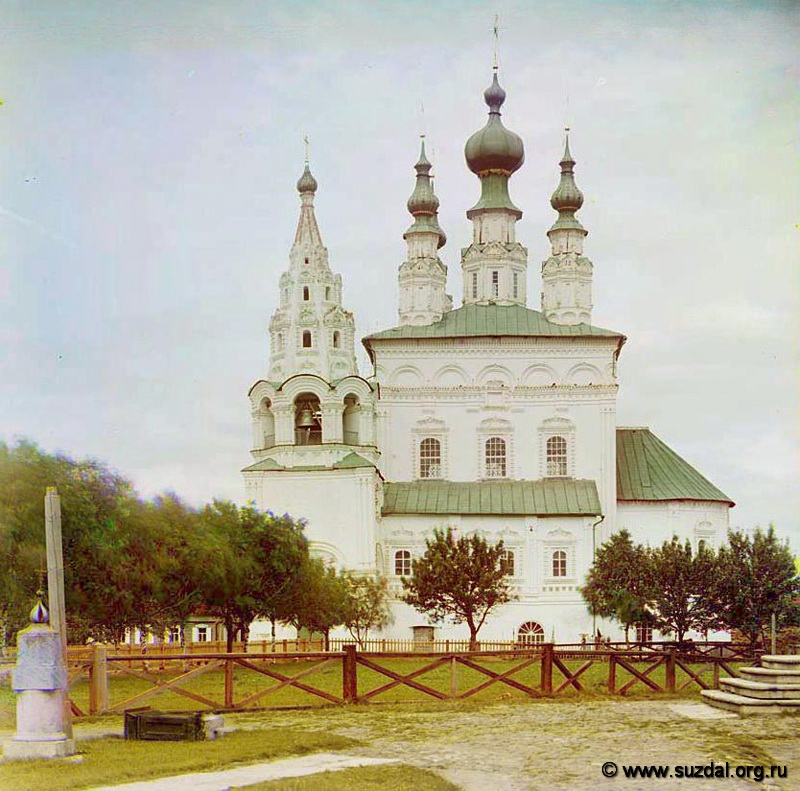
At the beginning of the 19th century, on the territory of the monastery in honor of the victory over Napoleon, under the leadership of the mason Kuzmin, a 72-meter-high Preobodensky bell tower was erected. The last in the monastery territory was the Sretenskaya refectory church, made of red brick in the pseudo-Russian style (1882).
In 1923, the Rizopolozhensky monastery was closed, its 12 bells were sent for re-melting, and the guards of the political isolator located in the Savior Euthymius Monastery were housed in the monastery premises. A power station was set up at Rizopolozhensky Cathedral, and the Holy Gates were used as a fuel depot.
In 1999, the monastery was transferred to the Russian Orthodox Church and renewed as a convent of the Vladimir-Suzdal diocese .
Monastery architectural ensemble
Cathedral of the Robe Deposition
The three-headed Cathedral of the Robe Deposition of the Saints ( 1520 - 1560 ) is an example of a pillarless church with three apses adjacent to the altar. The church’s foursome is blocked by a baptized vault and, being devoid of internal support, is crowned with lightweight thin and high domes, which is unusual for similar structures of that time. The smooth walls of the temple are cut through with simple embrasures of windows, and the side facades are decorated with false curtains and divided into three parts by pilasters with portals in the central one. The porch , attached to the western part of the cathedral in 1688, has a rich decor , including a carved portal, as well as ornamental platbands decorated with “ melons ”, “plaits” and polychrome tiles . The heads of the cathedral underwent several transformations. The original helmet-shaped domes were replaced in the 19th century by onions , in 1929 the drums and the domes of the cathedral turned into a power station were completely demolished and only in the late 1960s during the restoration they were returned to their original form.
Holy Gate
The most interesting building of the monastery is the two-hipped Holy Gate erected in 1688. The gates with two different-sized arches are decorated with stone carvings and trowels with tiles. The larger travel arch has an almost semicircular shape, the smaller arch is trimmed with small rust . Crowned with small heads, the tents are set on low eights with small windows, the edges of the tents are trimmed with false dormer windows.
Reverend bell tower
The three-tiered Venerable bell tower appeared on the territory of the monastery on the site of a tent-shaped bell tower burnt at the end of the 18th century and was erected in honor of the victory in the Patriotic War of 1812 in 1813 - 1819 . The construction of the 72-meter building, which became the tallest city building, was led by Suzdal mason Kuzmin. The bell tower is made in the style of classicism and is typical of its time, although it does not fit into the overall architectural style of the city. The tiers of the bell tower, decreasing upwards, rely on a powerful classic portal with an arch and are crowned with a spire , and for its decoration, double columns with decorative pediments were used .
Sretensky refectory church
From Sretensky refectory church [4] , built in 1882 on the site of an older building, only red brick walls have survived to this day. The remains of the decor indicate its belonging to the pseudo-Russian style. In Soviet times, after the monastery was closed, the building was first used as a club, and later as a movie theater.
Holy Gates of the Former Trinity Monastery
In the fence of the Rizopolozhensky monastery, the Holy Gates of the former Trinity Monastery are preserved. They resemble the Holy Gates of the nearby Alexander Monastery , which is no coincidence: the construction of the latter was undertaken by I. Gryaznov, one of the authors of constructions of the late XVII century on the territory of the Rizopolozhensky and Trinity Monasteries.
Notes
- ↑ Rizopolozhensky monastery in Suzdal (Inaccessible link) . Date of treatment June 30, 2006. Archived November 29, 2012.
- ↑ Holy Rizpozhenensky monastery // lubovbezusl.ru.
- ↑ “Historical collection about the God-saved city of Suzdal” by Anania Fedorova (“The Temporary of the Moscow general history and antiquities grew.”, Vol. XXII)
- ↑ Photo of the beginning of the XX century . Date of treatment January 8, 2011. Archived November 29, 2012.
Literature
- Archaeological notes on the cities of Suzdal and Shuya. // Zap. Rus archaeol. islands by det. Russian-Slavic archeology. - T. I. - St. Petersburg, 1851;
- Varganov A.D. From the early history of Suzdal (IX — XIII centuries) . - Vol. 12. - M .: KSIIMK, 1946. - S. 127-134.
- Kislenskaya . The history of Suzdal and its antiquity. - St. Petersburg, 1848;
- Protopopov . Historical sketch of the city of Suzdal. // Vladimir lips. statements. - 1839. - No. 25–37;
- Pudalov B.M. Russian lands of the Middle Volga (the second third of the XIII - the first third of the XIV century).
- Tolstoy M.V. Travel notes from the ancient Suzdal region. - SPb., 1869.
Links
- Rizopolozhensky monastery on the site Suzdal360 . Date of treatment July 31, 2010. Archived November 29, 2012.
- Rizopolozhensky monastery on the site of the city of Suzdal . Date of treatment July 31, 2010. Archived November 29, 2012.