Song cicadas [1] [2] [3] , or real cicadas [1] [3] ( lat. Cicadidae ) , is a family of insects from the suborder of the cicadus order of the half - winged .
| Song Cicadas | |||||||||||||||||||||||||||||||||||||||||
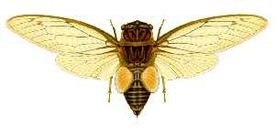 Arunta perulata | |||||||||||||||||||||||||||||||||||||||||
| Scientific classification | |||||||||||||||||||||||||||||||||||||||||
|---|---|---|---|---|---|---|---|---|---|---|---|---|---|---|---|---|---|---|---|---|---|---|---|---|---|---|---|---|---|---|---|---|---|---|---|---|---|---|---|---|---|
| |||||||||||||||||||||||||||||||||||||||||
| International scientific name | |||||||||||||||||||||||||||||||||||||||||
Cicadidae Westwood , 1840 | |||||||||||||||||||||||||||||||||||||||||
| Subfamilies | |||||||||||||||||||||||||||||||||||||||||
| |||||||||||||||||||||||||||||||||||||||||
Description

Insects of medium and large size (in temperate countries, body lengths are from 23 to 55 mm) [4] .
Head
The head is short, the eyes are very prominent; on a crown 3 simple eyes forming a triangle; short bristle-like antennae composed of 7 segments; the oral parts consist of a three-membered proboscis .
Wings and Feet
Fore wings longer than hind ones, wings mostly transparent, sometimes brightly colored or black; the thighs of the middle pair of legs are short and wide; fore femur thickened, spiked below; drumsticks are cylindrical.
Abdomen
The abdomen is usually quite thick and ends in females with an ovipositor , in males with a copulation apparatus. Extremely characteristic is the presence in males of cicadas of a special vocal apparatus - the timbal organs . They are placed on the underside of the hind thorax, behind the hind legs, under two large semicircular scales; this apparatus consists of a median and two lateral cavities. At the bottom of the middle cavity there are two pairs of membranes, of which two front membranes are called folds (due to folds), and two rear membranes are called mirrors, since they are shiny and smooth. The lateral cavities have a side opening that leads to the surface of the body. A tympanic membrane is inserted in the inner wall of these cavities, to which a muscle is attached, causing the membrane to vibrate. Middle cavities serve as resonators . In females, the vocal apparatus is rudimentary, so they cannot sing.
Biology
Habitat
Cicadas are for the most part large insects found in all parts of the world, mainly in hot countries. They live on trees and shrubs , they fly quite well.
Chirping
Males chirp or sing mainly in the hottest time of the day, since heat is an important source of energy, which the cicada spends on singing. Recently, however, scientists have found more and more cicadas chirping in the shade or during twilight in order to protect themselves from predators. Among them, the cicadas of the genus Platypleura are the most adapted to this ecological shift. Most Platypleura species warm themselves by compressing the muscles intended for flight. The singing of male cicadas serves to attract females.
Cicadas use a special sound membrane driven by muscle oscillation. The resulting metallic sound resonates in special cavities inside the body, reaching a high volume. South American cicada is capable of making a sound similar to the whistle of a steam locomotive. Females of many types of cicadas do not scream, but this is not true for everyone [5] .
Nutrition
With the help of the proboscis (and the female also the ovipositor ) cicadas injections into various trees and suck their juices. Often the sap of trees continues to flow out after injections of cicadas and, hardening in the air, forms the so-called manna, which is a nutrient .
Life Cycle
Cicadas lay eggs under the bark or peel of plants. Larvae are distinguished by a thick clumsy body, smooth and firm cuticle, and thick legs with single-jointed legs; forelegs with wide hips and legs, covered with spikes (type of digging limbs). Young larvae first suck plant stems , and at later stages of development they lead an underground lifestyle and suck plant roots . Larvae live for several years (sometimes up to 17 years), although for most species the larval life is unknown. After numerous molts , the larvae develop the rudiments of the wings ; the last molt is usually done on trees .
Systematics
3 subfamilies. The previously distinguished family of Tibicinidae (type genus Tibicina Amyot, 1847 ), is now considered (Molds, 2005) as part of the family Cicadidae, and the subfamily Tibiceninae Van Duzee, 1916 (type genus Tibicen Latreille, 1825 ) is synonymous with the tribe Cryptotympanini. The confusion in taxonomy arose because both genera were based on the same type species ( Cicada haematodes Scopoli ), which led to the synonymization and disbandment of the tribes and subfamilies based on them [6] [7] .
In 2018, the subfamilies and tribes were revised, including the allocation of 10 new tribes and the restoration of the Tettigomyiinae subfamily [8] .
- Cicadidae Latreille, 1802 [8]
- Cicadettinae Buckton, 1889
- Tribes: Carinetini Distant, Chlorocystini Distant, Cicadettini Buckton, Dazini Kato, Hemidictyini Distant, Huechysini Distant, Lamotialnini Boulard, Parnisini Distant, Prasiini Matsumura, Taphurini Distant.
- Cicadinae Latreille, 1802
- Tribes: Burbungini Molds, Cicadini Latreille, Cryptotympanini Handlirsch (= Tacuini Distant), Cyclochilini Distant, Distantadini Orian, Dundubiini Atkinson, Fidicinini Distant (= Hyantiini Distant), Gaeanini Distant, Hamzini Distantini, Jassribini , Jogribalti Oncotympanini Ishihara, Platypleurini Schmidt, Plautillini Distant, Polyneurini Amyot & Serville, Psithyristriini Distant, Sinosenini Boulard, Talaingini Distant, Tamasini Molds, Thophini Distant, Zammarini Distant.
- Tettigomyiinae Distant, 1905 (n. Stat., 2018) [8]
- Tribes: Lacetasini Molds & Marshall, 2018, Malagasiini Molds & Marshall, 2018, Tettigomyiini Distant, 1905, Ydiellini Boulard, 1973.
- Tibicininae Distant, 1905
- Tribes: Chilecicadini Sanborn, 2014, Platypediini Kato, 1932, Selymbriini Molds & Marshall, 2018, Tettigadini Distant, 1905, Tibicinini Distant, 1905.
- Cicadettinae Buckton, 1889
Some Views
Up to 2500 species of cicadas are known.
Cicada is the central genus of the family, characterized by large eyes and a wide head ; pronotum usually narrower than head ; front wings partly leathery and transparent, partly parchment-like at the root; tarsi for the most part are three-membered, less often two-membered; This genus includes numerous and large species that live mainly in the tropics . In Europe, there are 18 species.
Childbirth
Almost all genera of the superfamily Cicadoidea , except for one modern ( Tettigarcta ), belong to the family Cicadidae : [6]
- Abagazara
- Abricta
- Abroma
- Adeniana
- Ahomana
- Akamba
- Amphipsalta
- Arcystasia
- Arfaka
- Auta
- Babras
- Baeturia
- Bavea
- Beameria
- Bijaurana
- Birrima
- Borencona
- Burbunga
- Buyisa
- Cacama
- Calopsaltria
- Calalyria
- Carineta
- Chinaria
- Chlorocysta
- Chonosia
- Cicadetta
- Clidophleps
- Coata
- Conibosa
- Cornuplura
- Crassisternata
- Cyclochila
- Cystopsaltria
- Cystosoma
- Daza
- Decebalus
- Derotettix
- Diceroprocta
- Diemeniana
- Dinarobia
- Dorachosa
- Dulderana
- Durangona
- Elachysoma
- Euryphara
- Fractuosella
- Froggattoides
- Gazuma
- Graptotettix
- Guaranisaria
- Gudanga
- Gymnotympana
- Hemidictya
- Henicotettix
- Herrera
- Higherurashi
- Hilaphura
- Hovana
- Huechys
- Hylora
- Imbabura
- Inyamana
- Iruana
- Jacatra
- Jafuna
- Jassopsaltria
- Jiraiya
- Juanaria
- Kanakia
- Karenia
- Katoa
- Kikihia
- Klapperichicen
- Kobonga
- Koranna
- Kumanga
- Lacetas
- Lembeja
- Lemuriana
- Leptopsalta
- Ligymolpa
- Lisu
- Luangwana
- Lycurgus
- Magicicada
- Malagasia
- Malgachialna
- Malgotilia
- Maoricicada
- Mapondera
- Mardalana
- Masupha
- Mauricia
- Melampsalta
- Mendozana
- Miranha
- Monomatapa
- Mouia
- Muda
- Musimoia
- Musoda
- Nablistes
- Nelcynadana
- Neocicada
- Neomuda
- Neoplatypedia
- Nosola
- Notopsalta
- Novemcella
- Odopoea
- Okanagana
- Okanagodes
- Orapa
- Orellana
- Udeboschia
- Owra
- Pacarina
- Paectira
- Pagiphora
- Paharia
- Panka
- Paragudanga
- Paranistria
- Parnisa
- Parnkalla
- Parvittya
- Pauropsalta
- Pinheya
- Platypedia
- Platypleura
- Plautilia
- Pomponia
- Prasia
- Procollina
- Prosotettix
- Prunasis
- Psaltoda
- Psilotympana
- Quesada
- Quintilia
- Rhinopsalta
- Rhodopsalta
- Sapantanga
- Sataticula
- Scieroptera
- Selymbria
- Sinosena
- Spoerryana
- Stagina
- Stellenboschia
- Subpsaltr
- Tacua
- Taipinga
- Takapsalta
- Taphura
- Tanna
- Tettigades
- Tettigetta
- Tettigomyia
- Tettigotoma
- Thaumastopsaltria
- Tibicen
- Tibicina
- Tibicinoides
- Tozena
- Toxopeusella
- Trismarcha
- Ueana
- Uhleroides
- Ubunana
- Venustria
- Viettealna
- Xosopsaltria
- Xossarella
- Zammara
- Zammaralna
- Zouga
In Culture
There is a mention of cicadas in the oldest surviving monuments of Greek literature - in the " Iliad " of Homer (~ XI-IX centuries BC). The ancient Greeks greatly appreciated their singing, and, as you know, Anacreon wrote an ode in honor of the cicadas. The cicadas are actually mentioned in Aesop 's fable “The Grasshopper and the Ant” and Lafontaine ’s fable “The Cicada and the Ant” written on its motives, the free translation of which, in turn, is Krylov’s fable “The Dragonfly and the Ant.” According to ancient Greek mythology, the goddess Eos turned into her cicada her aged husband Titon , whom she had abducted as a young man, being captivated by his beauty [9] .
In the countries of the Far East and China, the cicada is considered a summer insect and hides in the ground for hibernation. Buddhist sages saw in this system a resemblance to how a human being is reborn through death, passing from one body to another. In the ancient Chinese tradition, there is a rite when a jade cicada is placed under the tongue of the deceased. This, according to legend, should help him find a worthy embodiment in a new life and allow him to talk in the afterlife. Until now, this tradition exists both in its original form and slightly changed when a cicada is placed on the body of a deceased. In Japan, cicadas were associated with summer and the transience of life; they were often depicted in engravings, and poets dedicated poems to these insects.
Cicada is one of the heroes of Victor Pelevin's novel Life of Insects .
Terry Goodkind’s book “Pillars of Creation” refers to cicadas in one of the prophecies that speaks of their 17 year life cycle.
300 jewels, presumably in the form of cicadas (called "golden bees"), were found in the grave of the first Frankish king, Childeric I (died in 482 CE).
The Chinese artist Qi Baishi (1864-1957) has a painting called Autumn Cicada on Lapin Flowers.
Folk and pop singer from the USA Linda Ronstadt glorifies the life of the cicada in the song “La Cigarra”, and alludes to their short life.
There is also the ballet of the French composer Jules Massenet "Cicada" (La Cigale).
There is also the animated series "When Cicadas Cry" , where in each series the actions are accompanied by a long song of cicadas.
Interesting fact: in many anime series, frames with cicadas are used.
In the Russian translation of The Last of Us, cicadas is a group that opposes the military and plays a major role in the game.
Coin from Ancient Greece: Athena's left, an owl on the right and a singing cicada on the lower left under the wing
Coin from Athens: designated cicada spot
Golden bees (cicadas) inlaid with pomegranate from the tomb of Childeric
See also
- Aphids
- Dragonfly and Ant (film, 1913)
- A place where cicadas dream
- Ash cicada
Notes
- ↑ 1 2 Striganova B. R. , Zakharov A. A. The Bilingual Dictionary of Animal Names: Insects (Latin-Russian-English-German-French) /Ed. Dr. biol. sciences, prof. B.R. Striganova . - M .: RUSSO, 2000 .-- S. 39. - 1060 copies. - ISBN 5-88721-162-8 .
- ↑ Key to insects of the European part of the USSR. Volume 1. Lower, ancient winged, with incomplete transformation / under total. ed. G. Ya. Bey-Bienko . - (In the series: Keys to the Fauna of the USSR, published by the Zoological Institute of the Academy of Sciences of the USSR . Issue 84). - M.-L .: Nauka, 1964 .-- S. 357. - 936 p.
- ↑ 1 2 Animal life. Volume 3. Arthropods: trilobites, chelicerae, tracheal breathing. Onychophors / ed. M.S. Gilyarova , F.N. Pravdina, Ch. ed. V. E. Sokolov . - 2nd ed. - M .: Education, 1984. - S. 215. - 463 p.
- ↑ Arnett, Ross H. Jr. American Insects: A Handbook of the Insects of America North of Mexico . - 2nd. - CRC Press, 2000. - P. 297. - ISBN 0-8493-0212-9 .
- ↑ Morozov V.P. Entertaining bioacoustics. Ed. 2nd, add., Rev. . - M .: Knowledge, 1987.- S. 38. - 208 p.
- ↑ 1 2 Molds, MS 2005. An appraisal of the higher classification of cicadas (Hemiptera: Cicadoidea) with special reference to the Australian fauna. Records of the Australian Museum, 57: 375–446.
- ↑ Cryan Jason R. 2005. Molecular phylogeny of Cicadomorpha (Insecta: Hemiptera: Cicadoidea, Cercopoidea, and Membracoidea): adding evidence to controversy. Systematic Entomology 30 (4), Oktober 2005, Seite 563-574.
- ↑ 1 2 3 David C. MARSHALL, Max MOULDS, Kathy BR HILL, Benjamin W. PRICE, Elizabeth J. WADE, Christopher L. OWEN, Geert GOEMANS, Kiran MARATHE, Vivek SARKAR, John R. COOLEY, Allen F. SANBORN, Krushnamegh KUNTE, Martin H. VILLET, Chris SIMON. 2018. A molecular phylogeny of the cicadas (Hemiptera: Cicadidae) with a review of tribe and subfamily classification . Zootaxa . Vol 4424, No 1: 1–64
- ↑ Typhon, spouse of Eos // Brockhaus and Efron Encyclopedic Dictionary : in 86 volumes (82 volumes and 4 additional). - SPb. , 1890-1907.
Literature
- Rimsky-Korsakov M.N. ,. Cicadas // Brockhaus and Efron Encyclopedic Dictionary : in 86 volumes (82 volumes and 4 additional). - SPb. , 1890-1907.
- Molds, MS 2005 : An appraisal of the higher classification of cicadas (Hemiptera: Cicadoidea) with special reference to the Australian fauna. Records of the Australian Museum, 57: 375—446.
- African cicadas warm up before singing , Science News, 28 Июня 2003: 408.