Glazov ( Udm. Glaz, Glazkar [4] ) is a city in the Udmurt Republic of Russia . The administrative center of the Glazov district , which is not included. Forms the municipality of the city of Glazov with the status of the urban district as the only settlement in its composition.
| City | |||||
| Eyes | |||||
|---|---|---|---|---|---|
| udm Eye, Glazkar | |||||
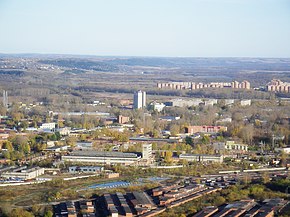 | |||||
| A country |  Russia Russia | ||||
| Subject of the federation | Udmurtia | ||||
| City District | city of Glazov | ||||
| Mayor | Bekmemetyev Oleg Nikolaevich | ||||
| History and geography | |||||
| First mention | 1678 | ||||
| City with | 1780 | ||||
| Square | 68.27 [1] km² | ||||
| Center height | 150 m | ||||
| Timezone | UTC + 4 | ||||
| Population | |||||
| Population | 6 93,628 [2] people ( 2017 ) | ||||
| Density | 1,356.93 p / km² | ||||
| Nationalities | Russians , Udmurts , Tatars | ||||
| Denominations | Orthodox , Muslim , Evangelical | ||||
| Katoykonim | glazovchaninin glazovanka, glazovane | ||||
| Official language | Udmurt , Russian | ||||
| Digital identifiers | |||||
| Telephone code | +7 34141 | ||||
| Postcode | 427620 - 427649 [3] | ||||
| OKATO code | 94420 | ||||
| OKTMO code | |||||
| glazov-gov.ru | |||||


Title
There are several versions of the origin of the name of the city [5] .
The geographical version arose due to the fact that the geographical features of the relief of the city resemble the shape of the eye, when viewed from a bird's-eye view or from Soldyrskaya mountain.
According to the toponymic legend , the name of the city gave Catherine II . The drawing plan of the future district city, presented to the empress, caused her association with the All-Seeing Eye (eye), therefore the city was named “Eyes”. Meanwhile, the future city was called the village of Glazov long before the Ekaterina’s administrative reform of 1780.
According to the version put forward by local historian M. I. Buney, the name of the city is the Russian translation of the Udmurt toponym Singurt - literally “eye-village”. Udmurts called the place where the spring beats out of the ground with the word “ blue eye” [6] .
The most plausible version raises the name of the city to the name (or surname) of its founder. According to A. G. Tatarintsev , the toponym "Singurt" was invented by local historians themselves, since it has not been documented anywhere. The name “Glazov” was never translated by Udmurts. It was first mentioned in the Russian census book for 1678 , and the census takers usually never translated the Udmurt village names, either writing down their Udmurt name, or a well-known Russian, or calling the village after the name of the founder. So, by the name of the founder, was recorded and Glazov. The truth is not known who exactly was the founder of the repair and what name formed the basis of his name - Russian, Udmurt or Tatar [7] .
In addition to the official name, the unofficial name “Northern capital of Udmurtia” also stuck to the city. This name Glazov received in memory of the fact that in 1921 he was the first capital of the Votsk Autonomous Region .
Physical-geographical characteristic
Geographical position
The city of Glazov is located in the Ural region in the north-west of Udmurtia, 180 km from Izhevsk , on the left bank of the Cheptsy river (a tributary of the Vyatka ). The length of Glazov from north to south is 4-5 km, from west to east - 10-12 km. The city covers an area of 6,916 hectares, its perimeter is 64 km.
Relief and soil
The relief of the city of Glazov is flat, cut by the valleys of the Cheptsy, Sygi and Malaya Sygi rivers . Absolute heights range from 135 to 235 m (Mount Soldier, part of the territory of the urban district). On the territory of the city and in its vicinity there are various soils: gray podzolic on the substrate alluvial sandy loams and heavy surface loam, young artificial, having a sandy substrate of alluvial material, podzolic hydromorphic on a loamy, sandy-sandy substrate, and peat-marsh soils.
Time Zone
The city of Glazov is located in the time zone designated internationally as the Samara Time Zone (SAMT) . The offset from UTC is +4: 00. Time in Glazov corresponds to geographic zone time .
Climate
The climate of the city is moderately continental with the determining influence of continental air masses of temperate latitudes. In summertime, very warm air masses come from the south and southeast, causing hot dry weather. The frost-free period is 112 days. Spring frosts stop at the end of May. The most severe frosts are observed in December-March. During the invasion of maritime air of temperate latitudes from the west, warming is observed, right up to thaws. The average maximum height of snow cover is 73 cm, the average depth of soil freezing is 56 cm. The average annual rainfall is 525-550 mm. Thunderstorms are observed from May to September (25-30 days with thunderstorms). The average value of air humidity is 74%. Winds of the west and south-west points dominate most of the year. The maximum frequency of 26% is on the south-west rumba, the minimum 5% is on the north. The average annual wind speed is 3-4 m / s, fluctuations by month are insignificant: from 2.6 to 5.1 m / s, with gusts of 15 m / s. Calmness is rare, with an average of 6-13 days a year.
| Climate Glazova | |||||||||||||
|---|---|---|---|---|---|---|---|---|---|---|---|---|---|
| Indicator | Jan. | Feb | March | Apr | May | June | July | Aug | Sen | Oct. | Nov. | Dec | Year |
| Absolute Maximum, ° C | 3.0 | 5.6 | 9.2 | 25.3 | 30.4 | 34.2 | 37,8 | 37.1 | 32.7 | 20.9 | 9.6 | 3.2 | 37,8 |
| Average maximum, ° C | −10 | −9 | −1 | 7 | sixteen | 21 | 24 | 20 | 14 | five | −4 | −9 | 6 |
| Average temperature, ° C | −13,5 | −12,1 | −5,4 | 3.7 | 11.6 | 17 | 18.7 | 15.6 | 9.8 | 2.5 | −5,6 | −10.3 | 2.7 |
| Average minimum, ° C | −16 | −16 | −10 | −2 | five | ten | 12 | ten | 6 | 0 | −8 | −14 | −2 |
| Absolute minimum, ° C | −46,3 | −39,5 | −33,2 | −24 | −8,8 | −2,5 | 2.3 | −0,2 | −7.3 | −24,2 | −35,3 | −46,8 | −46,8 |
| Rainfall rate, mm | 18.3 | 13.7 | 13.3 | 14.1 | 21.4 | 45.4 | 44.8 | 35.0 | 32.1 | 36.5 | 24.9 | 17.3 | 316.8 |
| Source: weather.msn.com | |||||||||||||
History
Background
Glazov’s chronology dates back to 1678 , when on the pages of the household census of Mikhail Petrovich Voeikov and clerk Fyodor Prokofiev in the Chepetsk share of the Karinsky camp of the Khlynovsky district , the “Glazov village beyond the river Chepetya ”, consisting of 11 U. The use of the term “village” rather than “ repairs ”, as well as a significant population, indicates that the settlement had existed for some time at the time of the census. He was not mentioned in the census of 1662, so he could appear in any year between these censuses. The fixes, judging by the census data, were founded by people from the neighboring village of Krasnaya Sludka [7] [9] .
After the wooden Ascension Church was built in 1747, the village became the village of Glazov.
District city as part of Vyatka province
In 1780, by decree of Catherine II, the village of Glazovo received the status and emblem of the city. The number of residents at that time was less than a thousand people. The newly formed city became the center of Glazov County [10] .
In 1793, a stone cathedral , called the Transfiguration, was built on the central square of the city. From 1796 to 1818, Pyotr Fyodorovich Tchaikovsky , the grandfather of composer PI Tchaikovsky , was the mayor of Glazov. When the mayor of Tchaikovsky Glazov acquired the town hall and the first hospital.
Since 1804, the construction of the city is carried out according to the plan of the architect from St. Petersburg Ivan Lem . A rare type of radial-arc layout of the city center has been preserved to this day. If you look at the central square from above, then in form it represents an eye , from which seven street-eyelashes diverge, which gives the name of the city a special symbolism.
In 1811, Ivan Seliverstovich Volkov, a merchant of the 2nd guild, was acting head of the city; his report states that the city’s society does not feel oppressed by the city authorities [ significance of fact? ] [11] .
On October 7, 1823, the city was visited by Emperor Alexander I , who traveled extensively in the last years of his life. He stayed at the Lyapunov house and presented the hostess with an expensive ring.
In 1826, participants in the Decembrist uprising were transported to Siberia through the eyes. In 1837, the future emperor Alexander II stayed on his way to the Urals in Glazov. The Russian poet Vasily Andreevich Zhukovsky accompanied him on this trip. In honor of this event, a Alexander Nevsky chapel was built in the city (it has now been restored to original sketches).
By 1856, Glazov became the main shopping center of the county. Bread, flax, leather, hemp, lard were exported abroad through the port of Arkhangelsk . In the second half of the 19th century, along with many other cities of the Russian Empire distant from the capitals, Glazov is the place of exile for members of various political and social movements. In 1879, V. G. Korolenko was exiled here, later describing Glazov in the essay “The Unreal City” (1880).
In 1876, a women's gymnasium opened in the city, becoming a full-fledged secondary school at the beginning of the 20th century. Soon a male gymnasium appeared in the city.
Since 1877, the construction of the Transfiguration Cathedral begins on the Cathedral Square. On September 24, 1879, the unfinished cathedral collapsed [12] . An emergency commission from Vyatka revealed errors in the calculations of the builders. After 8 years, according to the corrected drawings, everything was restored with special care, taking into account the strength and beauty of the brickwork. On June 15, 1887, the reborn temple was consecrated. Since 1889, the city occupied the Glazovskoe Vicariate of the Vyatka diocese .
In 1898, the Trans-Siberian Railway passed through the territory of Glazovsky district. Until 1917, in a small provincial town, single-storey and two-storeyed log buildings and few brick buildings prevailed.
The city of Glazov at the turn of the XIX and XX centuries | ||||||||||
Revolution and Civil War
In the First World War, march companies and battalions for the active army were formed in Glazov; there were two hospitals for the wounded. The city was filled with revolutionary-minded soldiers. The Bolshevik Council of Workers', Soldiers' and Peasants' Deputies actually became political power in the city and district even before the armed uprising in Petrograd [13] . Having received a message about the overthrow of the Provisional Government, the executive committee of the Council officially declared its sole power.
In the summer of 1918, major anti-Bolshevik uprisings swept through Svyatogorsk, Bykovskaya, Afanasyevskaya and some other volosts of Glazovsky district. They were brutally suppressed by the Red Army units stationed in Glazov [14] .
In May-June 1919, the Eastern Front of the Civil War passed through the city. Due to the difficult situation for the Red Army, Stalin and Dzerzhinsky came to Glazov. On June 2, 1919, the city was occupied by Kolchak's Siberian army (group of General Pepeliaev ), but already on June 13 it was again taken under control by the 3rd Red Army. In both cases, the fighting in the city was not.
Soviet years
From January to June 1921, Glazov was the capital of the Votsk Autonomous Region . By 1923, the city’s population reached 4,397 inhabitants.
In the mid-1930s of the 20th century , the first master plan of the Soviet Glazov was developed [15] . The architect of the project, Emmanuel Mekler, retained the “rays” of I. Lem, while simultaneously planning the development of the main development to the west. In the late 1930s, construction of a flax factory began.
By June 1941, 16,906 people lived in Glazov. At the beginning of World War II , enterprises and institutions from the western regions of the country were evacuated to the city. These were mainly defense factories with equipment and people. The tobacco factory and the 2nd Leningrad Infantry School , as well as the cartridge factory No. 544, built on the territory of a flax mill and equipped with equipment for the evacuated from Podolsk and Kuntsev cartridge factories worked for the needs of the front .
In the postwar years , the construction of the factory No. 12 understudy began in the city. On the basis of the ammunition plant number 544, the Prikamsky office of Glavgorstroy of the PGU was set up - an enterprise for the production of uranium (the future Chepetsk Mechanical Plant ). To the west of Glazov, construction began on the working village of the plant. In the first years of construction, the village was built up with wooden and filling two-story houses, as well as Finnish houses. In 1947, in the area of Parkovaya and Shkolnaya streets, the first brick residential apartment buildings were built. Since 1948, the working village began to be built up according to a new general plan with typical brick two and three storey houses. In addition to residential buildings, in the first years of the construction of a new factory village, kindergartens, a hospital campus, a school, a canteen, a cinema, a house of culture, etc. were built. For the construction of a new production and settlement, all the available building forces were involved, including German prisoners of war and prisoners. New energy services were designed and urgently put into operation, electrification and heating of the city were carried out.
Since the late 1950s, the construction of the so-called " Khrushchev " began in the city. The workers' settlement of the plant began to be actively built eastwards - in the direction of the old, pre-war buildings of Glazov.
Within two years (1960-1962), the Transfiguration Cathedral was destroyed on Svoboda Square, despite the fact that in 1945 the cathedral was recognized as a monument of architecture of the UASSR . The formal basis for the demolition of the temple was the approved project of a new reinforced concrete bridge across the Cheptsa River, the access route to which is in place of the demolished cathedral [12] . In 1962, the last church of the city was demolished - St. George's Church.
In 1965, the first nine-story houses in Udmurtia were commissioned on Lenin Street.
In the late 1960s, a new master plan for the city was developed. In the coming decades, the development of the city was planned in the south-west and north-east, on the site of the old wooden buildings. The first phase of construction involved the construction of a large residential area to the south of the railway. Twenty thousand people were to live in a southwestern residential area, a pond was planned on the Syga River. The northeastern residential area was planned to be built secondarily because of the high cost of construction, the need for alluvium and the demolition of the old wooden buildings. In 1970, due to the discovery of sand pits near the city, it was decided to postpone the construction of a northeast residential area to the first phase of construction. In the 70s microdistricts “B”, “I”, “K” and “L” were built.
In the early 1980s , construction began on a large residential area, Left Bank-1, northeast of the historical part of the city. Especially for the area in various Moscow design institutes residential and public buildings were designed.
In the late 1980s, construction began on a large instrument-making plant belonging to the All-Russia Scientific-Research Institute of Technical Physics and Automation.
In 1987, celebrations were held in Glazov on the occasion of the birth of a 100-thousandth resident [16] .
Starting from the 90s in Glazov they planned to start building three large residential districts at once. In the north-east direction was planned Left Bank-2. In the southern direction they planned to build up almost the entire territory of private building. In the western direction, the Khimmash plant developed a project for a residential area on the site of the village of Vaebizh.
Modernity
Before the reforms in the 1990s, the quality of life of the population in Glazov was significantly higher than the nationwide level [17] . In the current political and economic situation, the highly urbanized Glazov, closely connected with the military-industrial complex, found itself in a difficult position. The decline in production caused by a drop in demand for products caused an outflow of qualified personnel. Since the beginning of the 1990s, as a result of the economic crisis, the volume of industrial products produced by enterprises of the city has drastically decreased [18] . Some enterprises, unable to withstand market competition, have ceased or suspended their activities. The instrument-making plant was never completed. Housing construction practically was not conducted.
Since 2000, the economic situation has been improving, some enterprises have been increasing production, and the construction of residential buildings has resumed.
In 2007, the city lost the status of the one hundred thousandth [16] .
In the first decade of the 21st century, large-scale works were carried out on the improvement of the Freedom Square and the reconstruction of the historical ensemble of buildings. A new Transfiguration Cathedral was built on the site of the Ascension Church.
Population
| Population | ||||||||||
|---|---|---|---|---|---|---|---|---|---|---|
| 1782 [19] | 1856 [20] | 1858 [19] | 1897 [20] | 1904 [19] | 1913 [19] | 1926 [20] | 1931 [20] | 1939 [20] | 1959 [21] | 1967 [20] |
| 257 | ↗ 2200 | ↗ 2204 | ↗ 3500 | ↗ 3997 | ↗ 5855 | ↗ 6600 | ↗ 8600 | ↗ 16,500 | ↗ 59,012 | ↗ 65,000 |
| 1970 [22] | 1973 [20] | 1975 [23] | 1976 [24] | 1979 [25] | 1982 [26] | 1985 [27] | 1986 [24] | 1987 [28] | 1989 [29] | 1990 [30] |
| ↗ 68 348 | ↗ 73,000 | ↗ 77,000 | → 77 000 | 144 81,144 | ↗ 87,000 | ↗ 96,000 | → 96 000 | ↗ 98,000 | ↗ 104,072 | ↗ 105,000 |
| 1991 [24] | 1992 [27] | 1993 [24] | 1994 [24] | 1995 [27] | 1996 [27] | 1997 [31] | 1998 [27] | 1999 [32] | 2000 [33] | 2001 [27] |
| ↗ 106,000 | ↗ 107,000 | → 107 000 | → 107 000 | → 107 000 | → 107 000 | ↘ 106,000 | → 106 000 | → 106 000 | ↗ 106,300 | ↗ 106,800 |
| 2002 [34] | 2003 [20] | 2004 [35] | 2005 [36] | 2006 [37] | 2007 [20] | 2008 [20] | 2009 [38] | 2010 [39] | 2011 [20] | 2012 [40] |
| ↘ 100,894 | 900 100,900 | ↗ 101,000 | 800 100 800 | 400 100,400 | ↘ 99,600 | ↘ 98,200 | ↘ 97,070 | ↘ 95,854 | ↗ 95,900 | ↘ 95,553 |
| 2013 [41] | 2014 [42] | 2015 [43] | 2016 [44] | 2017 [2] | ||||||
| 117 95,117 | ↘ 94,909 | ↘ 94,610 | ↘ 93,995 | ↘ 93,628 | ||||||

As of January 1, 2018, in terms of population, the city was located at 186 out of 1113 [45] cities of the Russian Federation [46] .
Administrative Device
The structure of local governments of the city (municipality of the city of Glazov ) are: [47]
- The City Council is a representative body of the municipality;
- The head of the municipality;
- Administration of the municipality - local administration (executive and administrative body of the municipality);
- Control and accounting body of the municipality.
- Heads of the city
- Vladimir Y. Pereshein (2005–2010) [48]
- Alexander Viktorovich Vershinin (2010–2015) [49]
- Oleg Nikolaevich Bekmemetyev (2015–2018) [50]
- Sergey Nikolaevich Konovalov (elected December 29, 2018) [51]
Symbols
Infrastructure and transportation
Residential Construction
Throughout the history of Glazov, a gradual development of the urban area can be traced in accordance with the approved urban planning documents, which positively affected the formation of a clear planning structure of the city with the allocation of residential and industrial areas, social and business and recreational areas.
The basis of the planning structure of Glazov is formed by mutually perpendicular streets, saturated with social and business objects of various purposes: Kirov Street, passing in the latitudinal direction and connecting the main districts and the public center of the city; Korolenko street, passing in the meridional direction. The territory of the city center has a radial-ring layout laid down in the first general plan of the city, developed by the architect Lem . Here are the main part of the historical and cultural monuments, squares, boulevards, administrative, cultural, social and business buildings and structures.
The main housing stock of the city is concentrated in the territorial-planning formations - residential areas. The total area occupied by residential areas is 681 hectares, of which 469 hectares are occupied by multi-storey and medium-storey apartment buildings, 212 hectares by individual residential houses with land plots.
Formation of areas of mass housing construction occurred in parallel with the placement of large industrial facilities. The main areas of mass housing construction are residential areas of Central, Western, Southern, Left Bank and Syga.
Since the mid-1990s, there has been a significant change in the structure of new housing construction. So, along with multi-storey residential buildings of improved planning, individual housing construction received significant development, which led to a noticeable increase in the territories occupied by low-rise residential buildings.
In 2008, a new General Plan of the city of Glazov was adopted [18] .
According to Udmurtstat, the housing stock of Glazov as of January 1, 2006 was 1,820.1 thousand m² - an average of 18.1 m² per inhabitant, which is less than the national figure of about 20 square meters. The Foundation is represented by high-rise (44%) and individual residential buildings (56%). Virtually all apartment buildings are equipped with plumbing, sewage, central heating, electricity. Individual housing stock is also equipped with the main types of engineering infrastructure. The area of dilapidated and emergency buildings is 31 thousand m², or 1.7% of the housing stock.
The largest (according to planned volumes) areas of new housing construction are:
• Northeast residential area - Left Bank-2;
• Southern;
• Syga residential area.
Engineering Infrastructure
Glazov possesses a developed engineering infrastructure, which was formed during the period of active growth of the industrial potential and residential areas of the city (1950—1994). At this time, centralized water supply and drainage systems, heat, gas and electricity, telephone communications were formed.
In Glazov there is a separate centralized sewage system . Wastewater from residential and public buildings, as well as industrial enterprises, after local treatment, enter the municipal sewage system and are transported to a central pumping station and further to biological treatment plants located on the industrial site on the north-western outskirts of the city.
The main source of power supply of Glazov for household consumers is the power system of Udmurtenergo branch of IDGC of Center and Volga Region, PJSC. The city has a 220/110/35 kV “Zvezdnaya” base substation, which is powered by the 220 kV “ Balezino -Zvezdnaya” and “Zvezdnaya - Falyonki ” overhead lines.The city-wide substations include: Sibirskaya, Glazov, Broilernaya and Yuzhnaya. The distribution of electricity by urban consumers is carried out mainly at a voltage of 6 kV and only from the substation Broilernaya at a voltage of 10 kV.
The main sources of centralized heat supply in the city are CHPPs of JSC United Thermal Power Company (Moscow) and boiler house No. 2 of the MUE Glazovskiye Heating Network. The main types of fuel are natural gas , coal , fuel oil . The networks are made in a two-pipe version, the consumer heating system is dependent, with an open hot tap.
Газоснабжение города осуществляется природным и сжиженным газом.
Rail Transport
Станция «Глазов» находится на перегоне Киров - Пермь Горьковской железной дороги , являющимся частью северного маршрута Транссибирской железнодорожной магистрали . В городе существует вокзал.
Автомобильный транспорт
Глазов является конечным пунктом дороги регионального значения Р321 « Ижевск — Игра — Глазов». Город связан автодорогами с районными центрами Удмуртской Республики: Яр , Балезино , Юкаменское , Красногорское ; а также с другими административными центрами: Люм , Понино , Карсовай , Чажай. В городе функционирует автовокзал. В 2023—2029 годах Министерством транспорта России планировалось построить скоростной международный автодорожный маршрут «Северная хорда», проходящий через Глазов [52] , однако в изменённом проекте от 2013 года эта информация отсутствует [53] .
Городской общественный транспорт
В городе действуют 15 автобусных маршрутов: [54]
- № 1 p. Nikolsk - zd "Khimmash"
- No. 2 Ring
- No. 2B Ring (in the opposite direction)
- Number 3 st. Kalinin - st. Glinka
- No. 3A Kalinin - st. Glinka
- № 4 st. Kalinina - Electricity
- No. 5, Kalinina - Syga Village - Glazovskaya Poultry Farm
- No. 6, Kalinina - Western Passage of the ChMZ
- No. 7, Kalinina - Krasnogorsk tract
- № 8 pl. Svoboda - the village of Stanigurth
- № 9 st. Kolkhoznaya - Western Passage of the ChMZ
- No. 10, Kalinina - Glazovskaya Poultry Farm
- № 11 Poultry Farm "Glazovskaya" - Western entrance to the CMP
- No. 12 md Left Bank - Western Passage of the ChMZ
- № 15 Western settlement - mkr. Left bank
Closed Routes:
- No. 11, Kalinin - st. Mira (closed in 2011)
- No. 13A Kalinina - Western Passage of the ChMZ (closed in 2011 due to low profitability)
- No. 13B, Kalinina - Western Passage of the ChMZ (closed in 2011 due to low profitability)
- No. 14, Kalinina - Water station (closed in 2011 due to low profitability)
- No. 15, Pehtina - West Passage of the ChMZ (closed in 2011)
- No. 30, Kalinina - UMiAT (the period of work of the route is 2000–2004 due to the lack of service buses at the enterprise SPO CHUS)
- No. 40 of the Electric Grid - UMiAT (similar to route No. 30)
- No. 61 st. Pehtina - West Passage of the ChMZ (closed in 2011)
- No. 70 Poultry Farm - Western Passage of the ChMZ (closed in 2011, changed and supplemented in line in 2012 to the existing route No. 11)
Economy
The city of Glazov is a developed industrial center of the Udmurt Republic, which is the second largest region in terms of industrial production [17] . The historically developed specialization of the city’s economy is the city of the nuclear industry (the town-forming enterprise is Chepetsky Mechanical Plant JSC ). Glazov has a diversified economy that unites high-tech enterprises of the nuclear industry, mechanical engineering, building materials, forestry and woodworking, light industry, and the food and beverage industry.
On the territory of the city of Glazov, further development of the machine-building complex and wood processing is assumed [18] .
TOR "Glazov"
The RF Government Resolution No. 125 of February 12, 2019 approved the status of the territory of advanced socio-economic development [55] .
Industry
In the rating of the “250 largest industrial centers of Russia”, Glazov ranks 215th (2013) [56] .
In 2011, the volume of goods shipped from manufacturing industries (by large and medium-sized organizations) amounted to 19.3 billion rubles. In 2013 - 21.4 billion rubles.
Geographically, most of the enterprises of the city are concentrated in two industrial zones: the North-West industrial region and the Southern industrial region. Among the main industrial enterprises of Glazov are:
- Chepetsky Mechanical Plant OJSC is an enterprise in the nuclear fuel production chain of TVEL Corporation of Rosatom State Corporation for processing uranium raw materials into uranium tetrafluoride , as well as the production of zirconium and its alloys, calcium , rare-earth metals , niobium, and other related products. The production of superconducting materials for the world's first thermonuclear reactor has been created as part of the international program ITER [57]
- OJSC "Glazov plant" Metalist ""
- OSPAO "Chepetsky construction management" (in the stage of bankruptcy)
- LLC "Glazov plant" Himmash ""
- JSC "Glazov furniture factory"
- OJSC Garment Factory "Working Brand"
- OJSC Glazovsky DistilleryThe ancient building Glazovskogo Distillery
- Udmurt Construction Materials Plant OJSC (At the stage of bankruptcy)
- LLC "Management of road transport"
- Oskon OJSC (liquidated)
- LLC "Glazov Woodworking Plant"
- CJSC Avtoremmash-Service (“ARMS”)
- OJSC "Remmash"
- Ceramics OJSC (liquidated)
- MTS Glazovagrohimiya OJSC (liquidated)
- Glazovskaya Printing House LLC
- LLC "Experimental Experimental Plant" Teploagregat ""
- Garant-G LLC - antenna service, telemasters.
Manufacturing enterprises
- LLC Glazovsky "Bakery number 1"
- LLC "Udmurt Poultry Holding"
- LLC "Udmurt Poultry Farm"
- JSC "Glazov-Milk"
- Glazovsky Bakery OJSC (until 2013, now closed)
- OJSC “Glazov Food Processing Plant” (since 2008, Glazov branch of LLC Mostrestkonditer.)
- LLC “Glazov feed mill”
- LLC Glazovskiy timber processing plant
Trade and services
Trade networks are represented in Glazov: federal ( Magnit , Pyaterochka), regional (Izhtreyding) and local. There is significant pressure from large networks on local entrepreneurs, some of which do not stand up to competition [58] .
Chepetsk industrial production zone
In Glazov, it is planned to organize the “Chepetskaya industrial-production zone” advanced development zone [18] . The organization of this zone is assumed on the basis of the existing enterprises of the city and production areas.
Within the framework of this concept, an innovative industrial technopark “Glazovsky” will be created [17] . The technopark's core will be represented by small innovative enterprises created on the basis of ChMZ OJSC . These enterprises will implement high technologies using rare-earth metals. The second promising direction in the technology park is the creation of a cluster of information and communication technologies. The third promising direction is the creation of a forest-agro-industrial cluster through the cooperation of small innovative enterprises of the city of Glazov and 6 northern districts of the Udmurt Republic.
Attractions
- Historical and Cultural Museum-Reserve " Idnakar ".
- The ancient settlement of the 9th - 13th centuries is located four kilometers from the city of Glazov on a high cape (Soldier mountain), formed by the confluence of the rivers Cheptsa and Pyzep . The materials of the patrol book of 1615 contain an entry about the pogost “at the ancient settlement of Soldarsky above the river above Cheptsoy”, where there were 8 yards.
- At the end of the 17th and the beginning of the 18th centuries, the village on the former city site ceased to exist, but the name Idnakar was preserved as the unofficial modern village Soldyr located 1.5 km from the site of ancient settlement.
- The historic center of the city, built in a rare fan radial-arc layout.
- Glazov Museum of Local Lore (building of the former female gymnasium).
- The houses of the merchants Smagin-Timofeev, Zavalishin, Volkov (the future emperor Alexander II who visited Glazov in 1837 stayed in it), Kolotova, Stolbov, Veselukhin.
Culture
In Glazov, a great experience has been gained in the interaction of all major national cultures: the holding of monthly cultures, competitions of national cuisines, the House of Friendship of Peoples works.
The city takes an active part in the activities of Russian organizations representing the interests of local self-government as a special level of government. Since 1997, Glazov has been represented in the Association of municipalities "Cities of the Urals", which includes 28 Ural cities. In the same year, he joined the Union of Russian Cities, which unites more than 90 cities of Russia, and taking into account the associated members of more than 250 municipalities. In 1999, Glazov joined the Union of historical cities and regions in order to revive and develop the history of the city and preserve the historical, cultural and natural heritage. In 2001, Glazov became a member of the Association of Small and Medium Cities of Russia, which unites municipalities of the Russian Federation with a population of no more than 200 thousand people, through which he later becomes a member of the Congress of municipalities of the Russian Federation.
Operates Glazovsky municipal theater "Paraphrase" .
Cultural Events
| Title | Description | Day of | A place | Years of |
|---|---|---|---|---|
| Day of the city | Festive events, mass celebrations. | First Saturday after the first Monday of June | Freedom Square, LDS Progress | 1922-2017 |
| Festival "Theatrical palms" | All-Russian festival-seminar of theaters, where children, teenagers and young people play. | May | 1996-2007 | |
| Motor Racing on Ice (Speedway) | Conducted in the framework of the All-Russian Championships. | January March | Progress Stadium | 2012 |
| Glazov Street Fest | Regional festival of youth street culture. | Last Saturday of July or August | Gorky Park, the sports complex "Progress" | 2008-2011 |
| Rock festival "We are together" | Open inter-regional rock festival. | Last sunday may | Youth club "Rodnik" | 1999-2010 |
| Bike-rock rally "Garage" | July | Outdoor, Shooting Range | 2006-2013 |
Education
The urban community is characterized by a high scientific and educational level; has its own higher school, represented by the following universities:
- Glazov State Pedagogical Institute named after V. G. Korolenko
- Glazovsky Engineering and Economic Institute (branch) GOU VPO IzhSTU
- Glazov branch of the Institute of Law, Social Management and Security of Udmurt State University
- Glazov branch of the University of the Russian Academy of Education ( URAO )
In the system of secondary and primary vocational education of the city of Glazov, there are eight educational institutions; among them are the Glazov Technical College, a medical school, a technical school, and three vocational schools. There are 18 general education schools, three gymnasiums (including linguistic), a physics and mathematics lyceum [59] , an art and music school, and the Lyceum of Arts.
Youth Self-Government Day in Local Government
On the last Friday of June, the entire city government passes into the hands of students and young teachers of urban universities. Representatives of the pedagogical institute are engaged in social areas, the rest are students of the engineering and economic institute. Preceding the transfer of power internship participants up to a month.
- Years: 2003—2013
Sports
Hockey
- The Progress Hockey Club ( 1954 - 1956 - Tractor, 1957 - 1961 - Torpedo, since 1962 - Progress) was founded in 1954 .
- Hockey club "Progress-2" - founded in 2009 . (disbanded in 2010 )
Figure Skating
- Elizaveta Tuktamysheva - Russian figure skater . World Champion 2015, champion of the I Winter Youth Olympic Games (2012). Honored Master of Sports of Russia. Born in Glazov, she started figure skating right here.
Futsal
- Mini-football club " Progress ". He played in the Higher League , the second division in the structure of Russian mini-football. In 2013, he won first place in the standings, lost to TYUMEN-2 in the finals, but by the decision of AMFR, Progress was transferred to the best mini-football league in the country. Winner of the AMFR Cup 2008/2009 season. Since May 2018 does not exist.
Mass Media
News agencies
- IA "Eyes. RU"
Radio
| Title | Frequency, MHz |
|---|---|
| Radio Russia | 70.94 |
| The sound of the TV channel " Russia 1 " | 91.75 |
| Comedy radio | 94.9 |
| Radio Mayak | 95.30 |
| Road Radio | 96.90 |
| DFM | 97.70 |
| Nrj | 98.10 |
| Love radio | 99.00 |
| Humor fm | 98.50 |
| Russian radio | 99.90 |
| Autoradio | 100.30 |
| Our radio | 100.80 |
| Militia wave | 101.70 |
| My Udmurtia | 102.30 |
| Radio for two | 102.80 |
| Radio Maximum | 103.30 |
| Europa Plus | 103.70 |
| Retro FM | 105.00 |
| Radio Dacha | 105.40 |
| Radio record | 106.20 |
| Radio Chanson | 106.80 |
| New radio | 107.70 |
Wired radio of ChMZ OJSC can be heard in the buildings of the plant and its subsidiaries. Basically, the broadcast is broadcast on the radio "My Udmurtia" or "Lighthouse". Periodically come out their own programs, plant news, greetings, messages about evacuation and emergency situations.
Newspapers
- Municipal newspaper "Red Flag", the application "Kalina Krasnaya", newspaper ads "Red Price"
- Newspaper "My city of eyes"
- The newspaper "Market today" - the weekly free ads of the city and region
- The newspaper "The First Newspaper of the Week" -free newspaper
- The newspaper "Belova, 7" JSC "CMW"
- The newspaper "Good about different things"
- Newspaper "Avos-KA"
- Newspaper “Garant. TV "- a weekly free newspaper with a program guide, distributed by mail
- The newspaper "Central Market Glazov" - a weekly free newspaper, distributed in stores
- Newspaper "Novaya Gazeta Glazova"
Communication
Landline services
- Rostelecom"
- Radiolink LLC
Cellular communication
- MTS
- Beeline
- "Megaphone"
- "TELE2"
- "SkyLink"
- "YOTA"
Notes
- ↑ Database of municipalities
To display the information you need to fill the search fields. - ↑ 1 2 The population of the Russian Federation by municipalities as of January 1, 2017 (July 31, 2017). The date of circulation is July 31, 2017. Archived July 31, 2017.
- ↑ Postal codes of Russia
- ↑ The Glazkar form is artificial and is practically not used in live speech. Residents of rural areas call Glazov simply City : Udm. City, Kar "nest, city ", tat. Kala "city, fortress."
- ↑ Small cities of Russia - the city of Glazov
- ↑ How old is the city of Glazov and why is it so called? // "The Red Banner" dated February 17, 1998
- ↑ 1 2 Tatarintsev A. G. The First Vigilantes of the City of Glazov // Komsomolets Udmurtia. August 14, 1975 His own. Glazovtsam about Glazov // Red Banner. April 14, 1969.
- ↑ Documents on the history of Udmurtia XV-XVII centuries / Comp. P.N. Luppov . Izhevsk, 1958. P. 298.
- ↑ http://glazovschool3.narod.ru/10_10_10/tishkin/history_derevnya.htm
- ↑ Glazov, district town of Vyatka province // Brockhaus and Efron Encyclopedic Dictionary : 86 tons (82 tons and 4 extra). - SPb. , 1890-1907.
- ↑ Ligenko N.P. Essays on the history of Udmurtia of the XIX century. - Izhevsk: Udmurt Institute of History, Language and Literature of the Ural Branch of the Russian Academy of Sciences, 1996. - P. 54. - ISBN 5-7691-0563-1 .
- ↑ 1 2 Cochin, “The Fate of the Ascension-Transfiguration Cathedral of the City of Glazov”
- ↑ The October Revolution and the Civil War in Udmurtia
- Серге site of Sergey Zhilin
- ↑ Architecture Glazov
- ↑ 1 2 Red Banner: Growth with a minus sign
- ↑ 1 2 3 The development of innovative entrepreneurship on the example of the city of Glazov
- ↑ 1 2 3 4 On approval of the General Plan of the city of Glazov
- ↑ 1 2 3 4 Eyes. Documents and materials. 1678 - 1989 / edited by A.A. Tronin. - Izhevsk: Udmurtia, 1992. - 260 pp., Ill.
- ↑ 1 2 3 4 5 6 7 8 9 10 11 People's encyclopedia "My city". Eyes . The date of circulation is June 26, 2014. Archived June 26, 2014.
- All-Union census of 1959. The urban population of the RSFSR, its territorial units, urban settlements and urban areas by sex . Demoscope Weekly. The date of circulation is September 25, 2013. Archived April 28, 2013.
- ↑ 1970 All-Union Population Census The urban population of the RSFSR, its territorial units, urban settlements and urban areas by sex. Demoscope Weekly. The date of circulation is September 25, 2013. Archived April 28, 2013.
- Russian Statistical Yearbook, 1998
- ↑ 1 2 3 4 5 Russian Statistical Yearbook. 1994 . The date of circulation is May 18, 2016. Archived May 18, 2016.
- ↑ 1979 All-Union Population Census. The urban population of the RSFSR, its territorial units, urban settlements and urban areas by sex. Demoscope Weekly. The date of circulation is September 25, 2013. Archived April 28, 2013.
- ↑ National Economy of the USSR 1922-1982 (Anniversary Statistical Yearbook)
- ↑ 1 2 3 4 5 6 Russian Statistical Yearbook. Goskomstat, Moscow, 2001 . The appeal date is May 12, 2015. Archived May 12, 2015.
- ↑ USSR national economy for 70 years : anniversary statistical yearbook: [ arch. June 28, 2016 ] / USSR State Statistics Committee . - Moscow: Finance and Statistics, 1987. - 766 p.
- All-Union Population Census 1989. Urban population . Archived August 22, 2011.
- ↑ Russian Statistical Yearbook 2002: Stat.sb. / Goskomstat of Russia. - M.: Goskomstat of Russia, 2002. - 690 p. - In Russian. lang - ISBN 5-89476-123-9: 539.00.
- ↑ Russian statistical yearbook. 1997 . Circulation date May 22, 2016. Archived May 22, 2016.
- ↑ Russian statistical yearbook. 1999 . The appeal date is June 14, 2016. Archived June 14, 2016.
- ↑ Russian statistical yearbook. 2000 . The date of circulation is June 13, 2016. Archived June 13, 2016.
- ↑ All-Russian census of 2002. Tom. 1, table 4. The population of Russia, federal districts, constituent entities of the Russian Federation, districts, urban settlements, rural settlements — regional centers and rural settlements with a population of 3,000 or more . Archived on February 3, 2012.
- ↑ Russian statistical yearbook. 2004 . The date of circulation is June 9, 2016. Archived June 9, 2016.
- ↑ Russian Statistical Yearbook, 2005 . The date of circulation is May 9, 2016. Archived May 9, 2016.
- ↑ Russian Statistical Yearbook, 2006 . The date of circulation is May 10, 2016. Archived May 10, 2016.
- ↑ The resident population of the Russian Federation by cities, urban-type settlements and districts as of January 1, 2009 . The date of circulation is January 2, 2014. Archived January 2, 2014.
- ↑ Results of the 2010 All-Russian Population Census. 5. The population of Russia, federal districts, constituent entities of the Russian Federation, districts, urban settlements, rural settlements - district centers and rural settlements with a population of 3,000 or more . The appeal date is November 14, 2013. Archived November 14, 2013.
- Population of the Russian Federation by municipalities. Table 35. Estimated number of resident population on January 1, 2012 . The date of circulation is May 31, 2014. Archived May 31, 2014.
- ↑ Population of the Russian Federation by municipalities as of January 1, 2013. - M .: Federal State Statistics Service Rosstat, 2013. - 528 p. (Table 33. Population of urban districts, municipal districts, urban and rural settlements, urban settlements, rural settlements) . The appeal date is November 16, 2013. Archived November 16, 2013.
- ↑ Table 33. The population of the Russian Federation by municipalities as of January 1, 2014 . Circulation date August 2, 2014. Archived August 2, 2014.
- ↑ Population of the Russian Federation by municipalities as of January 1, 2015 . Circulation date August 6, 2015. Archived August 6, 2015.
- Population of the Russian Federation by municipalities as of January 1, 2016
- ↑ taking into account the cities of Crimea
- ↑ Population of the Russian Federation by municipalities as of January 1, 2018. Table “21. Population of cities and towns in federal districts and subjects of the Russian Federation as of January 1, 2018 ” (RAR-archive (1.0 Mb)). Federal State Statistics Service .
- ↑ Charter of the city
- ↑ Biography V. Yu. Peresheina
- ↑ Elected Mayor of Glazov
- ↑ Elected Mayor of Glazov
- ↑ Sergey Konovalov became the new head of Glazov
- ↑ International Road Route Northern Chord
- ↑ TRANSPORT STRATEGY OF THE RUSSIAN FEDERATION .
- ↑ Official portal MO city Glazov / Transport service of the population within the borders of MO "City Glazov" . glazov-gov.ru. The date of appeal is November 30, 2017.
- On the creation of the territory of advanced social and economic development "Glazov"
- ↑ Institute of Territorial Planning "Urbanika". Rating "250 largest industrial centers of Russia" (2013).
- ↑ Start new production
- ↑ Large retail chains came to Glazov
- Official website of the Physics and Mathematics Lyceum
Links
- Glazov Map
- Eyes in the directory directory Open Directory Project (dmoz)
- The official portal of the Municipal Formation "City of Eyes"