| Seminary | |
| Tashkent Teachers' Seminary | |
|---|---|
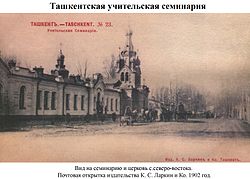 Tashkent Teachers' Seminary | |
| A country |  Uzbekistan Uzbekistan |
| City | Tashkent , Amir Temur Square |
| First mention | 1879 year |
| condition | Reorganized, demolished building |
Content
- 1 Tashkent Teachers' Seminary
- 1.1 Training
- 1.2 Location
- 2 House Church
- 3 Gallery
- 4 notes
- 5 Literature
- 6 References
Tashkent Teachers' Seminary
The Tashkent Teacher’s Seminary was opened in 1879 in Tashkent and was originally called the Teacher’s Seminary of Turkestan . The seminary trained teachers for schools, including Russian-native schools .
Basically, the children of Russian immigrants living in Turkestan studied here, the number of students from the local indigenous population of the region was insignificant: for example, in 1886 out of 61 students, only 9 were of local nationalities, in 1883-1904 out of 254 graduates of the seminary, only 39 were local nationality.
Since 1918, after the revolution , the preparation of teachers for Soviet Uzbek schools began here. In 1920, the Uzbek male institute of education was transformed into the Regional Uzbek Institute of Education .
Training
The seminaries studied: God's Law , pedagogy , Russian, arithmetic , algebra , geometry, physics , natural sciences, general history, geography , drawing, calligraphy, singing, music, needlework, gymnastics, Kazakh and Persian. Since 1884, at the initiative of V.P. Nalivkin , teaching of the Uzbek language was introduced instead of Kazakh. He was the first teacher of systematic courses of the Uzbek and Persian (essentially Tajik) languages, compiled anthology, dictionaries, grammar, and textbooks in these languages.
Location
Initially, the seminary was located in the house of Colonel Tartakovsky, rebuilt according to the project of A. L. Benois (1881–1887) [1] . In 1887, a new building was built near Konstantinovsky Square . [2]
House Church
In 1898, E.P. Dubrovin, according to a project by A.L. Benois, built a five-domed house church in the name of the Holy Prince Alexander Nevsky to the western part of the seminary building. The church was closed in the 30s of the XX century, its domes were demolished. The building itself continued to be used for various needs. After the collapse of the USSR passed into private ownership, operated as an office building.
The former church was an architectural monument and had a protective status, was in relatively good condition. Despite this, on the weekend of November 18-21, 2009 it was demolished by decision of the city authorities in order to free up space for new construction [3] [4] . At the same time, trees of the old square were cut down, many of which were more than 100 years old.
Gallery
Teacher seminary
Temple
Iconostasis
Temple and teacher training seminary building
Temple
Temple and teacher training seminary building
Notes
- ↑ E. G. Zhdanov “Turkestan” Benoit (inaccessible link)
- ↑ In Soviet times, this building housed the City Health Department of the Tashkent Executive Committee.
- ↑ Demolition of the building of the Orthodox Church of the XIX century in Tashkent: details // IA REGNUM, November 25, 2009.
- ↑ An Orthodox church was demolished in Tashkent and monuments were dismantled in honor of the victory in the Great Patriotic War // Russian Observer, November 23, 2009.
Literature
Golenberg V. A. "Ancient temples of the Turkestan region." Tashkent 2011