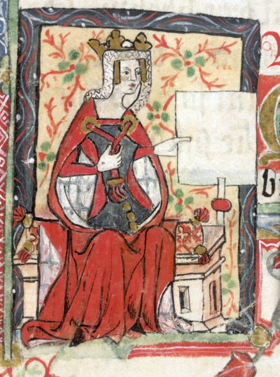
Matilda , or Maud ( English Matilda , Saxon form of the name - Maud or Maude , February 7, 1102 , Winchester , Hampshire , England - September 10, 1167 , Rouen , Normandy ), - Queen of England in 1141 , daughter and heiress of King Henry I . The removal of Matilda from the throne after the death of Henry I in 1135 caused a prolonged civil war in England between the supporters of Matilda and Stephen Blois . In 1141, Matilda managed to briefly seize the English throne, but she could not hold power in her hands. The Civil War ended in 1154 with the coronation of the son of Matilda Henry II Plantagenet . Due to the fact that the first spouse of Matilda was the Holy Roman Emperor Henry V , she became known in England under the name Empress Matilda ( English Empress Matilda ).
| Matilda | |||||||
|---|---|---|---|---|---|---|---|
| English Matilda | |||||||
 | |||||||
| Coronation | not crowned | ||||||
| Predecessor | Stefan Blois | ||||||
| Successor | Stefan Blois | ||||||
| Birth | February 7, 1102 Winchester , Hampshire | ||||||
| Death | September 10, 1167 (aged 65) Rouen | ||||||
| Burial place | Rouen Cathedral | ||||||
| Kind | Norman Dynasty | ||||||
| Father | Henry I | ||||||
| Mother | Matilda Scottish | ||||||
| Spouse | 1. Emperor Henry V 2. Geoffrey V Anjou | ||||||
| Children | sons: Henry II Plantagenet , Geoffrey VI of Anjou , Guillaume Plantagenet | ||||||
Content
- 1 Youth
- 2 Heir to the English throne
- 3 The beginning of the civil war
- 4 The rise to power and the fall
- 5 Defeat in the Civil War
- 6 Recent years
- 7 Marriages and children
- 8 Image in art
- 9 notes
- 10 Literature
Youth
Matilda was the only daughter of the English king Henry I of Bocklerc and his first wife, Matilda of Scotland . On the maternal side, she was the granddaughter of the King of Scotland, Malcolm III and St. Margaret , thus being a direct descendant of both the Anglo-Saxon royal dynasty and William the Conqueror .
Matilda was born on February 7, 1102. Winchester is considered her birthplace, but recent studies with high probability say that Matilda was born in the royal palace in Sutton Courtenay , Berkshire (currently in Oxfordshire ). At the age of seven, Matilda was engaged to Henry V , emperor of the Holy Roman Empire , and in 1111 she was sent to foster court in Germany .
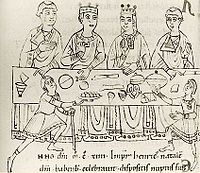
On January 7, 1114, the sumptuous wedding ceremony of Henry V and Matilda took place in Worms . This marriage was dictated by political considerations: England sought to enlist the support of the Holy Roman Empire in the confrontation with the French king Louis VI . Subsequently, the Anglo-German alliance played a significant role in deterring French aggression in Normandy : the attack of Henry V in 1124 stopped the invasion of Louis VI in Vexin . The marriage of Matilda and Henry turned out to be fruitless, although according to a contemporary, the chronicler German Tourney , the Empress gave birth to Henry one child who died in infancy. There was a legend that this child did not die, but was foster parents and later became known as Thomas Becket , Archbishop of Canterbury .
In 1125, Emperor Henry V passed away, leaving the twenty-three-year-old Matilda as a widow. Although later Matilda used the title of Empress, in reality she was never crowned as such by the Pope , as required by tradition, and formally had only the right to the title of Queen of the Romans . In adulthood, Matilda managed to convince the English chroniclers that she was crowned papa.
Heir to the English throne
| Kings of england |
|---|
| Norman Dynasty |
| William I the Conqueror |
| Robert III Kurtgez |
| Wilhelm II Rufus |
| Adela Norman |
| Henry I Bocklerc |
| Robert III Kurtgez |
| Wilhelm Cliton |
| Wilhelm II Rufus |
| Henry I Bocklerc |
| Empress Matilda |
| Wilhelm Adeline |
| Robert of Gloucester |
| Reginald Fitz Roy |
| Stefan Blois |
| Eustachius IV of Boulogne |
| William of Boulogne |
| Maria of Boulogne |
Soon after the death of her husband, Matilda returned to England. Since on November 25, 1120, her brother Wilhelm Adeline , the only legitimate son of Henry I and the heir to the throne, died during a shipwreck , the king decided to declare Matilda his successor. In 1127, he convened the barons, among whom was his nephew Stefan of Blois , and forced them to swear allegiance to Matilda and recognize her as heir to the English throne in the absence of the king's legal sons. This oath was confirmed on September 8, 1131 and on August 2, 1133 [1] . However, the attitude of the Anglo-Norman barons towards the prospect of accession to the throne of Matilda was ambiguous. Neither in England nor in Normandy there was a precedent for the reign of a woman. Moreover, Matilda, who was outside England for a long time, had practically no personal connections and a sufficiently wide circle of her supporters among the local aristocracy. According to contemporaries [2] , the empress was distinguished by an extremely unpleasant character: she was arrogant, arrogant, demanded unquestioning fulfillment of her orders and was contemptuous of ordinary people. This significantly complicated the formation of a solid support for Matilda in the English nobility.
Although the main condition of the Anglo-Norman barons when giving consent to declare Matilda the heiress was the need to coordinate the candidacy of her future spouse with the aristocracy, [3] already in 1127, King Henry I secretly organized the betrothal of his daughter with Geoffrey V Krasivy , nicknamed Plantagenet , son of Fulk V , Count of Anjou , whose support was necessary for Henry to stabilize the situation in Normandy. However, the marriage of the heiress of the English throne and Geoffrey Plantagenet displeased the nobility, who did not want to see the Frenchman as the ruler of the Anglo-Norman monarchy, especially the representative of the Anjou house , who had been the main rival of the Norman dukes in Northern France for more than a century. According to the chronicler, “ all the British and French have unkind words to commemorate this marriage ” [4] .
Count Fulk V soon went on a crusade to the Holy Land , and was later proclaimed king of Jerusalem and never returned to his homeland. During his absence, Fulk instructed his young son to govern the county of Anjou. The wedding of Geoffrey and Matilda took place on June 11, 1128 . At first, the relationship of the newlyweds did not work out, a big difference in age affected (Geoffrey was a little over fourteen years old, and Matilda was about twenty-six), as well as explosive temperaments and authoritarianism of both spouses. A year after the wedding, Geoffrey sent his wife along with all her property to Rouen .
In 1131, the couple finally reunited [5] and for some time lived in relative agreement. On March 5, 1133 their first-born Henry was born - the future king Henry II Plantagenet . In 1134, Matilda gave birth to a second son - Geoffrey , Count of Nantes , and the birth was difficult, and she almost died. In 1136, their third son, Guillaume , Count of Poitou , was born. The appearance of children in Matilda meant for Henry I a solution to the problem of inheritance. In 1133, the king arrived in Rouen, where he spent the last years of his life caring for his eldest grandson, as well as in trying to pacify the unrest of the Norman barons that broke out due to the intrigues of Geoffrey and Matilda. December 1, 1135, Henry I passed away.
Civil War Start
After the death of Henry I, the initiative in the struggle for the English throne was seized by Stephen Blois , the nephew of the deceased king, the youngest son of his sister Adela of Normandy . He was quite popular among the English nobility, was brought up at the court of the king and had extensive possessions both in Normandy and in England. Having broken the oath of allegiance to Matilda, Stephen immediately after the news of the death of Henry I landed in England and was enthusiastically received by the inhabitants of London . The English clergy, led by Archbishop Wilhelm de Corbeil and Stephen's brother Henry Winchester , as well as those who controlled the royal administration ( Roger of Salisbury and his relatives), and a significant part of the English aristocracy, hostile to Matilda, took over on his side. The refusal to fulfill the oath of allegiance to the empress was justified by the fact that Matilda was supposedly illegitimate - her mother, Matilda of Scotland , remained in the monastery before her marriage with Henry I and, accordingly, was bound by a vow of celibacy [6] , and cannot claim the crown of England . At first, the circumstances were in Stefan's favor: Matilda and her children were overseas in Anjou , the nobility preferred to see an adult and popular man on the throne, rather than an arrogant woman with a young heir. On December 22, 1135 [7] in London, William de Corbeil entrusted the crown of England to Stephen of Blois. The following year, the barons of England and Normandy swore allegiance to Stephen, including the half-brother of Matilda Robert , Earl of Gloucester , the half-son of Henry I.
While Stephen strengthened his position in England, Matilda and Geoffrey made an attempt to subjugate Normandy. After the death of Henry I, Matilda managed to establish control over the most important Norman fortresses along the southern border of the duchy - Domfron , Argentanten , Alencon and Se . The detachments of Geoffrey of Anjou in 1136 invaded Normandy, but were stopped by the troops of the Norman barons - supporters of Stephen, led by Galerand de Beaumont and Wilhelm of Ypres . After a six-month truce, the attacks of the Anjou resumed. In March 1137, Stefan Bloisky landed in Normandy, who, however, was unable to decisively rebuff the forces of Geoffrey and Matilda, and the conflict between the Flemish mercenaries of the king and Norman chivalry caused a split in the ranks of Stephen's supporters. Soon, Stefan was forced to return to England. This allowed the Anjou to go on the offensive. In 1138, Bessin , a significant part of Cotentin , Bayeux and Caen fell under the rule of Geoffrey and Matilda. The retaliatory offensive of the army of Galerand de Beaumont and William Ypresky forced the troops of Matilda to retreat to Anjou, but the beginning of a full-scale civil war in England in 1139 led to the departure of Galerand de Beaumont and William of Ypres for the English Channel and a significant weakening of the party of Stephen in Normandy. By 1144, Geoffrey of Anjou managed to conquer most of the duchy and proclaim himself the duke of Normandy .
Along with the military operations against Stephen, Matilda launched a struggle on the diplomatic front. In the summer of 1138, she asked the Pope to declare Stephen’s coronation illegal. The case was considered at the Second Lateran Council of 1139 in the presence of representatives of both parties and ended in the defeat of Matilda: Pope Innocent II recognized Stephen as the rightful king of England. However, the empress’s diplomatic failure was more than compensated by the breakup of Robert of Gloucester with Stefan and his open transfer in 1138 to the camp of supporters of Matilda, his half-sister. Soon, around the Earl of Robert began to group the English barons, dissatisfied with the king, especially the feudal lords of the western and southern counties . Stefan initially managed to restrain the rebels, but his actions against Bishop Roger of Salisbury in early 1139 led to the departure of the English clergy from the support of the king. Even Stephen's younger brother Henry , bishop of Winchester, appointed papal legate in England, went over to the side of Matilda. The country started a civil war.
Matilda took advantage of the outbreak of hostilities in England. On September 30, 1139, the empress landed on the coast of Sussex and fortified herself in Arundel Castle , which belonged to her stepmother Adelise of Louvain . Earl Robert moved west and settled in Bristol . The military operations of the king against the empress and Robert of Gloucester were unsuccessful. Matilda soon managed to move to Bristol, which became the main center of the empress's supporters in England. During 1140, almost the entire western and southwestern part of the country, as well as some areas of the central counties, came under the control of Matilda and Robert. Supporting the Empress, David I , king of Scotland , captured most of northern England, north of Tees .
The rise to power and the fall
At the end of 1140, Matilda Ranulf de Jernon's supporter, Earl of Chester , captured the city of Lincoln . Stefan headed north and tried to recapture the city. But on February 2, 1141, the king’s army suffered a crushing defeat at the battle of Lincoln from the troops of Robert of Gloucester and Ranulf de Jernon, and Stephen himself was captured. This opened the way for Matilda to take possession of the English crown. The king was placed in Bristol Castle, where, according to legend, he was kept in chains, and Matilda and Robert of Gloucester moved to Winchester. Having promised Heinrich Bloisch , Bishop of Winchester, not to interfere in church affairs after his coronation, Matilda was allowed into the city and took possession of the royal treasury located there. On April 8, 1141, Winchester officially elected Matilda Queen of England. She took the title of Mrs. English ( Latin: Domina Anglorum ; English Lady of the English ), as the English monarchs were usually called in the interval between their election and coronation .
Then Matilda moved to London , on the way occupying the fortresses of Stefan's supporters ( Oxford , Reading ). In mid-June 1141, the Empress, accompanied by Robert of Gloucester and her uncle, Scottish King David I, entered London, whose inhabitants generally remained on the side of Stephen. After being elected Queen, Matilda began a massive distribution of lands and titles to her supporters, continued by her in London: in a few months she established six new count titles [8] . However, Matilda’s rule turned out to be short: the Londoners, who had already formed by that time a military organization similar to Italian communes to protect urban freedoms, were outraged by Matilda’s neglect of their privileges, her arrogance and arrogance. The Empress tried to overlay the city with a waist , which caused a riot in London. Residents took up arms and expelled Matilda from the city. At the same time, a large army of Stefan's supporters, recruited by William of Ypresky in Kent , headed by the wife of King Matilda of Boulogne, approached London. The Empress retreated to Oxford, and the troops of Matilda of Boulogne entered London. The latter, through the mass distribution of land and money, managed to win over some of the empress’s former associates, including Geoffrey de Mandeville and the Bishop of Winchester.
In early September 1141, the troops of Empress Matilda entered Winchester and besieged the bishop's palace. However, unexpectedly the army of Queen Matilda approached the city, significantly superior to the strength of the rival. On September 14, the Empress gave the order to withdraw, which turned into a stampede when the Queen's troops went on the offensive. The battle of Winchester ended with the defeat of the Empress. Matilda herself managed to escape, and in the company of her faithful servant Brian Fitz-County, she reached Gloucester . However, Count Robert was captured. To free his brother and leader of his party, Matilda had to make a heavy sacrifice: on November 1, 1141, she released King Stephen in freedom in exchange for Robert of Gloucester.
Defeat in the Civil War
The complete failure of Matilda's policy during her short reign of 1141 significantly undermined the position of supporters of the empress. A significant part of the barons went over to Stephen's side, public opinion was also inclined in favor of the king, who suffered "cruelly" during his detention. The English Church also supported Stephen: at the synod in Westminster on December 7, 1141, Stephen was again recognized as king, and threatened supporters of Matilda with excommunication . A significant role in breaking the English clergy with the empress was played by the fact that during the period of her short reign she revived the practice of secular investiture of bishops , which was condemned by the pope, which Henry I abandoned in 1107 . In 1142, the king went on the offensive: his troops captured Wareham , thus cutting the connection of Matilda with the Angevins in Normandy, as well as Chirenchester , Bampton and Radkot . On September 26, 1142, Stephen's troops broke into Oxford , where the Empress was at that time, and burned the city. Matilda took refuge in Oxford Castle and withstood the siege of superior enemy forces for three months. When the food came to an end, and the help from her supporters in the western counties did not come, Matilda made a bold escape from the fortress: dressed in white clothes on a winter night, she went down the castle wall and ran along the ice-covered Thames to Wallingford , which was located under the control of her friend Brian Fitz County .
The fall of Oxford deprived Matilda of support in the central counties. Only Gloucestershire , Bristol , Devon , Somerset , Herefordshire , Shropshire , Cheshire , Lancashire and part of Wiltshire remained under her rule, but the number of her supporters was steadily declining. In 1145, Ranulf de Jernon , Earl of Chester , and Philip of Gloucester, son of Earl of Robert , sided with the king. In the same year, having won at Farington , Stefan cut off the West English counties from the allies of the Empress in the Thames Valley. Finally, on October 31, 1147, Robert of Gloucester died in Bristol, the Empress’s most faithful ally and actual leader of her party in England. Although in the same year, Henry Plantagenet , son of Matilda and Geoffrey of Anjou, landed in Northern England at the head of a small detachment, he failed to achieve anything. After several defeats from the royal army at the end of 1147, Henry returned to Normandy. Realizing the collapse of his plans, in February 1148, Matilda also left England.
Recent years
After a decade of struggle for the English throne, Matilda returned to Normandy in 1148, which finally came under the rule of her husband Geoffrey of Anjou. The empress retired to Rouen , where she kept her own courtyard, and during the absence of Normandy her son Henry Plantagenet headed the administration of the duchy. Although Matilda did not take more direct part in the struggle for the English throne, she retained a significant influence on Henry, especially in foreign policy matters. So, in 1155, under the pressure of Matilda, Henry abandoned the plan of the invasion of Ireland .
In 1153, Stephen, tired of the twentieth anniversary of the Civil War and Anarchy and broken by the death of his son Eustachius , concluded a treaty with Henry Wallingford , recognizing the latter as heir to the English throne. At the end of 1154, Stephen died, and Henry II Plantagenet was crowned king of England. After the accession of her son to England, Matilda remained in Normandy. Она неоднократно вмешивалась в конфликты между Генрихом II и его младшими братьями, пытаясь сохранить мир в семье. В 1160-е годы при дворе Матильды нашёл убежище Вильгельм , граф Пуату , младший и, видимо, самый любимый её сын, покинувший Англию из-за конфликта с архиепископом Кентерберийским . Здесь он и скончался в январе 1164 года . Позднее Матильда занималась, правда, безуспешно, примирением Генриха II и Томаса Бекета .
10 сентября 1167 года Матильда скончалась и была похоронена в аббатстве Бек , в 1847 году её останки были перенесены в Руанский собор . Эпитафия на её надгробии гласит:
Здесь упокоена дочь, жена и мать Генриха, великая по рождению, ещё более по браку, но более всего по материнству.
Оригинальный текст (англ.)Here lies the daughter, wife, and mother of Henry; great by birth, greater by marriage, but greatest in motherhood.
Браки и дети
- Первым браком (1114) замужем за Генрихом V (1086—1125), императором Священной Римской империи , детей не имели;
- Вторым браком (1128) замужем за Жоффруа V Плантагенетом (1113—1151), графом Анжуйским , их дети:
- Генрих II Плантагенет (1133—1189), король Англии (c 1154), герцог Аквитании (c 1151), граф Анжуйский (с 1151);
- Жоффруа VI Анжуйский (1134—1158), граф Нанта , потомства не оставил;
- Гийом Плантагенет (1136—1164), граф Пуату , потомства не оставил.
Образ в искусстве
Матильда и члены её семьи являются главными действующими лицами романов Эллен Джоунс «Роковая корона» ( англ. The Fatal Crown , 1991) и Элизабет Чедвик «Королева Англии» ( англ. Lady of the English , 2011).
Notes
- ↑ О повторных клятвах верности Матильде упоминают лишь Вильям Мальмсберийский (клятва 1131 года) и Роджер Ховеденский (клятва 1133 года), что позволяет некоторым исследователям оспаривать факт их принесения.
- ↑ См., например, Вильям Ньюбургский , История Англии. Перевод на русск. яз. Д. Н. Ракова.
- ↑ Позднее неполучение предварительного согласия английских баронов на брак Матильды и Жоффруа стал одним из предлогов для отказа от исполнения клятвы верности императрице и избрания королём Англии Стефана Блуаского . По крайней мере, на это ссылался Роджер Солсберийский , убеждая баронов поддержать кандидатуру Стефана.
- ↑ Round JH, Geoffrey de Mandeville: A Study of the Anarchy.
- ↑ Вильям Мальмсберийский приписывает воссоединение Матильды и Жоффруа совету английских баронов во время принесения ими повторной клятвы верности 8 сентября 1131 года в Нортгемптоне .
- ↑ Об обстоятельствах нахождения матери Матильды в монастыре см. статью Матильда Шотландская .
- ↑ По другим сведениям, 28 декабря 1135 года .
- ↑ Графские титулы учреждённые Матильдой: граф Корнуолл , граф Девон , граф Оксфорд , граф Солсбери , граф Херефорд и граф Сомерсет .
Literature
- Вильям Ньюбургский . История Англии . / Пер. на русск. яз. Д. Н. Ракова.
- Ордерик Виталий . Церковная история.
- Матильда, супруга императора Генриха V // Энциклопедический словарь Брокгауза и Ефрона : в 86 т. (82 т. и 4 доп.). - SPb. , 1890-1907.
- Мортон А. А. История Англии. — М. , 1950.
- Штокмар В. В. История Англии в средние века. — СПб. , 2001.
- Bradbury, J. Stephen and Matilda — The Civil War of 1139—53. — Alan Sutton Publishing, 1996.
- Clibnall, M. The Empress Matilda: Queen Consort, Queen Mother and Lady of the English. — Oxf. : Blackwell, 1993.
- Poole, AL From Domesday Book to Magna Carta 1087—1216. — Oxf. , 1956.
- Thornton-Cook, E. Her Majesty; The Romance of the Queens of England, 1066—1910. — Ayer Publishing, 1970 (репринт издания 1926 года).