Elliptic integrals are not expressed in terms of elementary functions. By definition, elementary functions [1] are functions defined by formulas containing a finite number of algebraic or trigonometric operations performed on an argument, function, and some constants.
Elliptic integrals in the Legendre form of the 1st, 2nd, and 3rd kind [1] , as well as integrals similar to them (with the substitution of plus signs for minus signs and / or with the replacement of cos with sin or vice versa) are precisely represented by the functional series . Such a representation is not an elementary function due to the infinite number of members of this series.
Guided by considerations of achieving the necessary accuracy and taking into account the n initial members of the series and neglecting the remainder, that is, the sum of the remaining members of the series from n + 1 to {\ displaystyle \ infty}  , we obtain an approximation of the (definite or indefinite) elliptic integral in the form of an elementary function. Approximations of elliptic integrals are applied similarly to ordinary integrals .
A certain integral of the first kind can be represented as:
- {\ displaystyle \ int _ {\ varphi _ {1}} ^ {\ varphi _ {2}} {\ frac {d \ varphi} {\ sqrt {1-k ^ {2} \ sin ^ {2} \ varphi }}} = {\ sqrt {1 + E}} \ left (\ varphi - {\ frac {E \ sin 2 \ varphi} {4}} + ... \ right) {\ Bigr |} _ {\ varphi _ {1}} ^ {\ varphi _ {2}};}

{\ displaystyle (\ varepsilon \ approx 4 {,} 2 \ cdot 10 ^ {- 6}; ~~ \ mu _ {\ varepsilon} (2) \ approx 330).} 
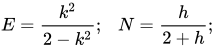
Hereinafter in the formulas the following notation applies:
- {\ displaystyle E = {\ frac {k ^ {2}} {2-k ^ {2}}}; ~~~ N = {\ frac {h} {2 + h}};}
- {\ displaystyle \ varepsilon _ {0} = \ left | {\ frac {F (\ varphi) \ mid _ {\ varphi _ {1}} ^ {\ varphi _ {2}} - \ int _ {\ varphi _ {1}} ^ {\ varphi _ {2}} f (\ varphi) d \ varphi} {\ int _ {\ varphi _ {1}} ^ {\ varphi _ {2}} f (\ varphi) d \ varphi}} \ right |}
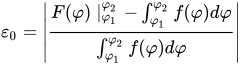 Is the calculated relative error in the calculation of elliptic integrals using the indicated formulas for ellipses similar to the Earth’s meridional ( {\ displaystyle k ^ {2} = 0 {,} 006693}
  and {\ displaystyle h = 0 {,} 006674}
  )
)
- {\ displaystyle \ varepsilon = \ varepsilon _ {0max}}
 - maximum calculated relative error of the corresponding formula in the range of angles {\ displaystyle \ Delta ~ \ varphi = \ varphi _ {2} - \ varphi _ {1} <{\ frac {\ pi} {2}}.}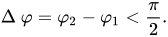
- {\ displaystyle \ mu _ {\ varepsilon} (m)}
 - a number indicating how many times the maximum calculated relative error of the corresponding formula will decrease, if we add {\ displaystyle m}
  unspecified members in her decomposition formula.
A definite integral of the second kind can be represented as:
- {\ displaystyle \ int _ {\ varphi _ {1}} ^ {\ varphi _ {2}} {\ sqrt {1-k ^ {2} \ sin ^ {2} \ varphi}} \ d \ varphi = { \ frac {1} {\ sqrt {1 + E}}} \ left (\ varphi + {\ frac {E \ sin 2 \ varphi} {4}} + ... \ right) {\ Bigr |} _ { \ varphi _ {1}} ^ {\ varphi _ {2}};}

{\ displaystyle (\ varepsilon \ approx 1 {,} 4 \ cdot 10 ^ {- 6}; ~~ \ mu _ {\ varepsilon} (2) \ approx 500).} 
The length of the ellipse arc with a single semi-major axis:
- {\ displaystyle \ int _ {\ varphi _ {1}} ^ {\ varphi _ {2}} {\ sqrt {1-k ^ {2} \ cos ^ {2} \ varphi}} \ d \ varphi = { \ frac {1} {\ sqrt {1 + E}}} \ left (\ varphi - {\ frac {E \ sin 2 \ varphi} {4}} + ... \ right) {\ Bigr |} _ { \ varphi _ {1}} ^ {\ varphi _ {2}};}

{\ displaystyle (\ varepsilon \ approx 1 {,} 4 \ cdot 10 ^ {- 6}; ~~ \ mu _ {\ varepsilon} (2) \ approx 500).}
A certain integral of the 3rd kind can be written in the form:
- {\ displaystyle \ int _ {\ varphi _ {1}} ^ {\ varphi _ {2}} {\ frac {d \ varphi} {(1 + h \ cdot \ sin ^ {2} \ varphi) {\ sqrt {1-k ^ {2} \ sin ^ {2} \ varphi}}}} =}
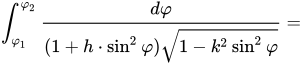
- {\ displaystyle = {\ frac {\ sqrt {1 + E}} {2 + h}} \ cdot \ left ({\ frac {2 + h} {\ sqrt {1 + h}}} \ operatorname {arctg} \ left ({\ sqrt {1 + h}} \ cdot \ operatorname {tg} \ varphi \ right) \ left (1 - {\ frac {E} {2N}} + ... \ right) + \ varphi \ cdot \ left ({\ frac {E} {N}} + ... \ right) + ... \ right) {\ Bigl |} _ {\ varphi _ {1}} ^ {\ varphi _ {2} };}

- {\ displaystyle (\ varepsilon \ approx 4 {,} 2 \ cdot 10 ^ {- 6}; ~~ \ mu _ {\ varepsilon} (3) \ approx 330).}

To calculate the length of the arc of the geodesic line on the surface of the terrestrial spheroid [2] , the calculation of a certain integral of the form is required:
- {\ displaystyle \ int _ {\ varphi _ {1}} ^ {\ varphi _ {2}} {\ frac {d \ varphi} {(1 + h \ cdot \ cos ^ {2} \ varphi) {\ sqrt {1-k ^ {2} \ sin ^ {2} \ varphi}}}} =}
- {\ displaystyle = {\ frac {\ sqrt {1 + E}} {2 + h}} \ cdot \ left ({\ frac {2 + h} {\ sqrt {1 + h}}} {\ text {arctg }} \ left ({\ frac {{\ text {tg}} \ \ varphi} {\ sqrt {1 + h}}} \ right) \ left (1 + {\ frac {E} {2N}} +. .. \ right) - \ varphi \ left ({\ frac {E} {N}} + ... \ right) + ... \ right) {\ Bigr |} _ {\ varphi _ {1}} ^ {\ varphi _ {2}};}
- {\ displaystyle (\ varepsilon \ approx 4 {,} 2 \ cdot 10 ^ {- 6}; ~~ \ mu _ {\ varepsilon} (3) \ approx 330).}