Sialia , or azure birds ( lat. Sialia ), is a genus of birds of the family of thrush order of the Passeriformes . One of several genera of blackbirds of the New World . Includes three species common in North and Central America .
| Azure birds |
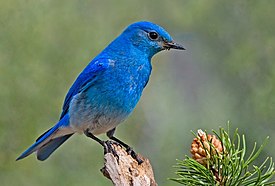
Blue sialia |
| Scientific classification |
|---|
| No rank : | Bilateral symmetrical |
| Infrastructure : | Passerida |
| Superfamily : | Muscicapoidea |
|
| International scientific name |
|---|
Sialia ( Swainson , 1827 ) |
|
Content
The average size (15-20 cm in length). The plumage is predominantly blue, the chest is reddish, the bottom is light. Females are colored about the same, but less brightly. Sometimes the differences in the color of males and females are almost imperceptible.
Sialia prefer open habitats with sparse trees. Territorial birds.
Azure birds are monogamous, like most blackbirds. Nests are arranged in sheltered places - hollows, tree forks, in artificial nests ( birdhouses , hollows). Eggs are bluish or almost white, monochromatic. They feed on insects that are caught in flight. Sometimes, like blackbirds , they switch to eating berries.
- Eastern sialia Sialia sialis (Linnaeus, 1758)
- Western Sialia Sialia mexicana Swainson, 1832
- Blue Sialia Sialia currucoides (Bechstein, 1798)
Sialia is valued for the benefits it brings, exterminating mass pests of garden and garden crops. Birdhouses are made and hung especially for their attraction. It has been observed, however, that they often cannot compete for breeding with introduced species such as sparrows and starlings . In the 1970s, the number of sialia in the United States fell sharply, including for this reason [1] .
In culture, azure birds often personify happiness and joy. Many well-known songs in the USA use this image ( Over the Rainbow , I'm Always Chasing Rainbows , Bluebird of Happiness ). He is also present in the folklore of Native Americans.
Blue sialia is selected by the state bird in Idaho and Nevada .
- ↑ Gowaty PA House sparrows kill eastern bluebirds // Journal of Field Ornithology. - 1984. - Vol. 55, no. 3. - P. 378–380.
