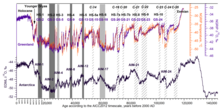
Ice Age / interglacial | Cooling / Warming (Eastern / Western Europe) | Start time (years ago) / Start of ICS (MIS) |
|---|---|---|
| Holocene | Preboreal period | Less than 11 590 |
| Deglaciation | ||
| Late dryas | 12 680 | |
| Allergy warming | 13 350 | |
| Ancient dryas | 13 540 | |
| Bölling Warming | 13 670 | |
| Ancient dryas | 13 800 | |
| Meyendorf Warming | 14,450 (MIS 1) | |
| Late Valdai Glaciation ( LGM ) | ||
| Vepskovsky (Mecklenburg) phase | ~ 15 000 | |
| Edrovskaya (Pomeranian) phase | ~ 17,000 | |
| Usvyachskaya (Frankfurt phase) | ~ 22,300 | |
| Usvyachsky (Brandenburg) phase) | 24,000 (MIS 2) | |
| Valdai Warming | ||
| Dunaevskoye (Denekamp) | ~ 28,800 | |
| Shenskoye | ~ 30,000 | |
| Leningrad (Hengelo) | ~ 39,000 | |
| Leningradskoye (Moersoft) | ~ 47,000 | |
| Kashinsky (Ebersdorf) | ~ 50,000 | |
| Krasnogorsk (Glinde) | ~ 55,500 | |
| Krasnogorsk (Oerel) | 58,000 (MIS 3) | |
| Early Valdai Glaciation | ||
| Shestikhinskoe | ~ 60,000 (MIS 4) | |
| Kruglitskoe (Odderade) | 74,000 (MIS 5a) | |
| Lapland (Raederstal) | ~ 85,000 (MIS 5b) | |
| Verkhnevolzhskoe (Breruup) | ~ 93,000 | |
| Verkhnevolzhskoe (Amersford) | ~ 100,000 (MIS 5c) | |
| Kurgolovskoe (Herning) | 115,000 (MIS 5d) | |
| Mikulinsky interglacial | ||
| ← Eemian warming | 128,000-117,000 (MIS 5e) |


The last ice age ( Wurm glaciation , Vislinsky glaciation , Valdai glaciation, last glaciation ) is the last of the ice ages in Europe as part of the Pleistocene or Quaternary ice age .
The icing began about 110 thousand years ago and ended about 11.7 thousand years ago . During this era, the expansion and contraction of the ice sheets occurred repeatedly. The last glacial maximum , when the total volume of ice in the glaciers was the largest, dates back to about 26.5-19 thousand years ago . Although the general trends of global cooling were similar, there were local features of the development of glaciation, for example, of individual phases of advance and retreat, reaching maximum sizes, stages of decrease and disappearance of individual ice sheets.
The last ice age is the most studied part of the current Quaternary ice age. It has been well studied in North America , northern Eurasia , in the Himalayas and other regions of the world that have previously experienced cover glaciation.
The term “last ice age” most often corresponds to the term English. The Last Glacial Period (LGP) . It should not be confused with the narrower concept of “ The Last Glacial Maximum ” ( The Last Glacial Maximum (LGM) ), which indicates its final stage.
Age 67.4–61.2 thousand liters. n cooling in France dates. OK. 63 thousand liters n was the Brerup interstadial of the early Wurm [1] [2] .


Content
Global Review
Northern Hemisphere
Canada was almost completely covered in ice. The northern United States was also under ice. Local glaciations existed in the Rocky Mountains (see Vashonsky glaciation ).
Glaciers were in the UK, Germany, Poland. In Russia, under the glacier was the Taimyr Peninsula . The greatest glaciation occurred in Western Siberia between 16,000 - 15,000 years ago. There were no continental-scale glaciers in Northeastern Siberia; there were a number of large glaciers, including on the Mountain ranges of the North-East of Siberia and Kamchatka .
The Arctic Ocean was not totally frozen. Its glaciation did not exceed today's level, the ice thickness was approximately the same and was subject to seasonal fluctuations. During the summer season, as in our days, the ocean had vast expanses of ice-free water, including the icebergs we knew.
In the more southern regions, glaciers were significantly less pronounced, and, in principle, cooling affected only high mountain ranges and individual glaciers located in the mountains. In particular, in the mountains of Taiwan, glaciers periodically appeared and melted between 42,000 and 8,600 years ago. The Taiwanese mountains themselves do not belong to the high class, hence the instability of glaciation even during periods of maximum cooling on Earth. In the mountains of Japan, similar processes of glacier growth and subsequent thawing took place - the maximum glacier growth occurred between 58,000 and 28,000 years ago.
In Africa, the most visible trace of the last glaciation remained on Mount Kilimanjaro . Previously, the glacier at its peak had an area of several hundred square kilometers. The same large glacier was in the Ruvenzori massif.
Southern Hemisphere
The ice age in the Southern Hemisphere had a noticeably smaller impact, due to the smaller vastness and width of the continents. Research suggests that glaciers existed in the Andes - the Patagonian ice sheet. Between 31,500 and 11,900 years ago, there were six glaciers in the Chilean Andes.
Antarctica was completely glaciated. In mainland Australia, the glacier was only in the vicinity of Mount Kosciusko and had a small area. In Tasmania, glaciation is more widespread. In New Zealand, glaciers covered all its mountains. Small ice caps existed in the Indonesian mountains of Irian Jaya, of which three Pleistocene glaciers have survived to date.
See also
- Quaternary extinction
- Ice age
- Milankovitch Cycles
- Bond Cycles
- Oscillations of Dansgor - Ashger
- Blitt-Cernander scheme
Notes
- ↑ William James Burroughs . Climate Change in Prehistory. The End of the Reign of Chaos. 356 p. Cambridge UP, 2005, p. 86
- ↑ Paleolithic of the USSR. / Ans. ed. P.I. Boriskovsky. M .: Nauka, 1984. 384 p. (Series "Archeology of the USSR"), p.32, 109
- ↑ Crowley, Thomas J. Ice age terrestrial carbon changes revisited (neopr.) // Global Biogeochemical Cycles. - 1995. - T. 9 , No. 3 . - S. 377-389 . - DOI : 10.1029 / 95GB01107 .
Literature
- Pazynych V. Revision of the scale of last North American glaciation Part 1. Southern Rocky Mountains Revision of the scale of last North American glaciation Part 1. Southern Rocky Mountains
- Serebryany L. R. How many glaciations did the Quaternary have? // Ancient glaciation and life / Executive Editor Corresponding Member of the USSR Academy of Sciences G. A. Avsyuk. - M .: Nauka , 1980 .-- S. 35-48 .
- Bondarev L.G. , Bakov E.K., Melnikova A.P. In defense of the old views on the Tyur-Shan Wurm glaciation // Materials of glaciological studies. Vol. 103. M .: Nauka, 2007.S. 39-46.
- Bowen, DQ, 1978, Quaternary geology: a stratigraphic framework for multidisciplinary work. Pergamon Press, Oxford, United Kingdom. 221 pp. ISBN 978-0-08-020409-3
- Ehlers, J., and PL Gibbard, 2004a, Quaternary Glaciations: Extent and Chronology 2: Part II North America. Elsevier, Amsterdam. ISBN 0-444-51462-7
- Ehlers, J., and P L. Gibbard, 2004b, Quaternary Glaciations: Extent and Chronology 3: Part III: South America, Asia, Africa, Australia, Antarctica. ISBN 0-444-51593-3
- Gillespie, AR, SC Porter, and BF Atwater, 2004, The Quaternary Period in the United States. Developments in Quaternary Science no. 1. Elsevier, Amsterdam. ISBN 978-0-444-51471-4
- Harris, AG, E. Tuttle, SD Tuttle, 1997, Geology of National Parks: Fifth Edition . Kendall / Hunt Publishing, Iowa. ISBN 0-7872-5353-7
- Mangerud, J., J. Ehlers, and P. Gibbard, 2004, Quaternary Glaciations: Extent and Chronology 1: Part I Europe. Elsevier, Amsterdam. ISBN 0-444-51462-7
- Sibrava, V., Bowen, DQ, and Richmond, GM, 1986, Quaternary Glaciations in the Northern Hemisphere, Quaternary Science Reviews. vol. 5, pp. 1-514.
- Pielou, EC, 1991. After the Ice Age: The Return of Life to Glaciated North America . University Of Chicago Press, Chicago, Illinois. ISBN 0-226-66812-6 (paperback 1992)