
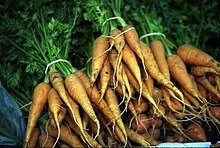

Root crop - part of the plant that stores nutrients, most often associated with the root system, where the first part of the name comes from. The fruits are not, the second part of the name is biologically incorrect, but traditional. In agriculture, root crops are called both specially grown plants for the sake of powerful juicy underground organs ( root crops ), and those parts that are actually harvested and used for food and animal feed. The main shoot (basal part), hypocotyl and the main root of the plant participate in the formation of root crops.
The formation of root crops is characteristic of biennial plants from the families:
- Cabbage ( turnip , radish , rutabaga , turnip )
- Umbrella ( carrots , parsley , celery , parsnip )
- Hazel beets
- Asters ( chicory , scorzonera )
Much less frequently, root crops are formed:
- in annuals (e.g. radish )
- in perennials (for example, katran from the Cabbage family)
In the first year of life, most root crops develop a rosette of leaves and a “root crop”. Its upper part - the “head” - carries a rosette of leaves and is formed by a shortened stem. Under it there is a “neck”, which is a sub-cotyledonous knee, or hypocotyl , a section of the stem of a seedling between the cotyledons and the main root (for example, in carrots) or only its upper part (for example, beets , turnips, rutabaga). Actually the root - usually this is the main root of the seedling - branches, forming lateral roots. The mass of the “root crop” consists of an overgrown parenchyma of the secondary xylem (cabbage family) or the secondary phloem (family of umbelliferous) and sometimes bark ( carrots ). In beets, the growth ring from xylem and phloem is formed by several cambium rings, and nutrients are stored in the parenchyma. In the 2nd year of life, a flowering and fruiting stem develops from buds located in the axils of rosette leaves. After fertilization and seed maturation, the plant dies.
Root crops are demanding on moisture. Their good yields are obtained on fertile loose soils, especially with artificial irrigation. Sugars ( sugar beets , swede ), inulin ( chicory ), starch (katran), mineral salts, vitamins (carrots, turnips, radishes) accumulate in root crops.
They are used in food in boiled, stewed and raw form, they are dried and canned. An important component of succulent feed for farm animals.
See also
- Tuber
Literature
- Fedorov Al. A., Kirpichnikov M. E., Artyushenko Z. T. Root modifications // Atlas on the descriptive morphology of higher plants: Stem and root = Organographia illustrata plantarum vascularium: Caulis et radix / under the general. ed. P.A. Baranova. - M. - L .: Publishing House of the Academy of Sciences of the USSR, 1962. - Issue. [2]. - S. 49-52. - 352 p. - 3000 copies.
Links
- Root plants / V. A. Bakulin // Congo - Baptism. - M .: Big Russian Encyclopedia, 2010. - P. 332. - ( Big Russian Encyclopedia : [in 35 vols.] / Ch. Ed. Yu. S. Osipov ; 2004—2017, vol. 15). - ISBN 978-5-85270-346-0 .