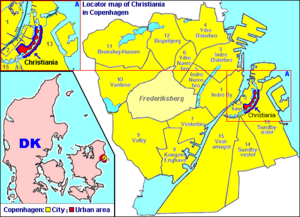
Christiania (The Free City of Christiania , the Free City of Christiania ) is a partly self-governing, unofficial “state within the state” located in the Christianshaun district of Copenhagen , the capital of Denmark .
| Virtual state | |||
| Free City of Christiania | |||
|---|---|---|---|
| Fristaden christiania | |||
| |||
| I kan ikke slå os ihjel [1] | |||
| A country | Denmark | ||
| Enters into | Copenhagen Bådsmandsstræde 43 | ||
| History and geography | |||
| Date of education | September 26, 1971 | ||
| Date of abolition | |||
| Square | 0.32 [2] km² | ||
| Timezone | UTC +1 | ||
| Population | |||
| Population | 878 [3] people ( 2003 ) | ||
| official languages | Danish | ||
| Digital identifiers | |||
| Abbreviation | CA | ||
| Telephone code | +45 | ||
| Zip Codes | 1407 | ||
| Official site | |||
 | |||
| Notes: Currency - Lyon [4] Danish krone | |||


The inhabitants of Christiania proclaim their goal “ to create a self-governing society in which each individual is responsible for the welfare of the whole community. A society must be economically self-sufficient, and be adamant in the belief that physiological and physical destruction can be prevented . ”
Description
Christiania is a quarter of Copenhagen . At the entrances are large stones, repeatedly cleaned by the government, but returning to the place by the inhabitants of Christiania.
Resident population approx. 1000 people, there are restaurants, cafes, shops [5] . There are several reservoirs in Christiania.
Residents of Christiania declare their own laws, independent of the laws of Denmark. Among them: bans on cars , theft , hard drugs , firearms and body armor [6] .
The main street is Pusher Street ( English Pusher Street ). On it there is a trade in light drugs and photography is prohibited.
The landmark on which Christiania can be found is the Church of the Savior with a high tower and a spiral staircase leading to it [5] .
History
Christiania appeared on September 26, 1971 , when a group of hippies illegally moved into abandoned barracks in Copenhagen . One of the most significant people in the history of Christiania was Jacob Ludwigsen ( dat. Jacob Ludvigsen ), who published an anarchist newspaper, in which he proclaimed the creation of a free (free) city.
The legal status of Christiania was not defined for a long time, and the authorities repeatedly tried to clear the premises of the barracks, but without success. In 1984, a motorcycle gang arrived in Christiania in the hope of capturing lawless space and monopolizing the trade in hashish . In the end, local residents, using peaceful means, drove bikers out of the area.
In 1995, the residents of Christiania entered into an agreement with the Danish Ministry of Defense , which owns the barracks, and have since been paying taxes.
The population with constant persistence, but also with a sense of humor, opposes the attempts of the government to eliminate Christiania. For example, when in 2002 the government criticized the overt street trade in hashish in Christiania, the vendors camouflaged their military-style stands. In 2004, the stands were destroyed by the people themselves for the sake of preserving independent Christiania. One of the surviving stands was purchased and exhibited by the Danish National Museum .
In the 2000s, government pressure and attempts to eliminate the Free City of Christiania were intensified. The police regularly conduct “purges”, accompanied by arrests. In 2004, the Danish government passed Law L205, rejecting Christiania as a collective with common property. According to this law, all residents of Christiania are separate individuals and have the right to private property . This led to the possibility of selling Christian land, both to the possession of individual residents and other persons (enterprises), but caused stubborn protest rallies among residents.
In February 2011, the Danish Supreme Court decided on a quarter of Christiania squatters , allowing everyone to be evicted. According to the sentence, they do not have rights to the territory they currently occupy, which is owned by the state. In April, the police raided there to detect drug dealers, the population of Christiania was outraged by the actions of the police. Guardians began to throw cobblestones and empty bottles, barricades quickly appeared on the streets. The police responded with tear gas. [7]
On August 15, 2011, the BBC reported that Christiania received a semi-autonomous status from the authorities. According to the new law, the residents of Christiania will have the opportunity to redeem land below cost, and the state will lease the rest of the land [8] .
See also
- Virtual state
- Norebro
- Tinbjerg
- Commune Niederkaufungen
- Squatting
- Anarchism
- Republic of Uzupis (in Vilnius, Lithuania)
- Mea Shearim
Notes
- ↑ Det internationale sigøjnerkompagni
- ↑ The Danish Building & Property Agency
- ↑ Forty Years Of Christiania
- ↑ Copenhagen.com
- ↑ 1 2 Hemp Encyclopedia (Christiania)
- ↑ Redefining freedom: Copenhagen's Freetown Christiania
- ↑ The hippie commune riot in Denmark turned into a riot (inaccessible link) . The appeal date is May 29, 2011. Archived on April 27, 2013.
- ↑ Danish Christiania: a hippie dream or a drug addict hangout? Bbc