Saint Pius X ( lat. Pius PP. X ; in the world - Giuseppe Melchior Sarto , Italian. Giuseppe Melchiorre Sarto ; June 2, 1835 - August 20, 1914 ) - Pope from August 4, 1903 to August 20, 1914 . Holy Catholic Church .
| His Holiness Pope | |||
| Saint Pius X | |||
|---|---|---|---|
| Sanctus Pius PP. X | |||
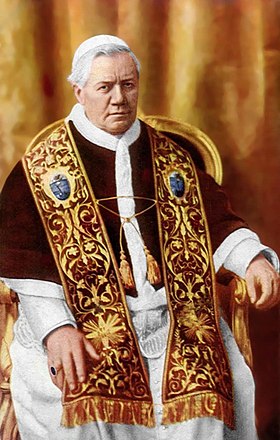 | |||
| |||
| August 4, 1903 - August 20, 1914 | |||
| Election | August 4, 1903 | ||
| Intronization | August 9, 1903 | ||
| Church | Roman catholic church | ||
| Predecessor | Leo XIII | ||
| Successor | Benedict XV | ||
| Birth name | Giuseppe Melquore Sarto | ||
| Original name at birth | Giuseppe Melchiorre Sarto | ||
| Birth | June 2, 1835 Riese , Lombardo-Venetian Kingdom | ||
| Death | August 20, 1914 (79 years) Rome Rome | ||
| Buried | |||
| Adoption of holy dignity | September 18, 1858 | ||
| Episcopal consecration | November 20, 1884 | ||
| Cardinal with | June 12, 1893 | ||
| Day of Remembrance | |||
| Autograph | |||
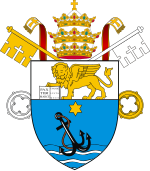 | |||
| Awards |
| ||


Early years

Giuseppe Melkore, Sarto was born on June 2, 1835 in Riez , near Treviso , the Lombardo-Venetian kingdom of the Austrian Empire (now Italy, the province of Treviso). He was the second of ten children of postman Giovanni Battista Sarto (1792-1852) and the dressmaker Margarita Sanson (1813-1894). He was baptized on June 3, 1835. Giuseppe's childhood was poor: he, being the son of an ordinary village postman, could hardly count on a decent education, but his parents valued the education of children, and Giuseppe walked almost 4 miles every day to school.
Giuseppe had three brothers and six sisters: Giuseppe Sarto (1834) died six days later, Angelo Sarto (1837–1916), Teresa Parolin-Sarto (1839–1920), Rosa Sarto (1841–1913), Antonia Dei Bey-Sarto (1843–1917), Maria Sarto (1846–1930), Lucia Boshin-Sarto (1848–1924), Anna Sarto (1850–1926), Pietro Sarto (1852) died at six months [1] . He rejected any favors for the family: his brother became a postman like his father, his favorite nephew became a village priest, his three unmarried sisters lived together in poverty in Rome; just like other people of that time, Giuseppe led a modest lifestyle.
In his youth, Giuseppe studied Latin with a village priest, and later studied at the gymnasium in Castelfranco .
In 1850, he was ordained as a monk by the Bishop of Treviso , and received a scholarship from the Diocese of Treviso to study at the Padua seminary, "where he completed his classical, philosophical and theological studies with distinction" [2] .
On September 18, 1858, Sarto was ordained a priest and became a chaplain in Tombolo . Being a chaplain, Sarto expanded his knowledge of theology, studying the teachings of Thomas Aquinas and canonical law , served most of the functions of the parish pastor, who was seriously ill. In 1867, Sarto was appointed to Salzano . Here he restored the church and the hospital with money from alms and his own funds. He became popular among the local population, working and helping patients during cholera , sweeping through northern Italy in the early 1870s. Later he was appointed canon of the cathedral and chancellor of the diocese of Treviso, as well as the rector of the seminary of Treviso and examiner of the clergy. As chancellor, he made religious education possible for public school students. As a priest and later a bishop, he struggled to solve the problem of religious education for rural and urban youth, who were not able to attend Catholic schools.
In 1878, Bishop Zanelli died, leaving the bishopric of Treviso vacant. After the death of Zanelli, Sarto as Chancellor of the Diocese of Treviso, was appointed temporary administrator of the Diocese until the election of a new vicar bishop. In 1879, Sarto was elected to this position, and served on it from December 1879 to June 1880.
After 1880, Sarto taught dogmatic and moral theology at the Treviso seminary . On November 10, 1884, Pope Leo XIII was appointed Bishop of Mantua and ordained six days later in Rome in the church of St. Apolinaria by Cardinal Lucido Parocchi with the assistance of Pietro Rota and Giovanni Maria Berengo.
June 19, 1891 was appointed to the honorary post of assistant to the papal throne . Sarto asks for blessings from Pope Leo XIII to complete his doctoral studies before the episcopal consecration, but is refused, making him the last Pope who did not have a doctoral degree at the time of his election [3] .
Cardinal and Patriarch
Pope Leo XIII made him a cardinal priest with the title of the church of San Bernardo-Alle Terme in open conservatory on June 12, 1893. Three days after that, Cardinal Sarto was privately appointed Patriarch of Venice . His name became public after two days. This caused difficulties, since the government of united Italy claimed the right to propose a candidate for the post of patriarch, in contrast to the emperor of Austria . The uneasy relationship between the Roman Curia and the Italian government since the annexation of the Papal State in 1870 imposed an additional burden on purpose. The number of applicants soon rose to 30. Finally, Sarto was confirmed as patriarch in 1894.
As a cardinal patriarch, Sarto avoided participation in political life, giving up his free time for public works and strengthening parish banks. However, in his first pastoral letter to the Venetians, Cardinal Sarto stated that in matters relating to the Pope, "There should be no questions, no subtleties, no encroachments on the personal rights of the Pope, only obedience ..." .
Papal Elections
On July 20, 1903, Leo XIII died, and at the end of the month a conclave assembled to elect his successor. According to historians, the pope’s favorite secretary, Cardinal Mariano Rampolla , was to become the pope. In the first ballot, Cardinal Rampolla received 24 votes, Cardinal Gotti 17 votes, and Cardinal Sarto 5 votes. In the second round, Rampolla received five more votes and it seemed that he would be elected Pope. However, the course of the conclave was disrupted by the intervention of the Archbishop of Krakow, Cardinal Jan Puzyna , who, on behalf of the Austrian Emperor Franz Joseph I , vetoed Rampolla’s candidacy. The electors protested against the veto and expressed their discontent, even suggesting that the Pope was elected despite the veto, but they obeyed the will of the emperor. The third and fourth rounds of voting did not reveal a clear leader either; however, 30 votes were cast for Rampoll, and 24 votes for Sarto. It was clear that the Cardinals gave their preference to Sarto. The next morning, the fifth round of the conclave’s voting was the last, and the opinion of the electors was as follows: Rampolla 10 votes, Gotti 2 votes, and Sarto with 50 votes. Thus, on August 4, 1903, Cardinal Sarto was elected Pope. This conclave was the last one where the right of veto was used by the Catholic monarch.
However, Cardinal Sarto at first refused to be elected, I feel unworthy, later agreeing with the decision of the conclave. He was saddened that Austria-Hungary had vetoed Rampolla, and promised in the future to abolish this right and excommunicate those who would continue to use it.
Sarto chose the name Pius, out of respect for his predecessors, in particular, Pope Pius IX (1846–78), who fought against the liberalization of theology. The coronation of Pius X took place on Sunday, August 9, 1903. After being elected pope, he also became the Grand Master of the Holy Sepulcher of Jerusalem [4] .
Pontificate
The pontificate of Pius X is known for its conservatism in the field of theology, reforms of liturgy and church law. The motto of his Papacy, Pius X, made the phrase “Instaurare Omnia in Christo”, or “restore everything in Christ”, taken from his first encyclical, dated October 4, 1903, “E supremi apostolatus” (“Restore everything in Christ”). Pius X stated his primary task as follows: “We uphold the authority of God. His authority and the commandments should be recognized, they should be listened to, they should be respected . "
The simple origin of the Pope became clear immediately after his election, when, from the day of his coronation, Pius X began to wear the usual gold-plated cross. And when his entourage was horrified, the new pope said: “I always wore this cross, and did not bring any other with me” [5] . Pius X became famous for cutting and simplifying papal ceremonial. He also abolished the custom established by Pope Urban VIII, according to which the pope dines alone, and began to invite his friends to dine together [6] .
Once the public figures of Rome asked the Pope why he did not make his sisters countess, to which he replied: "I made them sisters of the pope, what else can I do for them?" [5]
Dad was friendly with kids. There were always candy in his pockets, which he distributed to children on the streets of Mantua and Venice, teaching them the catechism. During the papal audiences, Pius X always gathered children, and the Pope always talked with them about what interested them. His weekly catechism lessons at the San Damaso church in the Vatican always included special places for children. The decision of the Pope to admit children to the sacrament was dictated by the desire to return them from religious ignorance [5] .
Church reforms and theology
Restoration in Christ and Mariology
Pius X contributed to the introduction of the daily communion practice for all Catholics, which was repeatedly criticized for alleged “disrespect”. In his encyclical Ad diem illum , published in 1904, he sees the Virgin Mary in the context of "restoring all in Christ."
He wrote:
Spiritually, we are all her children, and she is our mother, therefore, she should be honored as a mother [7] . Christ is the Word made flesh and the Savior of mankind. He had a physical body, like any other person, and as the savior of the human race, he had a spiritual and mystical body — the Church. This has implications for our understanding of the Most Holy Mother of God. She perceived Christ both as the Son of God and as part of her human nature, so that He could become the Redeemer of the human race. Mary, carrying the Savior in herself, was his mother, and therefore the mother of us all. Thus, all believers are one with Christ, are part of His body and His flesh, from His bones and from the womb of the Virgin Mary [8] . Through the spiritual and mystical form, we are all children of Mary, and she is our mother. Mother is spiritual, but in reality, all Christians [7] .
Gregorian Chanting
On November 22, 1903, Pius X published the apostolic letter "Tra le sollecitudini". Classical and baroque music prevailed over Gregorian singing [9] . Pope announced a return to early musical styles, for which many composers, including Lorenzo Perozi, who was the director of the Sistine Chapel Choir since 1898, were in favor. Pius X declared Perosi "Life Director", and Joseph Potier became the head of the Vatican Commission for the publication of liturgical books and the main reformer of Gregorian singing .
Liturgical changes
The papacy of Pius X was marked by an increase in devotion and piety in the lives of the clergy and laity, helped by the reform of the Book of the Right, and especially the Holy Mass .
The Vatican graduation of 1906 began to contain the revived forms of tunes used by the celerant, which should be included in the missal. Gregorian singing was increasingly used in Communion . Pius X spoke about this: “The Holy Communion is the shortest and safest way to Salvation.” To this end, the Pope encouraged frequent reception of Holy Communion, including by children who had reached the appropriate age, that is, “at the discretion of age,” although he did not allow the ancient Eastern practice of the Children's Communion. Also, Pius X emphasized that the frequent addressing to the Sacrament of Confession contributes to a more worthy Communion. Pius X's devotion to the practice of the Eucharist, ultimately contributed to the fact that the Pope respectfully began to be called "the Pope of the Holy Gifts."
In 1910, a decree was issued by Quam Singulari, according to which the age of admission to the sacrament was reduced from 12 to 7 years ( age at discretion ). Dad lowered his age, believing that it will impress the minds of children and will encourage their parents to comply with religious norms. However, this decree was perceived as undesirable by some believers because of the belief that parents would massively take children from Catholic schools after the age of the First Communion [5] .
In the apostolic letter "Tra le sollecitudini" Pius X said:
"The primary and irreplaceable source of the true Christian spirit is participation in the Holy Sacraments and prayers [5] ."
Anti-Modernism
In response to secular education, the predecessor of Pius X, Pope Leo XIII, sought to revive the legacy of Thomas Aquinas , the so-called "union of reason and revelation." Neo-scholasticism (neo-Thomism) during the pontificate of Pius X became the main basis for theology [10] . Strongly condemning modernism and relativism, Pius X called these currents dangerous for Catholicism. This is perhaps the most controversial aspect of his papacy. The pope called for the formation of Sodalitium Pianum (Brotherhood of Pius), an anti-modernist network of informants, which was negatively perceived by many people because of unreasonable and unconvincing charges of heresy. He led the company against modernism professor of church history, prelate Umberto Benigni - Assistant Secretary of State for Foreign Affairs in the Vatican Secretariat of State. In 1909, by order of Cardinal Merri del Valya, Umberto Benigni created an agent network, the task of which was to identify persons who spoke in favor of the inevitability of modernism within the Vatican and church institutions [11] .
The attitude of Pius X to the modernists was uncompromising. Advising the Pope to show compassion for the “culprits” Pius X replied: “They want to be treated with oil, soap and petting. But coming together with them in a duel, they will beat with their fists, and you will no longer count and measure the blows, you will beat as much as you have enough strength [11] . ”
The modernists were some Catholic French scholars, such as Louis Duchesne , who questioned the belief that God was directly involved in human affairs, and Alfred Loisey , who denied that every line of Scripture literally, and not metaphorically, could be true. In contrast to the teachings of Thomas Aquinas, they argued that there was an insurmountable gap between natural and supernatural knowledge. These gaps and undesirable effects are called relativism and skepticism [12] .
Modernism, relativism, and rationalism in Catholic theology in terms of their presence in the church, were theological trends that modern philosophers, such as Immanuel Kant , tried to assimilate. Modernists argued that the beliefs of the Church have evolved throughout its history and continue to evolve. Anti-modernists viewed these concepts as contrary to the tenets and traditions of the Catholic Church.
The Lamentabili sane exitu decree (“deplorable Departure Really”) [13] , issued on July 3, 1907, which condemned alleged errors in interpreting Holy Scripture, history and interpretation of dogmas, officially condemned 65 modernist or relativistic judgments regarding the nature of the Church, revelation, interpretation The Bible, the Sacraments, and the Divinity of Christ. This was followed by the encyclical Pascendi Dominici Gregis ("Feeding the flock of the Lord"), which characterizes modernism as a "synthesis of all heresies." After this, Pius X ordered that all clerics take Oath against modernism for their oath against modernism. The aggressive policies of Pius X against modernism caused some unrest in the church. Although only about 40 clergymen refused to take the oath, the Catholic scholars of modernist tendencies were completely discouraged. Theologians and theologians who wanted to continue research in accordance with the principles of secularism, modernism, or relativism had to stop their research, as it threatened conflict with the Pope, and perhaps even excommunication from the church.
Catechism of Pius X
In 1905, Pope Pius X, in his encyclical Acerbo Nimis, instructed the Brotherhood of Christian Doctrine to open Sunday schools in each parish [5] .
The catechism of Pius X in its implementation was simple, concise, and popular for uniform application, strengthened in use in Rome and for several years in other parts of Italy, however, it was not intended for use in the whole Catholic Church [14] . The simplicity of presentation and the depth of the content made the catechism accessible not only for its time, but also for subsequent generations of believers [15] [16] . Catechism, as a method of teaching religion, was described in the encyclical Acerbo Nimis in April 1905 [17] , was released in 1908 in Italy under the name Catechismo della dottrina Cristiana ( Catechism of the Christian Doctrine ); has more than 115 pages [18] .
In an interview with the catholic monthly publication “30 Giorni” in 2003, Cardinal Joseph Alois Ratzinger, the future Pope Benedict XVI, said:
“Faith, as such, is always the same. Thus, the catechism of St. Pius X always retains its value. Instead, he may change the way he conveys the contents of the faith. Thus, one may wonder whether the Catechism of St. Pius X is still valid today? I believe that the Catechism that we are preparing must meet the needs of today. However, this does not exclude the fact that there may be individuals and groups of people who prefer the Catechism of Pius X. Do not forget that the Pius X Catechism originates from the text of a simple structure and deep content, which was prepared by the Pope himself when was the bishop of Mantua. For this reason, the Catechism of St. Pius X will also have followers in the future. ” [16]
Canon Law Reform
Canon law in the Catholic Church varied from region to region, without general prescriptions. On March 19, 1904, Pope Pius X appointed a commission of cardinals to develop a universal code of laws, which later became known as the Code of Canon Law, and was used in the Catholic Church for most of the 20th century. Two cardinals from this commission later became Papas: Giacomo Chiesa became Pope Benedict XV , and Eugenio Pacelli became Pope Pius XII . The first final version of the Code of Canon Law was adopted by Benedict XV on May 27, 1917, gained the force of law on May 19, 1918 and remained in force until 1983, when the current Code of Canon Law was adopted [19] [20] [21] . The Code of Canon Law of 1983 is valid only for the Catholic Church of the Latin Rite . In the Eastern Catholic churches , the Code of canons of the Eastern Churches , adopted in 1990, operates [22] .
Church Governance Reform
Pius X conducted a reform of the Roman curia in accordance with the Apostolic Constitution of Sapienti consilio , and indicated new rules for the supervision of bishops in seminaries in the encyclical Pieni L'Animo. Regional seminaries were established (at the close of some smaller ones), and a new training plan in seminaries was adopted. The clergy were also prohibited from participating in the management of public organizations.
Church policy toward secular authority
Pius X abolished Leo XIII’s approach to secular governments, appointing Cardinal Rafael Merri del Val to the Vatican’s Secretary of State (later, in 1953, canonization also began to Rafael Merri del Valya, but he is still not blinded [5] ). When French President Emile Loubet visited Italian King Victor Emmanuel III (1900–1946) in Rome, Pius X, who refused to recognize the annexation of the Papal States to Italy, rebuked the French president for a visit and refused to meet with him. This led to the rupture of diplomatic relations with France, and in 1905 the Law of Separation was issued in France, according to which the Church was separated from the state , which was condemned by the Pope. According to this law, the Church in France lost state funding. In response, two French bishops were removed from the Vatican for recognizing the Third Republic . In the end, France expelled the Jesuits and severed diplomatic relations with the Vatican.
The pope held a similar position with respect to secular governments in other countries: in Portugal, Ireland, Poland, Ethiopia and a number of other states with a large proportion of the Catholic population. His actions and statements against Italy have displeased the secular authorities of these countries, as well as some others, such as the United Kingdom and Russia. In Ulster, Protestants increasingly expressed the opinion that after Ireland gained independence and its own parliament, the Roman Catholic Church would gain political power over its interests in Ireland [23] .
In 1908, the bull Ne Temere entered into force, regulating marriage from the point of view of canon law and complicating interfaith marriage . One of the rules of this bull was that only church marriage had legal force, and if the marriage and the wedding were not performed by a Catholic priest, then it would mysteriously become invalid. The concern of some Protestants was caused by the fact that now the Church will separate those couples who were married in the Protestant church and civil institutions from Catholic unions [24] . The priests received the right, at their discretion, to refuse to enter into mixed marriages, or specify the conditions for children to be brought up in Catholicism. Bull was particularly controversial in Ireland, where there were large groups of Protestant minorities, which indirectly contributed to the subsequent political conflict, and was tabled in the United Kingdom House of Commons [25] .
Secular authorities challenged the papacy of Pius X, which became tougher and more aggressive. He suspended work, and later abolished the society Opera dei Congressi , which coordinated the work of Catholic associations in Italy, and also condemned Le Sillon , the French political and religious movement, trying to reconcile the church with liberal political views [26] . Also, the Pope spoke out against trade unions that were not exclusively Catholic organizations. Pius X partially repealed decrees prohibiting Italian Catholics from voting, but this was never recognized by the Italian government.
Relations with the Kingdom of Italy
Initially, Pius X maintained the status of a captive in the Vatican , but with the growth of socialism, the Latin expression “ Non Expedit ” (“It is not advisable”) was rethought in the encyclical “ Il Fermo Proposito ” (June 11, 1905). The pope allowed Catholics to vote when it “helps maintain public order,” but only for deputies who are not socialists.
Relations with Poland and Russia
Under Pius X, the traditionally difficult situation of Polish Catholics in Russia did not improve. Although Nicholas II issued a decree of February 22, 1903, promising freedom of religion for the Catholic Church, and in 1905 proclaimed the Constitution, which provided for freedom of religion [27] , the Russian Orthodox Church felt threatened. Under pressure from the ROC, papal decrees were banned and contacts with the Vatican remained outlaws for a long time.
Relations with the United States of America
In 1908, Pope Pius X raised the missionary status of the United States, in recognition of the growth of the American church [5] . During his pontificate, fifteen new dioceses were created in the United States and two American cardinals were appointed. Pius X was very popular among American Catholics, who seemed to be an ordinary person because of his poor background, which survived the accession to the papal throne [5] .
In 1910, the Pope refused to meet with former US Vice President Charles Fairbanks , who wanted to appeal to the Methodist associations in Rome, as well as to former US President Theodore Roosevelt , who intended to appeal to the same association [5] .
On July 8, 1914, Pope Pius X approved the request of American Cardinal James Gibbons for the patronage of the Immaculate Conception during the construction of the Basilica of the Immaculate Conception of the Blessed Virgin Mary in Washington .
Miracles during the life of the Pope
In addition to documented stories of miracles, through the intercession of the Pope after his death, there are also evidences of miracles during the lifetime of the Pope. One day during an audience, Pius X held a paralyzed child in his arms, who suddenly began to wriggle in his arms, tried to free himself from the embrace, and then ran around the room. In another case, a married couple (who confessed to him when he was bishop of Mantua) wrote to the Pope that their two-year-old child was sick with meningitis. Pope Pius X wrote to them in response that they needed to hope and pray. Two days later, the child was completely cured [5] .
Cardinal Ernesto Ruffini (later Archbishop of Palermo) visited the Pope after he was diagnosed with tuberculosis. Dad told him to return to seminary, and that he would be fine. Later, Ruffini conveyed this story to the researchers of the canonization of the pontiff [5] .
Other Activities
In addition to the political defense of the Church, liturgical changes, anti-modernism and the beginning of the codification of canon law, the papacy of Pius X was marked by the reorganization of the Roman curia. Pope sought to update the education of priests, seminaries and their curricula without reform. In 1904, Pope Pius X allowed diocesan seminarians to attend St. Thomas's College . On May 2, 1906, the college received the name of the papal ( Latin Pontificium Collegium Divi Thomæ de Urbe ) [28] [29] . In the Apostolic Epistle of November 8, 1908, signed by the Pope on November 17, Pius X established the Papal International College Angelicum ( lat. Pontificium Collegium Internationale Angelicum ), which replaced the College of St.. Thomas. Later, on March 7, 1963, Pope John XXIII assigned Angelicum the rank of the Pontifical University ( Latin Pontificia Universitas Studiorum a Sancto Thoma Aquinate in Urbe ).
Pius X canonized ten people: Valentin Faustino Berrio-Ochoa (1906), Marie-Geneviers Meunier (1906), Rosa Cretan (1906), Claire of Nantes (1907), Zdzislaw Lemberk (1907), John Bosco (1907), Johann Ruisbruck (1908), Andrew Nam Thung (1909), Lin Agatha (1909), Agnes De (1909), Jeanne d'Arc (1909), John Ed (1909). Four were among the saints : Alessandro Sauli (1904), Gerard Majella (1904), Clemens Hofbauer (1909), Joseph Oriol (1909).
Pius X published 16 encyclicals, among them was Vehementer Nos of February 11, 1906, which condemned the French law of 1905 on the separation of the Church from the state. Pius X also confirmed, although not without error, the presence of Limb in the 1905 catechism. Limb was the place of residence (or state) of souls who did not go to heaven, who are not hell or purgatory. The unbaptized “did not have the joy of God, but they did not suffer ... they did not deserve Paradise, but neither did they deserve Hell or purgatory” [30] [31] . In modern Catholic theology, the concept of limb is rejected. On April 20, 2007, the Vatican published a document that concluded that the doctrine of limb presents an “unsuitably restrictive view of salvation,” while God is merciful and “desires salvation to all people” [32] .
On November 23, 1903, Pius X issued a directive on his own initiative (“ Motu proprio ”), according to which women were forbidden to sing in church choirs.
In the prophecy of the popes of St. Malachi (collection 112 prophecies of the popes), Pius X is characterized by the phrase “Ignis ardens” or “Fiery Fire” , which is interpreted as follows: Pius X advocated the publication of the first complete Code of Canon Law , daily communion and the use of monophony of Gregorian singing in the Catholic liturgy , and was an opponent of modernism in the church. He was the first holy pope for the period of 400 years, the previous was Pius V.
In November 1913, Pope Pius X declared the dance of tango immoral and forbidden for Catholics [33] . Later, in January 1914, when tango turned out to be very popular to be banned, Pius X tried the tactics of “mocking tango,” saying that it was “one of the most boring things imaginable,” and recommended that people do tango instead of tango. Furlana (Venetian dance) [34] .
Pius X at home
In getting around was democratic. He kindly sat his guests in the armchairs. After moving to the Vatican, Pius X did not change his provincial habits. As before, he continued to use cheap onion watches, writing with an ordinary clerical pen, and cleaning the pen on the cuffs of his snow-white duster, which is why they were always smeared with ink.
Pius X liked the short film about the reconstruction of St. Mark’s belltower in Venice , he watched it many times, recognized it in frames of friends and acquaintances, poked them with his finger, loudly shouted their names, laughed, in a word, with might and main enjoyed the spectacle [35] .
Death and Funeral
In 1913, the Pope had a heart attack, after which his health dramatically weakened. The events that led to the beginning of the First World War (1914–1918) brought him to a state of melancholy. On August 15, 1914, the Pope fell ill on the feast of the Assumption of the Most Holy Theotokos , and he no longer recovered, his state of health continued to deteriorate, as a result of which he died of a heart attack on August 20, 1914. A day earlier, on August 19, the Jesuit leader Franz Xavier Wernz died in Rome on the very day when German troops entered Brussels.
Pius X was buried in a simple and unadorned tomb in the crypt of St. Peter's . The papal physicians of that time had a habit of removing internal organs to facilitate the embalming process. Pius X strictly forbade embalming for his future burial, and subsequent popes continued this tradition.
Canonization
Although the canonization of Pius X took place in 1954, the events that led to this began immediately after his death. In a letter dated September 24, 1916, Bishop of Nicotera and Tropea, Giuseppe Maria Leo, calls Pius X "the great saint and great Pope." To accommodate a large number of pilgrims wishing to access his grave, a metal cross was installed on the floor of the basilica, directly above the grave of Pius X, so that the believers could kneel directly above the grave. The masses near his grave lasted until 1930. [36]
The veneration of Pope Pius X between the two world wars was quite high. On February 14, 1923, in honor of the 20th anniversary of his accession to the papal throne, the process of placing the pope as a saint began - those responsible for canonization were appointed and a monument was erected at St. Peter's Cathedral. On August 19, 1939, Pope Pius XII (1939-1958) paid tribute to the memory of Pius X in Castel Gandolfo . On February 12, 1943, the further process of canonization was marked by the glorification of Pius X in the face of the Servant of God - this meant conferring the title that a deceased person would carry from the beginning of the process of his beatification to being considered the blessed.
On May 19, 1944, the tomb of Pius X was removed from the tomb and taken to the chapel of the Holy Crucifix in the Basilica of St. Peter's. When the coffin was opened, the body of Pius X was found in a well-preserved condition, despite the fact that he died 30 years ago, and wished that his body was not embalmed. According to Jerome Dye-Gala, “the whole body of Pius X was in an excellent state of preservation” [36] . After the examination and the end of the process, Pius XII bestowed on Pius X the title of the venerable - his body was exposed in Rome for 45 days, after it was placed back in the tomb.
The next step was the process of beatification, the preparation for which began with the study of the miracles performed by Pius X, which was confirmed and recognized by the Congregation for the canonization of the saints . The first miracle happened to the nun Marie-Françoise Deperras, who recovered from bone cancer in December 1928 during Novenna , a traditional Catholic prayer practice consisting of reading certain prayers for nine days in a row, during which a piece of Pius X's relics was placed on the chest nuns [37] . The second miracle happened to the nun Benedetta de Maria, who also in the process of Novena recovered from abdominal cancer in 1938 by touching the statue of Pius X in St. Peter's Cathedral [38] .
Pope Pius XII officially approved the two miracles on February 11, 1951, and already on March 4 declared that the Church continued to be the beatification of Pope Pius X. His beatification took place on June 3, 1951 in St. Peter's Cathedral - it was held by 23 cardinals, many bishops and archbishops gathered in the square in front of the cathedral, a crowd of more than 100,000 worshipers. During the beatification, Pius XII calls Pius X “the Pope of the Eucharist” (“Pope of the Sacrament”), since Pius X extended this rite by allowing children to it.
After beatification, on February 17, 1952, the body of Pius X was transferred from his tomb to the Vatican basilica and placed under the altar of the chapel of the Holy Crucifix. The body of the pontiff was placed in a glass and bronze sarcophagus, so that believers could see it [39] .
On May 29, 1954, less than three years after beatification, Pius X was canonized, after performing two more miracles recognized by the Congregation for the canonization of saints . The first miracle happened to the lawyer from Naples, Francesco Belsami, who, being ill with a pulmonary abscess, was healed while placing the image of Pope Pius X on his chest. The second miracle happened to the nun Maria Ludovica Scorcia, who, suffering from viral neuropathy, was completely cured after several Novennes . The canonization mass that Pius XII held in St. Peter’s Cathedral gathered about 800,000 laymen, believers, monks, cardinals and bishops. Pius X was the first in almost 250 years canonized Pope after Pius V, which was canonized in 1712 [40] [41] .
This canonization ceremony was the first recorded and shown on television, including NBC.
Prayer cards often depict the pontiff with the tools of the Holy Communion. In addition, Holy Pius X is also the patron saint of Treviso, revered in the parishes of Italy, Germany, Belgium, Canada and the United States. A large number of parishes, schools, seminaries and maternity homes are named after him in Western countries. This is partly due to the fact that the process of his beatification and canonization in the early 1950s coincided with the period after the Second World War, when there was an increase in construction in cities and population growth (the era of the Baby Boom ), which led to Catholic expansion [5] .
In 1955, a feast in honor of Pius X in the Common Roman calendar was established on September 3, and was celebrated until 1969. After it began to be celebrated on August 21 [42] .
The brotherhood of the Christian doctrine was a great supporter of its canonization. This was partly explained by the fact that the Pope predetermined the need for its existence in each diocese and because the Brotherhood was repeatedly criticized. It was believed that the canonized Pope, who gave permission for their activities, would help against criticism [5] . The brotherhood initiated a prayer crusade for its canonization, which secured the participation of more than two million believers [5] .
Another miracle happened after the canonization of the Pope: the Christian activist Klem Lane suffered a heart attack, after which he was taken to hospital, placed in an oxygen chamber and catholic. A particle of the relics of St. Pius X was placed above the camera, and to the great surprise of the doctors, the patient recovered quickly [5] . Also, the nun Loretto of Webster University in St. Louis, Missouri, claimed that her brother the priest was cured through the intercession of the Pope [5] .
In fiction and poetry
- The life of Pope Pius X is depicted in the Italian film “ Men do not look at the sky ” (1952), directed by Umberto Scarpelli. The film mainly shows the events of the last year of the Pope’s life (1914): Pius X is deeply saddened and excited at the thought of the great tragedy that threatens humanity, he is doing everything possible to prevent the First World War. The nephew calms the Pope, reminding him of the most important events of his life, after which the Pope is removed to serve the Holy Mass for the last time.
- Pope Pius X is satirically represented in Flann O'Brien 's novel “ Difficult Life ”: Irish travelers from Dublin to Rome are trying to get an audience with Pius X, which does not end well - an angry Pope in a mixture of Latin and Italian literally sends them to hell.
- In Guillaume Apollinaire ’s poem “The Zone”, Pope Pius X is called “L'Européen le plus moderne” (“Modern European”) [43] .
Encyclicals, Bulls, and Other Works
- E supremi ("Renew Everything in Christ"), first encyclical October 4, 1903
- Apostolic Epistle of Tra le sollecitudini (about church music), November 22, 1903
- Encyclical Ad diem illum laetissimum (on the 50th anniversary of the proclamation of the dogma of the immaculate conception of Mary), February 2, 1904
- Encyclical Iucunda sane (in memory of Pope Gregory the Great), March 12, 1904
- Encyclical Poloniae populum ("Polish people"), December 3, 1905
- Encyclical Vehementer nos (against the separation of church and state in France), February 11, 1906
- Catechism Collection of Christian Doctrine, 1906
- Bull "Sollicitudo omnium ecclesiarum" (regulation of the exclusivity of church marriage), 1907
- Encyclical Pascendi Dominici Gregis (on the condemnation of the teachings of the modernists), September 8, 1907
- Pascendi Dominici Gregis Apostolic Epistle (about excommunication of modernists), November 18, 1907
- Encyclical Editae saepe (on the 300th anniversary of the canonization of St. Carlo Borromeo ), May 26, 1910
- Sapiente concillo (on the reduction of the Curia congregations from 37 to 19)
See also
- List of cardinals erected by Pope Pius X
Notes
- ↑ Pope Pius X . Greenspun The appeal date is June 23, 2013.
- ↑ Herbermann, Charles, ed. (1913), " Pope Pius X ", Catholic Encyclopedia , New York: Robert Appleton Company
- ↑ The Pope Who Had No doctorate . The Catholic Herald (May 11, 1956). The appeal date is June 23, 2013.
- ↑ Grand Masters of the Order of the Holy Sepulcher Archival copy of March 16, 2015 on the Wayback Machine (ital.)
- ↑ 1 2 3 4 5 6 7 8 9 10 11 12 13 14 15 16 17 Avella, Steven M & Zalar, Jeffrey (Fall 1997), "The Case of St. Pius X", Catholic Historian (US) T. 15 (4): 57–80
- Lls 'Pope And Mussolini' Tells The Secret History Of Fascism And The Church: NPR . Npr . The appeal date is February 4, 2014.
- ↑ 1 2 Sarto, 1904 .
- ↑ Ephes. v., 30.
- De J. de Luca, Disharmony among bishops: Journal of the Australian Catholic Historical Society 35 (2014) , 28-37.
- ↑ Noel, 2009 , p. eight.
- ↑ 1 2 Cornwell, 2008 , p. 37
- ↑ Cornwell, 2008 , p. 35
- ↑ Sarto, Giuseppe Melchiorre Lamentabili Sane . Papal encyclicals (July 3, 1907). The appeal date is June 23, 2013.
- ↑ Sarto, 1905 , p. 3
- ↑ Joseph Ratzinger . On the Abridged Version of Catechism (May 2, 2003). Archived February 18, 2008.
- ↑ 1 2 Ratzinger, Joseph, Interview , IT : 30 giorni , < http://www.30giorni.it/us/articolo.asp?id=775 > Archive dated October 21, 2007 on Wayback Machine
- ↑ Sarto, Giuseppe Melchiorre Acerbo Nimis . Vatican (April 15, 1905). The appeal date is June 23, 2013.
- ↑ Sarto, 1905 , p. 2
- ↑ Ap. Const. Providentissima Mater Ecclesia
- ↑ Ap. Const. Sacrae Disciplinae Leges
- ↑ Code of Canon Law on the official website of the Holy See
- ↑ Code of canons of Eastern Churches
- ↑ Robert Kee : The Green Flag Vol. II: The Bold Fenian Men , Penguin Books, London, 1972, p.64
- Ir Moir, John S Canadian Protestant Reaction to the Ne Temere Decree . U Manitoba . The appeal date is June 23, 2013.
- ↑ Debate on 'Ne Temere' . Hansard . Mill Bank Systems (1911). The appeal date is June 23, 2013.
- S Le Sillon a pour but de réaliser en France la république démocratique. Ce n'est donc pas un mouvement catholique, ce ce n'est pas une œ uvre dont le but particulier de se mettre à la disposition des aévêtes et des curés les aider dans leur ministère propre. Le Sillon estouncile, ce qui n'empêche pas qu'il soit aussi un mouvement profondément religions. La Croix , 1905
- ↑ Schmidlin, 1904 .
- ↑ Acta Sanctae Sedis . - Vatican, 1906. - Vol. 39 .
- ↑ Renz, 2009 , p. 43 .
- ↑ Out On A Limbo (unavailable link) . Catholic. The appeal date is June 23, 2013. Archived on September 3, 2011.
- ↑ Past Roman Catholic statements on Limbo and the unbaptized infants who die? Religious tolerance. The appeal date is June 23, 2013.
- ↑ Limb in the Encyclopedia Krugosvet .
- Go 100 Years Ago You New England Historical Society.
- ↑ Do the Furiana Unsolved . The Milwaukee Journal.
- ↑ John Butler. TV, Movies & Morality: A Guide for Catholics. - Our Sunday Visitor, 1984. - p. 99. - 160 p. - ISBN 9780879736026 .
- ↑ 1 2 Thouvenot, Fr. Christian . Canonization of Pope Pius X by Pope Pius XII , The Angelus (April 2004). The appeal date is November 3, 2013.
- ↑ Pierre Delooz, Les Miracles: un défi pour la science? , éd. De Boeck Université, 1997, P. , en ligne (not available link)
- ↑ Walter Diethelm. Saint Pius X: The Farm Boy who Became Pope . - 1956. - P. 160-161. - ISBN 0-89870-469-3 .
- ↑ Christine Quigley. The Mummies of the Twentieth Century . - McFarland & Company , 2006. - p. 204. - ISBN 0-7864-2851-1 .
- ↑ The Canon Process - Museo San Pio X . Museo san Pio X. Date of appeal June 23, 2013.
- ↑ Life on the Newsfronts of the World (Neopr.) . - Life , 1954. - 18 January. - p . 42 .
- ↑ Calendarium Romanum (Libreria Editrice Vaticana, 1969), pp. 101, 137
- ↑ Alcools Unsolved . Chez.
Literature
- Grigulevich I.R. Papacy. Century XX. - M .: Politizdat , 1978. - T. Pius X - the first Pope of the XX century. - pp. 109-157. - 424 s.
- A. G. Krysov. “Vehementer nos”, 6th Encyclical of Pope Pius X // Orthodox Encyclopedia, ed. Patriarch of Moscow and All Russia Alexy II, T. VIII, M., Orthodox Church Encyclopedia Church Research Center, 2004, pp. 75-76.
- Bavoux, GA. Le porteur de lumière: [ fr. ] . - Pygmalion 1996.
- Browne-Olf, Lillian. Their Name Is Pius (1941) pp 235—304 online
- Chadwick, Owen. A History of the Popes 1830-1914 (2003). online pp 332–405.
- Chiron, Yves. Pope Saint Pius X: Restorer of The Church. - Angelus, 2002. - ISBN 1-892331-10-1 .
- Cornwell, John. Hitler's Pope: The Secret History of Pius XII. - Penguin, 2008. - ISBN 978-0-14311400-0 .
- FA Forbes . Pope St. Pius X. - TAN , 1954.
- Kühner, Hans. Lexikon der Päpste: [ him. ] . - Fischer, 1960.
- Lortz, Joseph. Geschichte der Kirche: [ him. ] . - 1934.
- Noel, Gerard. Pius XII: The Hound of Hitler. - Bloomsbury , 2009. - ISBN 978-1-84706355-7 .
- Renz, Christopher J. Albert the Great (1930–1980) . - Dominican School, 2009. - ISBN 978-1-88373418-3 .
- Regoli, Roberto. L'elite cardinaliza dopo la fine dello stato pontificio (ital.) // Archivum Historiae Pontificiae: diario. - 2009. - V. 47 . - P. 63-87 . (in Italian)
- Sarto, Giuseppe Melchiorre (1904), Ad diem Illumum , Rome, IT: Vatican Publishing House , 5 , < http://www.vatican.va/holy_father/pius_x/encyclicals/documents/hf_p-x_enc_02021904_ad-diem-illum-laetmett .html >
- Sarto, Giuseppe Melchiorre. Catechism . - Catholic Primer, 1905. Archival copy dated May 26, 2013 on the Wayback Machine
- Smit, JO. Beato Pio X / JO Smit, G dal Gal. - NV Drukkerij De Tijd, 1951. (translated by van der Veldt, JH (1965), St. Pius X Pope , Boston , MA: Daughters of St. Paul
- Cardinal Rafael Merry del Val . Pope Pius X. - Vatican, 1920.
- Catechismo della dottrina Cristiana, Pubblicato per Ordine del Sommo Pontifice San Pio X: [ ital. ] . - Il Sabato, 1999.
- Á Czaich -A. Fráter: X. Pius pápa. Életének és uralkodásának története napjainkig. Az Athenaeum, Budapest 1907.
During life
- Monsignor Hartwell de la Garde Grissell . Sede Vacante: Being a Diary Written During the Conclave of 1903. - James Parke & Co, 1903.
- Schmidlin, Edward. Life of His Holiness, Pope Pius X. - 1904. (by the American Cardinal), where criticism of the popery was criticized.
- Schmitz, Monsignor E Canon. Life of Pius X. - The American Catholic Publication Society , 1907.
- Monsignor Anton de Waal . Life of Pope Pius X. - The MH Wiltzius Co, 1904.
After his death
- FA Forbes . Life of Pius X. - 2nd. - PJ Kenedy & Sons, 1924. Merry del Val (above) is considered the most authoritative written on him.
- René Bazin . Pius X. - B Herder, 1928.
- Katherine Burton . The Great Mantle: The Life of Giuseppe Sarto. - Longmens, 1950.
- Thornton, Father Francis Beauchesne. The Burning Flame: The Life of the Pius X. - Benziger Brothers , 1952. Burton's book.
- Martini, Teri. The Fisherman's Ring: The Life of Giuseppe Sarto, The Children's Pope. - St Anthony Guild Press, 1954.
Links
- Pius X // Brockhaus and Efron Encyclopedic Dictionary : 86 t. (82 t. And 4 extra.). - SPb. , 1890-1907.