Blessed Pius IX ( lat. Pius PP. IX , Italian. Pio Nono ; in the world of Giovanni Maria Giambattista Pietro Pellegrino Isidoro Mastai de Ferretti ; May 13, 1792 , Senigallia - February 7, 1878 , Vatican ) - Pope from June 16, 1846 February 7, 1878 .
| His Holiness Pope | |||
| Blessed Pius IX | |||
|---|---|---|---|
| Beatus Pius PP. IX | |||
| |||
| June 16, 1846 - February 7, 1878 | |||
| Election | June 16, 1846 | ||
| Intronization | June 21, 1846 | ||
| Church | Roman catholic church | ||
| Predecessor | Gregory XVI | ||
| Successor | Leo XIII | ||
| Birth name | Count Giovanni Maria Giambattista Pietro Pellegrino Isidoro Mastai de Ferretti | ||
| Original name at birth | Giovanni Maria Giambattista Pietro Pellegrino Isidoro Mastai de Ferretti | ||
| Birth | May 13, 1792 Senigallia , Ancona , Papal States | ||
| Death | February 7, 1878 (85 years old) Vatican City | ||
| Buried | |||
| Holy Order | April 10, 1819 | ||
| Episcopal consecration | June 3, 1827 | ||
| Cardinal with | December 23, 1839 in pectore December 14, 1840 | ||
| Day of Remembrance | |||
| Autograph | 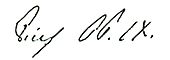 | ||
 | |||

He went down in history as a pope, who proclaimed the dogma of the immaculate conception of the Blessed Virgin Mary and convened the First Vatican Council , which approved the dogmatic teaching on the infallibility of the Roman high priest . Also known as the last pope to have secular power over the Papal Region . At the beginning of his long pontificate, he had to fight against the accession of his possessions to a single Italy . The loss of secular power while maintaining the spiritual gave rise to the Roman question , which lasted almost 60 years.
Content
Biography
Giovanni Maria Mastai Ferretti was born on May 13, 1792. He was the ninth child in the noble family of Girolamo, Count Ferretti. On his birthday, he was baptized in St. Peter's Basilica in Senigallia by his uncle, the priest Angello Mastai Ferretti. February 2, 1803 took the First Communion from the hands of the Bishop of Senigallia, the future Cardinal Bernardino Onrati . From 1803 to 1808 he studied at the Piarist College in Volterra , which was forced to leave due to sudden bouts of epilepsy that occurred after a head injury. In 1812, due to illness, he was released from conscription in the Royal Honorary Guard of the Sentinels. Since 1814, he often stayed in Rome with his uncle Paolino Mastai Ferretti. He entered the Roman Collegium (Collegio Romano), where he studied theology and philosophy. In 1815 he wrote a petition for joining the Noble Guard and was soon accepted into its ranks, but due to illness he was forced to leave the service. In the same year he went on a pilgrimage to Loreto , where he met Pope Pius VII , who played an important role in his future church career. After the fall of Napoleon, he returned to Rome, where he studied at the University of La Sapienza . At the same time, he studied at the seminary and at the same time was engaged in charity work at the Tata Giovanni Institute, where he worked with abandoned children. January 5, 1817 entered the Third Order of the Franciscans . Suffering from epilepsy, he turned to Pius VII with a request to allow his ordination to the priest, which was satisfied. On December 20, 1818 he was ordained a subdeacon , in March 1819 - a deacon, and on April 10, 1819 - a priest, Bishop of Senigallia, Cardinal Fabrizio Scheberass Testaferrata . For some time he was the rector of the Tata Giovanni Institute in Rome. Sent by Pius VII shortly before the death of the latter to Latin America , where he was to serve under the apostolic nuncio Giovanni Mutsi in Peru and Chile . In 1825 he was recalled to Rome, became a canon of the church of Santa Maria in Via Lata and was appointed Leo XII as the manager of the San Michele hospital, where he worked until 1827.
On May 21, 1827, Leo XII appointed Ferretti the Archbishop of Spoleto . On June 3, 1827, he was ordained bishop by Cardinal Francesco Saverio Maria Felice Caslioni (future Pius VIII ), in conjunction with the President of the Pontifical Church Academy and the titular Archbishop of Tamiatis Giovanni Giacomo Sinibaldi and titular Bishop Antonio Trapezius Trapezius Pratyepusi . In 1831, Ferretti was appointed apostolic ordinator of Spoleto and Rieti , December 17, 1832 - personal archbishop of the Diocese of Imola .
On December 23, 1839, Pope Gregory XVI elected him Cardinal " in pectore ." The announcement of his election as cardinal took place on December 14, 1840. He was elected Pope on June 16, 1846.
Since 1868, he suffered from erysipelas and open sores on his legs. Since 1877, due to illnesses, he stopped serving the daily mass . He died on February 7, 1878 at 5:40 in the morning from an attack of epilepsy. His body was originally buried in the Grotto of St. Peter from the outskirts of St. Peter ; later, on July 13, 1881, the remains were transferred to the Roman basilica of San Lorenzo fuori le Mura .
Pontificate Pius IX - the longest in the history of the Roman Catholic Church after the Apostle Peter . It lasted 31 years, 7 months and 22 days.
Papa election
After the death of Gregory XVI on June 1, 1846, the conclave took place, which took place in a difficult political environment, because of which only 46 of the 62 cardinals participated in it. The conclave was divided into two opposing groups, one of which held conservative views and supported Secretary of State Luigi Lambruschini , and the other, liberal, supported two candidates: Tommaso Pasquale Gizzi and 54-year-old Ferretti. In the first round, Ferretti received 15 votes. In the evening of June 16, 1846, the second round of elections took place, during which Giovanni Maria Mastai Ferretti was elected pontiff.
The next morning, Cardinal Deacon Tommaso Ríario Sforza announced the election of a new pope. Giovanni Maria Mastai Ferretti took the name Pius IX in honor of Pius VII , who authorized his ordination to the priesthood. June 21, 1846 took place the intronization of Pius IX.
Pontificate
Papal Region
In 1846-1847, Pius IX carried out liberal reforms in the Papal Region , which prompted some of the participants in Risorgimento to see in him the future unifier of Italy . Italian political circles saw in Pius IX a supporter of neo - Guelphs who sought to create an Italian confederation led by the Pope. At the beginning of the Revolution of 1848-1849, he carried out some liberal reforms in the Papal State. On April 29, 1848, Pius IX issued a statement that he could not support the hostilities between Austria and the Italian troops, which caused widespread protest in Rome. The subsequent assassination on November 15, 1848 of the chairman of the Council of Ministers, Pellegrino Rossi, resulted in the Italian revolution, as a result of which Pius IX was forced to flee from Rome to Gaeta . In February 1849, the Italian Republic was proclaimed, which announced the deprivation of Pius IX secular power, after which he appealed to the governments of France, Austria, Spain and the Kingdom of the Two Sicilies. On April 12, 1850, after the suppression of the uprising by French and Neapolitan troops, Pius IX returned to Rome.
Its patron was considered the French Emperor Napoleon III , whose troops, at the request of the pope, were introduced to Rome. Nevertheless, when Napoleon III demanded that the papal province of Romagna be given to the king of Italy , Pius IX answered him with the categorical refusal formula Non possumus [1] . On March 14, 1848, Pius IX issued an apostolic constitution, which reformed the state structure of the Papal Region. As a result of this reform, lay people began to prevail in the administration of the Papal Region in the ratio of 6,850 people against 300 people belonging to the clergy, who, nevertheless, had the right to make key decisions. In 1850, he created the Financial Assembly, consisting of four laity, to whom the financial departments of 20 provinces of the Papal Region were subordinate. The legal system of the Papal Region has not been reformed. The first legal act of Pius IX was the amnesty of all political prisoners in the Papal Region, during which about 13 thousand people were released [2] . At the same time, during the Pontificate Pius IX, the judicial system of the Papal Region sentenced 133 people to death.
On March 14, 1848, Pius IX approved the constitution of the Papal Region, which proclaimed the teaching of the Catholic Church the basis of state structure.
The army of the Papal Region was almost entirely composed of foreigners. In 1859, it numbered 15 thousand troops.
Education in the Papal Region was optional. Secondary education was mainly under private control or under the control of various monastic orders and congregations. In the Papal Region, one newspaper, the Giornale di Roma, and one magazine, Civilta Cattolica, were published under the patronage of the Jesuits .
After the defeat of France in the Franco-Prussian war, the papal region was annexed to the Italian kingdom, and Pius IX was deprived of secular power. In 1870, Pius IX declared himself a "captive of the Vatican" and never again left its borders until his death. According to the Italian Law of Safeguards adopted on May 13, 1871, the Vatican palaces were transferred to the pope and were paid annual compensation for the loss of the papal region.
Theology
He proclaimed the dogma of the immaculate conception of the Virgin Mary. Known as the author of “ Syllabus ”, “The List of the most important errors of our time,” written in 1864. This work was an appendix to the encyclical Quanta cura . In Sillabus, which consisted of 80 "main misconceptions," he repeated the previous condemnations of pantheism , naturalism , rationalism , liberalism , Protestantism , socialism and communism , previously given in encyclicals and allocutions . The Syllabus condemned the demand for separation of the church from the state, the denial of the secular authority of the popes, the recognition of the advantages of secular law over ecclesiastical law and the freedom of religion choice . The Syllabus caused widespread response and criticism in society, after which Bishop Dupanlu published a commentary on the encyclical Quanta cura, which was approved by Pius IX.
He counted the saints of the Spanish inquisitor Pedro Arbues , who was killed in 1485 , as well as the Greek Catholic bishop Josaphat Kuntsevich , who was killed by the Orthodox of Vitebsk . Convened I Vatican Ecumenical Council in 1870 . At the council on April 24, 1870, the Dei Filius constitution was adopted, which formulated the basic principles of the Catholic teaching on morality. On July 16, 1870, the dogmatic constitution of Pastor aeternus was adopted, which proclaimed the dogma of papal infallibility. The adoption of this dogma caused a split in the Catholic Church, after which the so-called Old Catholic Church was formed .
Established the charters of 74 new women's monastic congregations.
Relations with the Russian Empire
At the beginning of his Pontificate, Pius IX appointed in 1847 bishops to the vacant departments in the Russian Empire . On August 3, 1847, a concordat was established between the Holy See and the Russian Empire. At first, Pius IX maintained neutrality in the position of the Catholic Church in the Kingdom of Poland , not supporting the national liberation movement of the Polish people and not responding to the armed response of the Russian government against the Poles. Despite the position of Pius IX, 32 Catholic monasteries were closed in 1850 in the Kingdom of Poland and in the western provinces of the Russian Empire and restrictions were placed on the entry of novices into existing monasteries. A particular problem in relations between the Holy See and the Russian Empire was the position of the Greek Catholics.
Despite the fact that Pius IX did not support the Polish uprising , the Russian government banned the activities of most Catholic dioceses in the Russian Empire. Pius IX criticized the actions of Alexander II to evict the rebels to Siberia, in particular the expulsion of the Warsaw Archbishop Zygmunt Felinsky . In his message, he mentioned that 150 Catholic priests are kept in the Siberian villages of Tunk and Irkut. In response to this, the Russian government announced on December 6, 1863, the temporary termination of the concordat with the Holy See. The reaction of Pius IX to the actions of the Russian authorities was a separate encyclical Doverte, released on October 17, 1867, which forbade Russian Catholics to obey the decrees of the Theological Collegium . Since 1870, as a result of further aggravation of relations between the Holy See and the Russian Empire, all Catholic dioceses in the Kingdom of Poland became vacant.
Praise
Since 1878, the Italian government has repeatedly opposed the beatification of Pius IX. Despite the protests of the Italian government, Pope John Paul II declared Pius IX the Servant of God on July 6, 1985, and ranked him blessed on September 3, 2000. The beatification of Pius IX was criticized by the Jews who accused Pius IX of anti-Semitism.
After the beatification of Pius IX, the Catholic theologian Hans Kung called the church act of reckoning as a saint “an act of church policy” [3] .
Memorial Day at the Catholic Church - February 7th.
Encyclicals
During his pontificate, Pius IX wrote 38 encyclicals . A series of encyclicals is dedicated to denouncing liberal, socialist ideas that Pius IX believed threatened the Catholic Church. Some encyclicals are devoted to the penetration of liberal ideas into the clergy. In 1864, the encyclical Quanta cura was published, which condemned the violation of freedom of conscience. The text of the encyclical was prepared by the theologian, future cardinal and prefect of the Congregation of the Index of forbidden books, Luigi Billo . Pius IX adhered to the policy of Latinizing the Eastern rites, which was reflected in some encyclicals dedicated to the Eastern Catholic churches .
| No. | Encyclical Name | Russian name | Content | Publication date |
|---|---|---|---|---|
| one | Qui pluribus | About God the Father and religion | November 9, 1846 | |
| 2 | Praedecessores nostros | About Ireland Help | March 25, 1847 | |
| 3 | Ubi Primum | About the discipline of clerics | June 17, 1847 | |
| four | Ubi Primum | About the Immaculate Conception of the Blessed Virgin Mary | February 2, 1849 | |
| five | Nostis et nobiscum | About the Church in the Papal Region | December 8, 1849 | |
| 6 | Exultavit cor nostrum | About the results of the anniversary year | November 21, 1851 | |
| 7 | Nemo Certe Ignorat | About the discipline of clerics | March 25, 1852 | |
| eight | Probe Noscitis Venerabiles | About the discipline of clerics | May 17, 1852 | |
| 9 | Inter multiplices | About the Holy Spirit | March 21, 1853 | |
| ten | Neminem vestrum | About the persecution of Armenians | February 2, 1854 | |
| eleven | Optime noscitis | About the establishment of the Catholic University in Ireland | March 20, 1854 | |
| 12 | Apostolicae Nostrae Caritatis | A call to pray for peace | August 1, 1854 | |
| 13 | Optime noscitis | About Episcopal Meetings | November 5, 1855 | |
| 14 | Singulari quidem | About the church in Austria | March 17, 1856 | |
| 15 | Cum nuper | On the termination of the powers of priests | January 20, 1858 | |
| sixteen | Amantissimi redemptoris | On the clergy retirement | May 3, 1858 | |
| 17 | Cum sancta mater ecclesia | Call to prayer | April 27, 1859 | |
| 18 | Qui nuper | About the Papal Region | June 18, 1859 | |
| nineteen | Nullis certe verbis | On the need for state sovereignty | January 19, 1860 | |
| 20 | Amantissimus | About the churches | April 8, 1862 | |
| 21 | Quanto Conficiamur Moerore | About the promotion of false teachings | August 10, 1863 | |
| 22 | Incredibili | About the persecution in New Grenada | September 17, 1863 | |
| 23 | Maximae quidem | About the church in Bavaria | August 18, 1864 | |
| 24 | Quanta cura | Condemnation of Current Mistakes | December 8, 1864 | |
| 25 | Meridionali Americae | About the seminaries | September 30, 1865 | |
| 26 | Levate | About Church Membership | October 27, 1867 | |
| 27 | Respientientes | Protest Against Risorgimento | November 1, 1870 | |
| 28 | Ubi nos | About the Papal Region | May 15, 1871 | |
| 29th | Beneficia Dei | On the occasion of the 25th anniversary of the Pontificate | June 4, 1871 | |
| thirty | Saepe Venerabiles Fratres | Thanksgiving on the occasion of the 25-year-old Pontificate | August 5, 1871 | |
| 31 | Quae in patriarchatu | About the Church in Chaldea | November 16, 1872 | |
| 32 | Quartus supra | About the church in Armenia | January 1873 | |
| 33 | Etsi multa | About the church in Italy, Germany and Switzerland | November 21, 1873 | |
| 34 | Vix Dum A Nobis | About the church in Austria | March 7, 1874 | |
| 35 | Omnem sollicitudinem | About the Greco-Eastern rite | May 13, 1874 | |
| 36 | Gravibus ecclesiae | Anniversary Year | December 24, 1874 | |
| 37 | Quod nunquam | About the church in Prussia | February 5, 1875 | |
| 38 | Graves ac diuturnae | About the church in Switzerland | March 23, 1875 |
See also
- List of Cardinals Erected by Pope Pius IX
Notes
- ↑ "Dictionary of Latin winged words" - M .: Russian language, 1982. P. 522
- ↑ Catholic Encyclopedia, vol. 3, p. 1506
- ↑ Küng, Hans (2003). The Catholic Church: a short history. Random House. p. 173.ISBN 978-0-8129-6762-3.
Literature
- Pius IX, Catholic Encyclopedia, vol. 3, ed. Franciscantsev, M., 2007, pp. 1506-1510, ISBN 978-5-91393-016-3
Links
- Korelin M.S. Pius, popes // Encyclopedic Dictionary of Brockhaus and Efron : 86 volumes (82 volumes and 4 additional). - SPb. , 1890-1907.
- Information on the website of the Catholic Hierarchy (English)
- Pius IX (1792–1878), Derek Michaud, The Boston Collaborative Encyclopedia of Western Theology
- Pius IX (1792-1878) .
| Predecessor: Archbishop Mario Ankayani | Archbishop of Spoleto May 21, 1827 - December 17, 1832 | Successor: Archbishop Ignazio Giovanni Cadolini |
| Predecessor: Bishop Giacomo Giustiniani | Archbishop of Imola December 17, 1832 - June 16, 1846 | Successor: Bishop Gaetanno Baluffy |
| Predecessor: Gregory XVI | Pope June 16, 1846 - February 7, 1878 | Successor: Leo XIII |