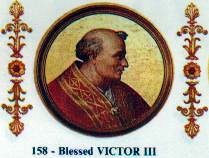
Victor III ( lat.Victor PP. III ; in the world Dauferius Epifani, Prince of Benevento , Italian Dauferio (or Desiderio) Epifani , in monasticism - Desiderius ; c. 1027 , Benevento, Campania - September 16, 1087 , Montecassino Monastery) - Pope from May 24, 1086 to September 16, 1087 .
| Victor III | |||
|---|---|---|---|
| lat Victor PP. III | |||
 | |||
| |||
| May 24, 1086 - September 16, 1087 | |||
| Church | Roman catholic church | ||
| Predecessor | Gregory VII | ||
| Successor | Urban II | ||
| Birth name | Dauferius Epifani, Prince of Benevento | ||
| Original name at birth | ital. Dauferio (or Desiderio) Epifani | ||
| Birth | 1026/1027 Benevento ( Italy ) | ||
| Death | September 16, 1087 Montecassino ( Italy ) | ||
| Buried | |||
| Father | Landulf V Benevento | ||
| Day of Remembrance | |||

Content
The Early Years and Abbey
Dauferius was born in 1026 or 1027 in Benevento and was the son of Prince Landulf V of Benevento . After his father died in the battle with the Normans in 1047 , they tried to marry him forcibly, but he fled and, although he was returned, fled again. He went to Cava de Tirreni , where he received permission to join the monks of the Hagia Sophia in Benevento. There he took tonsure under the name Desiderius. Life in the monastery of Hagia Sophia was not strict enough for the young monk, and he went to the island monastery of Tremita San Nicolo [1] in the Adriatic Sea, and in 1053 joined the hermits on Mount Maella in Abruzzi . Around this time, information about him was reported to Pope Leo IX, and it is likely that the pope ordered him to negotiate peace with the Normans after the Battle of Civitat.
A little later, Desiderius arrived at the court of Pope Victor II in Florence . There he met two monks from the famous Benedictine monastery of Montecassino , and with the permission of the pope in 1055 he arrived there and joined the monks. Pope was considered the rector of the monastery. In 1057 , Pope Stephen IX arrived at Montecassino for Christmas and, believing that he was dying, ordered the monks to elect a new abbot. Their choice fell on Desideria. The pope recovered, and wanting to keep the abbey behind him, he appointed his legate in Constantinople. In Bari , where he was planning to sail to the East, he received news of the death of the pope. After receiving a letter of protection from Robert Guiscard , the Norman Earl of Puglia, he returned to his monastery and was duly ordained by Cardinal Humbert for Easter 1058 . A year later, Pope Nicholas II elevated him to the dignity of the cardinal presbyter of the church of St. Cecilia and introduced him to the college of cardinals [2]
Desiderius rebuilt the church and monastery buildings, improved the library and strengthened monastic discipline. On October 1, 1071 , the new Montecassino Basilica was consecrated by Pope Alexander II. Desiderius's reputation increased the abbey's wealth. Money was spent on church decorations, including a large golden altar from Constantinople, adorned with precious stones and enamels. Desiderius was also appointed papal vicar in Campania, Puglia, Calabria and the Principality of Benevento with special powers in the reform of the monasteries. His reputation was so high that he received permission from the Roman pontiff to appoint bishops and hegumen from among his Benedictine brothers.
Within two years after the consecration of the new basilica of the monastery, Alexander II passed away and was succeeded by Hildebrand - Pope Gregory VII . Desiderius repeatedly assisted the pope against the Normans of southern Italy. As early as 1059 , he convinced Robert Guiscard and Richard of Capua to become vassals of the Holy See in their newly conquered territories. In 1074 and 1075 , Desiderius acted as a mediator on behalf of the pope in negotiations with the Norman princes, and even when the latter were at war with the pope, they still maintained good relations with Montecassino. At the end of 1080 , Desiderius drew Norman troops to help Gregory. In 1084 , when Rome was in the hands of Henry IV, and the pope was besieged in the castle of the Holy Angel, Desiderius warned the emperor and pope about the approaching army of Guiscard [2] .
Papacy
Desiderius, although he was a supporter of the reforms of Gregory VII, he belonged rather to the moderate party and did not support the pope. However, when Gregory lay dying in Salerno on May 25, 1085 , Abbot Montecassino was one of those whom he recommended to the cardinals of southern Italy as the most suitable successor. The Roman people expelled the antipope Clement III , and Desiderius arrived in the city to participate in the elections. The cardinals nominated him as the main candidate, but Desiderius refused and departed for Montecassino. When autumn came, he accompanied the Norman army to Rome . However, when he became aware of a conspiracy between the cardinals and the Norman princes regarding the laying of papal tiara on him, he refused to enter the city. As a result, the elections were postponed. In the Easter region, bishops and cardinals gathered in Rome and called Desiderius and the Cardinals to finally solve the issue of a new pontiff.
On May 23, a large clergy council was held, and Desiderius again refused to accept the papacy, threatening to return to his monastery in case of pressure. The next day, on the feast of Pentecost, the same scene was repeated. Then the Roman consul Sensius proposed to elect Odo, Cardinal Bishop of Ostia (later Pope Urban II), but the offer was rejected, since Odo was only a bishop.
As a result, Desiderius succumbed to the influence of the cardinals, and on May 24, 1086 he was proclaimed the new pope under the name of Victor III [3] . However, his election was not recognized by the Emperor of the Holy Roman Empire, Henry IV, and Desiderius was forced to flee Rome , occupied by the emperor’s protege Antipope Clement III . For almost a year, Victor remained in Montecassino. In the middle of Lent in 1087 , the conflict was settled, Desiderius at the Cathedral in Capua solemnly agreed to occupy the papal throne and confirmed his throne name in the presence of the Norman princes, the consul Sensia and the Roman nobility.
The Episcopal consecration and intronization of Victor III took place on May 9, 1087 in St. Peter's Basilica , as soon as Clement III was expelled from Rome by the Normans.
In June 1087 , Pope Victor returned to the city, but was forced to leave Rome again, which was besieged by the forces of the anti-Pope Clement. He returned to Montecassino, and in August of that year he convened a church cathedral , which excommunicated Clement III, proclaimed a kind of crusade against the Saracens in North Africa and subjected the anathema of Hugo of Lyons and Abbot Richard of Marseilles [2] .
The council lasted three days, and during this time Victor became seriously ill and retired to Montecassino to die on September 16, 1087 . He was buried in the tomb of the monastery basilica erected by him.
Honor
Soon after death, local veneration of Pope Victor III began. Officially, he was proclaimed blessed on July 23, 1887 by Pope Leo XIII . The memory of blessed pope Victor takes place on September 16 and October 16.
Compositions
Victor wrote a treatise, Dialogues, about miracles performed by Saint Benedict and other saints in Montecassino. A letter has also been preserved to the bishops of Sardinia, where he sent the monks, while still an abbot of Montecassino. In his De Viris Illustribus Casinensibus, Peter Deacon attributes to him the treatise Cantus ad B. Maurum and letters to King Philip I of France and Hugo of Clunius , which have not been preserved.
Notes
- ↑ The New Schaff-Herzog Encyclopedia of Religious Knowledge , 12 p. 178.
- ↑ 1 2 3 Webster, Douglas Raymund. "Pope Blessed Victor III." The Catholic Encyclopedia. Vol. 15. New York: Robert Appleton Company, 1912.13 Feb. 2013
- ↑ Miranda, Salvatore. "The Cardinals of the Holy Roman Church", Florida International University
Literature
- Victor, popes // Brockhaus and Efron Encyclopedic Dictionary : in 86 volumes (82 volumes and 4 additional). - SPb. , 1890-1907.
- A. G. Krysov. Victor III // Orthodox Encyclopedia . - M .: Church and Scientific Center "Orthodox Encyclopedia" , 2004. - T. VIII. - S. 442–443. - 752 s. - 39,000 copies. - ISBN 5-89572-014-5 .
- Webster, Douglas Raymund. "Pope Blessed Victor III." The Catholic Encyclopedia. Vol. 15. New York: Robert Appleton Company, 1912.
Links
- Victor III . Orthodox Encyclopedia . Date of treatment February 23, 2012. Archived May 25, 2012.
- Victor III (Eng.) . Encyclopædia Britannica . Date of treatment February 23, 2012. Archived May 25, 2012.
- Victor III (Eng.) . Catholic Encyclopedia . Date of treatment February 23, 2012. Archived May 25, 2012.