Hound Dog Taylor ( English Hound Dog Taylor ; real name Theodore Roosevelt Taylor , English Theodore Roosevelt Taylor ; April 12, 1915 , Natchez , Mississippi , USA - December 17, 1975 , Chicago , Illinois , USA ) - American blues guitarist, singer, author songs.
| Hound dog taylor Hound dog taylor | |
|---|---|
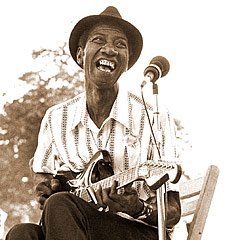 | |
| basic information | |
| Birth name | Theodore Roosevelt Taylor |
| Date of Birth | April 12, 1915 |
| Place of Birth | Natchez , Mississippi |
| Date of death | December 17, 1975 (60 years) |
| Place of death | |
| A country |  USA USA |
| Professions | singer , guitarist , songwriter |
| Years of activity | since |
| Instruments | guitar slide guitar |
| Genres | blues |
| Labels | |
Hound Dog Taylor is one of the top five Chicago slide guitarists - and blues in general. He, along with Elmore James , Robert Knightgock, Muddy Waters, and Jay Bee Hutto, combines the “wild” and chaotic delta-blues and urban Chicago style [1] . The influence of Hound Dog Taylor is felt in the work of many blues performers, like: George Torogud , Sonny Landreth, Vernon Reed, Son Silza and others [2] .
In 1984, the name of Hound Dog Taylor was solemnly entered into the Blues Hall of Fame [3] .
Content
Biography
Childhood and adolescence
Theodore Roosevelt Taylor, named after President Theodore Roosevelt , was born in Mississippi to the family of farmer Robert Taylor and Dell Herron with a physical disability: he had six fingers on each hand. His childhood was not happy - when Taylor was 9 years old, his stepfather collected his things in a bag and drove the stepson out of his house [3] , which made him live with his older sister for some time.
Since childhood, Taylor has learned to play the piano . He acquired his first guitar in his youth, but began to seriously study the game only at the age of 21 [3] . In the afternoon, Theodore worked on a farm, and in the evening he played guitar or piano in clubs and at parties throughout the Mississippi Delta [2] . He was invited several times to take part in the well-known KFFA King Biscuit Flour radio show in West Helena, Arkansas , where he played with legendary bluesmen Robert Lockwood and Sunny Boy Williamson . In 1942 , the racist terrorist organization Ku Klux Klan was attacked by Taylor because he met a white girl: the rest of that day, he was hiding in a drainage ditch - and the next day he fled to Chicago so that he would never again in his life those lands do not return [3] .
The first 15 years in the “city of winds” Taylor worked in a factory, made television receivers, and in his free time he played in ghetto bars. There he decided to start a musical career, becoming a bluesman. At the same time, he changed his style of play: he began to use the slide technique, where a smooth transition from sound to sound is achieved by pressing a metal plate or bottle neck to the strings. Undoubtedly, such changes were inspired by the play of the popular slide guitarist Elmore James .
In those years, Taylor gave concerts throughout the city and earned the favor of many blues fans, becoming the local favorite. Around this time, he got the nickname "Hound Dog" ( eng. Hound dog - "hound dog", "hunter"). One day, Taylor was sitting in a club, never taking his eyes off a two ladies, and his friend, noticing this, called him a “hunter,” because, according to the second, Taylor constantly “hunted” women . The nickname stuck [3] . One evening, being drunk, Taylor took a razor blade and cut off the sixth finger on his right hand [3] .
Hound Dog Taylor and the Houserockers
Hound Dog began to gradually select musicians for his own group. In 1959, during a performance on the West Side, Taylor met Mississippi-born guitarist Brewer Phillips, with whom he played for the first time together: both quickly became friends - and created the band Hound Dog Taylor and the Houserockers, joined by drummer Levi Warren. In 1960, Hound Dog recorded the first single, "Baby Is Coming Home" / "Take Five" on the Bea & Baby Records label - but was not successful outside of Chicago. In 1961, Freddie King became famous for his instrumental composition “Hideaway,” which he concluded by taking the heard Taylor song at a nightclub as a basis. In 1962 , Firma Records released Taylor's second single, Christine / Alley Music, and the next single, Watch Out / Down Home, was released after a five-year hiatus, in 1967 via Checker Records. Like the first single, these recordings were unsuccessful.
In 1965, Levi Warren replaced the new drummer Ted Harvey. Harvey and Taylor first met in 1955 , when Ted played with Elmore James; meeting for the second time at the funeral of James in 1963 - after talking with Taylor, Ted decided to join Hound Dog Taylor and the Houserockers. Thus, the group consisted of only three musicians: Hound Dog - guitar and vocals, Phillips - bass guitar (sometimes playing the second electric guitar) and Ted - drums. Since Taylor was a truly gifted slide guitar player and idolized to play live, The Houserockers never rehearsed before performing. Before any performance, the Hound Dog traditionally allowed himself one sip of whiskey , then a mug of beer: only after such a “ritual” was it ready to play. Similar with the members of the group: they began to play only after drinking, they loved to drink. As a rule, Taylor began his concert with the phrase: “Hey, let's have some fun” (Hey, let's have some fun!). The band used to play almost all night — six or seven-hour performances were the norm. In the 1960s, the Hound Dog most often performed at the Florence Lounge bar in the South Side of Chicago.
Collaboration with Alligator Records
In 1969, Taylor met future producer Bruce Iglauer, a man who was impressed by the talent of the musician. Iglauer first noticed Taylor at Eddie Shaw's nightclub, where Hound Dog performed with other bluesmen. However, Iglauer did not happen to hear Taylor play with The Houserockers. And only a year later, having arrived in Chicago , he finally attended one of the performances of the group. At that time, The Houserockers received meager wages: only $ 45 for each performance. Iglauer finally invited The Houserockers to the studio - and in vain tried to convince the director of Delmark Records Bob Kester to sign an agreement with Taylor. However, without having agreed with Kester, Iglauer, who inherited 2,500 thousand dollars, founded his own recording studio and independently produced Hound Dog records: this was how the new label Alligator Records was formed .
In the spring of 1971, work began on the Houserockers debut album at Chicago Sound Studios. Hound Dog played a Japanese electric guitar, which he bought for $ 30, and also used amplifiers from Sears Roebuck. Less than a year later, the album, released under the name Hound Dog Taylor and the HouseRockers, became one of the best-selling blues records on an independent label: in the first year alone, 9,000 copies were sold. The album consisted of 12 tracks: eight of them were written by Taylor himself, three borrowed from his idol, the legend of the Chicago blues Elmore James (“Held My Baby Last Night”, “Wild About You, Baby”, “It Hurts Me Too”) and one the song was folk ("44 Blues"). The song “Give Me Back My Wig” brought popularity to Taylor, the cover version of which was recorded by quite a few musicians, each in his own way. The best known versions are Stevie Ray Vaughn and Luther Ellison .
The album Hound Dog Taylor and the Houserockers brought Hound Dog a wide fame among the audience. Almost immediately after the release of the record, the band went on their first tour of the country, and then invited him to perform in Australia and New Zealand along with Freddie King , Sunny Terry and Brown McGee . According to many music critics, Hound Dog Taylor and the Houserockers are one of the best slide guitar albums of all time [4] . Even then, Taylor decided not to change his traditional concert program: he continued to sing the same songs and play in the same style on his cheap Japanese guitar.
After the release of the debut album on the pages of famous and reputable music publications (such as Rolling Stone and Guitar Player ), articles about Hound Dog Taylor began to appear for the first time. And when in 1973 the second studio album titled Natural Boogie was released - Taylor's slide guitar sounded more confident and more powerful than ever. All 11 songs were recorded during the first session in 1971 at Sound Studios. The album, in addition to Taylor's own compositions, included cover versions of two Elmore James songs: the dynamic guitar boogie “Hawaiian Boogie” and “Talk To My Baby” and “Talk To My Baby” and one instrumental work by Brewer Phillips called “One More Time ". The album included another of Taylor’s most famous songs, “Sadie,” which, according to producer Bruce Eglauer, was the first song written by a musician [5] . Other popular tracks include Take Five, which was released as a single back in 1960 . Taylor himself liked this album more than the previous one. He received a lot of approving reviews, and the musician cemented the fame of one of the leading bluesmen not only of Chicago, but of the whole country [6] [7] .
Anyone who loves the Chicago blues should have this album [8] .
Last years of life and death
Since the beginning of 1975 - when the musician was at the zenith of fame and his records were sold in large numbers - Taylor decided to record a live album. In those days, although Taylor and Phillips were friends, they often quarreled with each other, and sometimes these quarrels grew into fights. Such a fight between Phillips and Hound Dogs began in May 1975, when Phillips and San Silz stopped by to visit Taylor. Phillips offended Taylor's wife, and Hound Dog, leaving the room, subsequently returned with a rifle in his hands. Aiming at the sofa, he twice shot Phillips - the first bullet hit him in the forearm , and the second - in the leg of the guitarist. Fortunately, Sils immediately snatched the weapon from Taylor's hands, the injuries were not serious, and Phillips quickly recovered. However, the health of Taylor himself, who was a heavy smoker, deteriorated significantly at that time. In November 1975, Taylor was hospitalized due to breathing problems, and later a lung cancer was found in the musician.
In the minutes before his death, Taylor's last request was fulfilled: Phillips came to the hospital and forgave him the shooting, and the next day, December 17 , Taylor died. They buried the musician at Rivervale Cemetery in Elsip, Illinois. Taylor's bronze tombstone depicts a guitar and the musician's favorite phrase is written: “I'm Wit'cha, Baby ...” (“I'm with you, honey…”).
In 1976 a live album Beware of the Dog was released, the material of which was recorded during two concerts of the group: January 18, 1974 at Northwestern University in Evanston, Illinois and on performances from November 22-24, 1974 in the Smiling Dog Saloon club in Cleveland , Ohio State .
For a while, Brewer Phillips and Ted Harvey continued to play together, but subsequently Phillips decided to start a solo career [9] .
Discography
Numbered albums
- 1971 - Hound Dog Taylor and the HouseRockers
- 1973 - Natural Boogie
- 1976 - Beware of the Dog
- 1982 - Genuine Houserocking Music
- 1994 - Freddie's Blues
- 2004 - Release the Hound
Collections
- 1992 - Have Some Fun [live]
- 1992 - Live at Joe's Place
- 1997 - Houserockin 'Boogie
- 1997 - Live at Florence’s
- 1999 - Deluxe Edition
- 1999 - Live in Boston
Notes
- ↑ Hound Dog Taylor & Houserockers "Hound Dog Taylor and the Houserockers" 1971
- ↑ 1 2 Taylor Biography on Alligator Records
- ↑ 1 2 3 4 5 6 Biography of Hound Dog Taylor
- ↑ Review of the album Hound Dog Taylor and the Houserockers on Allmusic
- ↑ Review of the Natural Boogie album on Keno's HOUND DOG TAYLOR
- ↑ Review of the Natural Boogie album on the Alligator Records website
- ↑ Review of the Natural Boogie album on the Allmusic website
- ↑ Blues Unlimited - Natural Boogie
- ↑ BRUCE IGLAUER'S NOTES ON HOUND DOG