In the middle of the XIX century, a number of works appeared on the so-called symbolic calculus and its application to the solution of certain types of linear differential equations . The essence of symbolic calculus is that the functions of the differentiation operator are introduced and properly interpreted {\ displaystyle p = {d \ over dt}}  (see Operator Theory ). Among the essays on symbolic calculus should be noted published in 1862 in Kiev, a comprehensive monograph of Professor Mathematician M. Ye. Vaschenko-Zakharchenko "Symbolic calculus and its application to the integration of linear differential equations." It sets and resolves the main tasks of the method, which later became known as the operating method.
In 1892, the works of the English scientist O. Heaviside appeared , devoted to the application of the method of symbolic calculus to solving problems of the theory of propagation of electrical oscillations in wires. Unlike his predecessors, Heaviside defined the inverse operator uniquely, assuming {\ displaystyle {\ frac {1} {p}} f (t) = \ int \ limits _ {0} ^ {t} \! f (u) \, du} 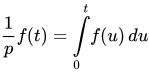 and counting {\ displaystyle f (u) = 0}
  for {\ displaystyle u <0}
  . Heaviside's works laid the foundation for the systematic application of symbolic, or operational, calculus to solving physical and technical problems.
However, the operational calculus widely developed in the Heaviside writings did not receive a mathematical justification, and many of its results remained unproved. The rigorous justification was given much later, when the link between the functional Laplace transform was established {\ displaystyle {\ bar {f}} (p) = L \ left [f (t) \ right] = \ int \ limits _ {0} ^ {\ infty} \! e ^ {- pt} f (t ) \, dt} ![{\bar {f}}(p)=L\left[f(t)\right]=\int \limits _{{0}}^{\infty }\!e^{{-pt}}f(t)\,dt](https://wikimedia.org/api/rest_v1/media/math/render/svg/cc36d3d57f68cac0ae7af1af265a41b6a5d2f443) and differentiation operator {\ displaystyle {d \ over dt}.}
and differentiation operator {\ displaystyle {d \ over dt}.}  Namely, if there is a derivative {\ displaystyle f ^ {\ prime} (t)}
  , for which {\ displaystyle L \ left [{df \ over dt} \ right]}
 ![L\left[{df \over dt}\right]](https://wikimedia.org/api/rest_v1/media/math/render/svg/487d19167a0449f2de0461472140ad26162fdbf9) exists and {\ displaystyle f (0) = 0}
exists and {\ displaystyle f (0) = 0}  then {\ displaystyle L \ left [{df \ over dt} \ right] = p {\ bar {f}} (p)}
 ![L\left[{df \over dt}\right]=p{\bar {f}}(p)](https://wikimedia.org/api/rest_v1/media/math/render/svg/118706c1762570c243146e84b22b7fcf9c214981)
The original of the linear combination of functions is equal to the linear combination of images with the same coefficients.
- {\ displaystyle a \ cdot f (t) + b \ cdot g (t) \ quad \ Rightarrow \ quad a \ cdot F (p) + b \ cdot G (p),}
where a and b are arbitrary complex numbers.
- {\ displaystyle f (at) \ quad \ Rightarrow \ quad {\ frac {1} {a}} F \ left ({\ frac {p} {a}} \ right),}
where a> 0.
- Differentiation of the original
- {\ displaystyle f (t) \ quad \ Rightarrow \ quad F (p);}
- {\ displaystyle f '(t) \ quad \ Rightarrow \ quad pF (p) -f (0);}
- {\ displaystyle f '' (t) \ quad \ Rightarrow \ quad p ^ {2} F (p) -pf (0) -f '(0);}
- {\ displaystyle f '' '(t) \ quad \ Rightarrow \ quad p ^ {3} F (p) -p ^ {2} f (0) -pf' (0) -f '' (0);}
- {\ displaystyle ...}
- {\ displaystyle f ^ {(n)} (t) \ quad \ Rightarrow \ quad p ^ {n} F (p) -p ^ {n-1} f (0) -p ^ {n-2} f ' (0) -p ^ {n-3} f '' (0) -...- f ^ {(n-1)} (0).}
- {\ displaystyle -tf (t) \ quad \ Rightarrow \ quad F '(p).}
- Integration of the original
- {\ displaystyle \ int \ limits _ {0} ^ {t} f (t) dt \ quad \ Rightarrow \ quad {\ frac {1} {p}} F (p).}
- {\ displaystyle {\ frac {f (t)} {t}} \ quad \ Rightarrow \ quad \ int \ limits _ {p} ^ {\ infty} F (p) dp.}
- {\ displaystyle e ^ {at} f (t) \ quad \ Rightarrow \ quad F (pa).}
- {\ displaystyle f (t- \ tau) \ quad \ Rightarrow \ quad e ^ {- p \ tau} F (p).}
- Multiplication theorem (convolutions)
- {\ displaystyle \ int \ limits _ {0} ^ {t} f (\ tau) g (t- \ tau) d \ tau \ quad \ Rightarrow \ quad F (p) \ cdot G (p).}
The transition process in the switched
RL-chain Task
The figure shows a switched RL chain . At some time t = 0, the key K closes. Determine the dependence of the current in the RL-chain from time to time.
The traditional solution
According to the second Kirchhoff law, the scheme is described by the following differential equation:
- {\ displaystyle U = iR + L {\ frac {di} {dt}},}
where the first term describes the voltage drop across the resistor R, and the second to the inductance L.
We do variable replacement {\ displaystyle i = ab} and reduce the equation to the form:
- {\ displaystyle U = Rab + L (a'b + ab '); \ qquad U = a (Rb + Lb') + La'b.}
Since one of the factors a, b can be chosen arbitrarily, we choose b so that the expression in parentheses is zero:
- {\ displaystyle Rb + Lb '= 0.}
Separate variables:
- {\ displaystyle {\ frac {b '} {b}} = - {\ frac {R} {L}}; \ qquad \ ln b = - {\ frac {R} {L}} t; \ qquad b = e ^ {- {\ frac {R} {L}} t}.}
Given the chosen value of b, the differential equation is reduced to the form
- {\ displaystyle U = La'e ^ {- {\ frac {R} {L}} t}; \ qquad a '= {\ frac {Ue ^ {{\ frac {R} {L}} t}} { L}};}
Integrating, we get
- {\ displaystyle a = {\ frac {L} {R}} \ cdot {\ frac {Ue ^ {{\ frac {R} {L}} t}} {L}} + C = {\ frac {Ue ^ {{\ frac {R} {L}} t}} {R}} + C; \ qquad}
We get the expression for the current
- {\ displaystyle i = ab = \ left ({\ frac {Ue ^ {{\ frac {R} {L}} t}} {R}} + C \ right) \ cdot e ^ {- {\ frac {R } {L}} t} = {\ frac {U} {R}} + Ce ^ {- {\ frac {R} {L}} t};}
The value of the integration constant is found from the condition that at the time t = 0 there was no current in the circuit:
- {\ displaystyle i (0) = 0; \ qquad {\ frac {U} {R}} + C = 0; \ qquad C = - {\ frac {U} {R}}.}
Finally we get
- {\ displaystyle i = {\ frac {U} {R}} \ left (1-e ^ {- {\ frac {R} {L}} t} \ right).}
Operator solution solution
Find images of each of the components of the differential equation:
- {\ displaystyle i \ Rightarrow I; \ qquad U \ Rightarrow {\ frac {U} {p}}; \ qquad iR \ Rightarrow IR; \ qquad L {\ frac {di} {dt}} \ Rightarrow L \ left [ pI-i (0) \ right] = pLI.} [one]
{\ displaystyle U \ Rightarrow {\ frac {U} {p}}} is obtained because the change in U in time is expressed by the function U = H (t) U (the key is closed at the time t = 0), where H (t) is a Heaviside step function , ( H (t) = 0 for t <0 and H (t) = 1 at t = 0 and t > 0, and the image H (t) is 1 / p ).
We get the following image of the differential equation
- {\ displaystyle {\ frac {U} {p}} = RI + pLI = I (R + pL).}
From the last expression we find the current image:
- {\ displaystyle I = {\ frac {U} {p (R + pL)}}.}
Thus, the solution is reduced to finding the original current in a known image. We decompose the right side of the equation into elementary fractions:
- {\ displaystyle {\ frac {U} {p (R + pL)}} = {\ frac {A} {p}} + {\ frac {B} {R + pL}} = {\ frac {A (R + pL) + Bp} {p (R + pL)}} = {\ frac {AR + p (AL + B)} {p (R + pL)}};}
- {\ displaystyle AR = U; \ qquad A = {\ frac {U} {R}};}
- {\ displaystyle AL + B = 0; \ qquad B = -AL = - {\ frac {UL} {R}};}
- {\ displaystyle I = {\ frac {U} {Rp}} - {\ frac {UL} {R (R + pL)}} = {\ frac {U} {Rp}} - {\ frac {U} { R ({\ frac {R} {L}} + p)} = {\ frac {U} {R}} \ left ({\ frac {1} {p}} - {\ frac {1} {{ \ frac {R} {L}} + p}} \ right).}
Find the originals of the elements of the last expression:
- {\ displaystyle {\ frac {1} {p}} \ Leftarrow 1; \ qquad {\ frac {1} {{\ frac {R} {L}} + p}} \ Leftarrow e ^ {- {\ frac { R} {L}} t}.}
Finally we get
- {\ displaystyle i = {\ frac {U} {R}} \ left (1-e ^ {- {\ frac {R} {L}} t} \ right).}
Conclusion
Operational calculus is extremely convenient in electrical engineering for calculating the dynamic modes of various circuits. The calculation algorithm is as follows.
1) All elements of the circuit are considered as resistances Z i , the values of which are found on the basis of images of transition functions of the corresponding elements.
For example, for a resistor:
- {\ displaystyle u = iR; \ quad \ Rightarrow \ quad U = IR \ quad \ Rightarrow \ quad Z_ {R} = R.}
For inductance:
- {\ displaystyle u = L {\ frac {di} {dt}} \ quad \ Rightarrow \ quad U = IpL \ quad \ Rightarrow \ quad Z_ {L} = pL.}
For capacity:
- {\ displaystyle u = {\ frac {1} {C}} \ int idt \ quad \ Rightarrow \ quad U = {\ frac {I} {pC}} \ quad \ Rightarrow \ quad Z_ {C} = {\ frac {1} {pC}}.}
2) Using the specified resistance values, we find the images of the currents in the circuit, using standard methods of calculating circuits used in electrical engineering.
3) Having images of currents in the circuit, we find the originals, which are the solution of the differential equations describing the circuit.
Remarks
It is interesting to note that the expressions obtained above for the operator resistance of various elements with accuracy up to
- {\ displaystyle p \ rightarrow j \ omega}
coincide with the corresponding expressions for resistances in AC circuits:
- {\ displaystyle Z_ {R} = R; \ qquad Z_ {L} = j \ omega L; \ qquad Z_ {C} = {\ frac {1} {j \ omega C}}.}