Christopher Columbus ( Italian: Cristoforo Colombo , Spanish Cristóbal Colón , Latin Christophorus Columbus ; between August 26 and October 31, 1451 , Republic of Genoa - May 20, 1506 , Valladolid , Kingdom of Castile and Leon ) - Italian navigator , in 1492 opened the New World ( America ) for Europeans .
| Christopher Columbus | |
|---|---|
| ital. Cristoforo colombo | |
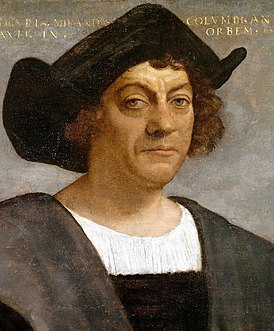 A possible posthumous portrait of a brush by Sebastiano del Piombo (1519). Metropolitan Museum of Art ( New York , USA ) | |
| Birth name | |
| Date of Birth | October 31, 1451 |
| Place of Birth | |
| Date of death | May 20, 1506 (54 years old) |
| A place of death | |
| A country | |
| Occupation | |
| Father | |
| Mother | |
| Spouse | |
| Children | Diego Columbus Fernando Columbus , |
| Autograph | |
Columbus was the first of the well-known travelers to cross the Atlantic Ocean in the subtropical and tropical strip of the northern hemisphere and the first of Europeans to go to the Caribbean Sea and Sargasso Sea [3] . He discovered and launched the study of South and Central America , including their continental parts and the nearby archipelagos - the Greater Antilles ( Cuba , Haiti , Jamaica and Puerto Rico ), the Lesser Antilles (from Dominica to the Virgin Islands , as well as Trinidad ) and the Bahamas .
Columbus can be called the discoverer of America for Europeans with reservations, because even in the Middle Ages Europeans in the person of the Icelandic Vikings were in North America (see Vinland ). But, since there was no information about these campaigns outside Scandinavia, it was the Columbian expeditions that first made information about the lands in the west public domain and laid the foundation for the colonization of America by Europeans.
In total, Columbus made 4 voyages to the shores of America:
- The first voyage ( August 3, 1492 - March 15, 1493 ).
- Second voyage ( September 25, 1493 - June 11, 1496 ).
- Third voyage ( May 30, 1498 - November 25, 1500 ).
- The fourth voyage ( May 9, 1502 - November 7, 1504 ).
Content
- 1 Biography
- 1.1 Youth
- 1.2 Expeditions
- 1.2.1 First expedition
- 1.2.1.1 Travel Timeline
- 1.2.2 Division of the world
- 1.2.3 Second expedition
- 1.2.3.1 Timeline
- 1.2.4 Third expedition
- 1.2.5 Fourth expedition
- 1.2.5.1 Timeline
- 1.2.1 First expedition
- 1.3 The last years of life and death
- 2 The fate of the remains
- 3 Proceedings
- 4 Mass colonization of Hispaniola
- 5 Columbus Contemporaries Expeditions to South America
- 6 Offspring
- 7 Coat of arms of Columbus
- 8 Memory
- 8.1 Monuments
- 8.1.1 Works Tsereteli
- 8.1.2 Demolition of monuments in Venezuela
- 8.1.3 In the USA
- 8.2 named after Columbus
- 8.3 Money Images
- 8.3.1 On columns
- 8.3.2 On commemorative coins
- 8.4 In philately
- 8.5 In culture and art
- 8.1 Monuments
- 9 notes
- 10 Literature
- 11 Links
Biography
Youth
Columbus was born in Italy into a poor Genoese family, his father was Domenico Colombo ( Italian: Domenico Colombo ), and his mother was Susanna Fontanarossa ( Italian: Susanna Fontanarossa ).
The exact transcription of his name from Spanish is Cristobal Colón , however in East Slavic and some other languages he is known as Christopher Columbus ( Christophor transliteration of the Greek name Χριστόφορος). According to the old version, in addition to Christopher, the family also had other children: Giovanni (died in childhood, in 1484), Bartolomeo , Giacomo, Bianchella (married Giacomo Bavarello). Traditionally, six cities in Italy and Spain dispute the honor of being the small homeland of Columbus.
The appearance of Columbus is known for portraits that were painted after his death. Bartolome de Las Casas , who saw Columbus in 1493, describes him like this:
He was tall, above average, his face was long and respectful, his aquiline nose, eyes bluish-gray, white skin with redness, his beard and mustache were reddish in youth, but turned gray in his labors.
Studied at Pavia University . Around 1470, he married Don Felipe Monis de Palestlello, daughter of the navigator of the times of Prince Enrique . Until 1472, Columbus lived in Genoa , and from 1472 in Savona . In the 1470s, he participated in sea trade expeditions.
It is believed that as far back as 1474, the astronomer and geographer Paolo Toscanelli informed Columbus in a letter that India could be reached by a much shorter sea route if you sail west. Apparently, even then, Columbus was thinking about his project of a sea voyage to India. Perhaps, Columbus' underestimation of the size of the Earth was influenced by the work of Imago Mundi (Latin Picture of the World, 1410) by Bishop Peter de Alliako [4] [5] . After making his own calculations based on the Toscanelli map, he decided that it was most convenient to sail through the Canary Islands , from which, in his opinion, there were about five thousand kilometers to Japan .
In 1476, Columbus moved to Portugal , where he lives for nine years. It is known that in 1477 Columbus visited England , Ireland and Iceland , where he could get acquainted with the data of Icelanders about the lands in the west. During this time, he also manages to visit the Gulf of Guinea as part of the expedition of Diogu de Azambuja , who went there in 1482 to build the fortress of Elmina (Ghana). The first appeal of Columbus with a proposal to sail to India by the western route dates back to about 1475-1480. He addressed it to the government and merchants of his native Genoa. There was no response. In 1483, he proposed his project to the Portuguese King Joao II . At first the king wanted to support a bold project, but after a long study he rejected it.
In 1485, Columbus with his son Diego moved to Spain, avoiding persecution. In the winter of 1485-1486, he finds shelter in the monastery of Santa Maria da Rabida . Rector Juan Perez de Marchena received him and organized the first letter to his acquaintance, the confessor of Queen Hernando de Talavera , with a summary of the ideas of Columbus. The king of Spain was at that time in the city of Cordoba , where preparations were under way for the war with Granada .
In 1486, Columbus was able to interest the Duke of Medina Seli with his project. Since his own finances were not enough to organize an expedition to the west, Medina Seli brought Columbus with royal financial advisers, merchants and bankers and with his uncle - Cardinal Mendoza .
In the winter of 1486, Columbus was introduced to Pedro González de Mendoza , the Archbishop of Toledo and the great Cardinal of Spain, who, in turn, contributed to his audience with the Catholic kings . To study the proposals of Columbus, a commission of theologians , cosmographers , lawyers , monks and courtiers was appointed, led by Talavera. The commission met for four years, but due to Columbus' secrecy and his reluctance to disclose plans, he did not reach a final verdict.
On April 20, 1488, Columbus, following the royal court from city to city, unexpectedly received a letter from the Portuguese king with a proposal to return to Portugal:
| And if you are afraid of Our justice regarding some of your obligations, then be aware that neither after your arrival, nor during your stay in Portugal, nor after your departure, you will be arrested, detained, charged, convicted, or prosecuted any reason arising from civil, criminal or any other law. |
Columbus sends his proposals to other addresses: from the king of England, Henry VII, in February 1488, he received a favorable reply, but without any specific proposals.
In 1491, a second personal meeting with Ferdinand and Isabella took place in Seville. The result for Columbus was again disappointing: "In view of the enormous costs and efforts required to wage war, starting a new enterprise is not possible." It was decided to return to the negotiations after the end of the war.
In the same year, Columbus turned to the Duke of Medina Sidonia , the largest tycoon, the owner of about a hundred merchant ships, but was also refused from him.
Finally, in January 1492, the long-awaited capture of Granada took place. Columbus apparently greatly overestimated the triumphant enthusiasm of the king of Spain: when he formulated the conditions under which he intended to open and own new lands (to appoint him vice-king of new lands, to award him the title of “Admiral of the World Ocean”), His Majesty recognized the demands of Columbus "Excessive and unacceptable," negotiations were interrupted, and the king departed from Santa Fe.
Columbus leaves for Cordoba in February 1492, and then declares his intention to emigrate to France altogether.
Here, Queen Isabella took a step towards. During a previous meeting, Columbus shared with her his idea of the possibility of striking from the east on the Ottoman Empire , which carried out at that time a massive attack on land and sea in Europe, and even on the possible liberation of Christian shrines in Palestine lost by Europeans since the Crusades [6] . The idea of the coming liberation of the Holy Sepulcher captured the heart of Isabella so much that she decided not to give this chance to either Portugal or France. Although the Kingdom of Spain was formed as a result of the dynastic marriage of Ferdinand of Aragon and Isabella of Castile, their monarchy was preserved, however, by separate independent administrations, cortes and finances. “I will lay my jewels,” she said.
On April 17, 1492, the royal couple granted Columbus and his heirs the title of “don” (that is, made him a nobleman) and confirmed that, if the overseas project was successful, he would be the Admiral of the World Ocean and the Viceroy of all the lands that he would discover or acquire , and will be able to transfer these titles by inheritance. Nevertheless, the money for the equipment of the expedition Columbus had to seek on their own due to the lost state tax payments of Her Majesty the Queen of Castile . In addition, under the contract, an eighth of the costs should have been borne by Columbus himself, who did not have a penny at all.
However, Columbus was helped by Martin Alonso Pinson . One of the ships, the Pint, was his own, and he equipped it at his own expense; He gave Christopher a loan of money for the second ship, so that Columbus could make his formal contribution under the contract.
Expeditions
Between 1492 and 1504, Christopher Columbus undertook four research expeditions, describing them in his logbook. The original of the magazine did not survive, but Bartolome de Las Casas made a partial copy of this magazine, which has survived to this day, thanks to which many details of travels became known.
First expedition
During his first expedition, Columbus equipped three vessels - the Karakara Santa Maria (the flagship owner and captain of the karaka was Cantabrian Juan de la Cosa ), Pinta (the owner of the vessel and its captain Martin Alonso Pinson ) and the third was a vessel that often called " Nina ." The length of the vessel is 17.3 meters, width - 5.6 meters, draft - 1.9 meters, displacement - 101.2 tons, crew - 40 people. The captain of Nigny is Vicente Yanyes Pinson , the maestre and master of the ship is Juan Niño ( Spanish Juan Niño ), the older brother of Pedro Alonso Nino, and the pilot is Sancho Ruiz da Gama. The flotilla team included only 100 people. The European’s foot first set foot on the islands of the Caribbean - Guanahani ( Bahamas ), Hispaniola ( Haiti ), Juan ( Cuba ). This journey began the expansion of Spain into the New World.
In historical science, the debate is about which island, called the local language " Guanahani ", and Columbus called "San Salvador", was opened on October 12, 1492 : Watling Island or Samana Key Island. However, there is no doubt that this was one of the Bahamas included in the Lucaya archipelago.
At the same time, Christopher Columbus considered these new lands East Asia - the outskirts of China , Japan or India. In the future, the newly discovered territories for a long time were called by the Europeans West Indies , literally "West India", since this "India" had to sail west, unlike India and Indonesia , which in Europe had long been called the East Indies (" East India ").
Travel timeline
- August 3, 1492 - Columbus launched ships from the harbor of the Spanish city of Palos de la Frontera .
- September 6 - After eliminating the leak at the Pint, the expedition continued straight west from the island of Homer ( Canary Islands ).
- September 16 - accumulations of green algae began to appear on the route of the expedition. Gradually, they became more and more. Ships went through this strange body of water for three weeks. So the Sargasso Sea was discovered.
- October 7 - at the request of a team that believes that Japan "slipped", the ships change course to the west-south-west.
- October 12 - at two o’clock in the morning, sailor Rodrigo de Triana from the board of the Pint discovered land. On the eve of the sailors noticed the lights .
- October 13 - Columbus landed, hoisted the Castilian flag on it, formally took over the island and drew up a notarial deed about it. The island is named San Salvador (for more details see Guanahani ). Its coordinates are 24 ° c. w. and 74 ° 30 ′ z. The Spaniards saw locals on the island. Perhaps they were Arawak . Arawaki walked completely naked, and ritual patterns were applied to the body. They did not know iron weapons. On the sea, they traveled on oars of the boat, accommodating forty people. It was here that the natives gave Columbus “dry leaves” - tobacco . Seeing some of them with pieces of gold, Columbus tried to find out its origin and, capturing six Arawak prisoners, forced them to show the way further. For two weeks, Columbus gradually moved south, discovering new islands from the Bahamas. The local people wore clothes made of cotton yarn. The Spaniards first saw hammocks in their homes. From the inhabitants of the Spaniards learned about the large southern island of Cuba .
- October 28, 1492 - Columbus landed in Bariei Bay in northeastern Cuba, 76 ° C. After talking with the locals, Columbus decided that he was on one of the East Asian peninsulas. However, the Spaniards found neither gold, nor spices, nor large cities. The houses of the inhabitants were built from branches and reeds, they cultivated cotton , potatoes , tobacco and maize ( corn ). Believing that he had reached the poorest part of China, Columbus decided to turn east, where, according to his ideas, the richer Japan lay.
- November 13, 1492 - after learning from the natives about an island full of gold, Columbus moved east in search of him.
- November 15, 1492 - Columbus in his diary for the first time describes tobacco used by the Indians .
- November 20, 1492 - Pinta disappeared. Her captain Pinson Sr. was distinguished by unauthorized actions and repeatedly retired. He left Columbus near the island of Cuba, hoping to discover an imaginary island. He was also the first to later discover Haiti and the river where he landed (now Puerto Cabello ; this river was originally named after him). The two remaining vessels continued eastward until they reached the eastern tip of Cuba, Cape Maisi.
- December 6, 1492 - the island of Haiti was discovered, which Columbus called Hispaniola, because its valleys seemed to him like the lands of Castile. Moving along the north coast, the Spaniards discovered the island of Tortuga .
- December 25, 1492 - "Santa Maria" sat on the reefs. With the help of local residents, guns, supplies and valuable cargo were removed from the ship. From the wreckage of the ship was built on about. Haiti Fort, named La Navidad (Christmas). Columbus left 39 sailors here, armed the fort with cannons from Santa Maria and left them supplies for a year, and on January 4, 1493 , taking several islanders with him, went to sea on a small Ninye.
- January 6, 1493 - off the north coast of Hispaniola, Nina came across a Pint. Pinson Sr. explained his absence due to weather conditions.
- January 16 - two ships embarked on the return trip.
- February 12 - a storm arose, and on the night of February 14, the ships lost sight of each other. The storm was so strong that the Spaniards were ready for imminent death.
- February 15 - when the wind calmed down a bit, the sailors saw the land, and on February 18, "Nina" approached the island of Santa Maria ( Azores ).
- On March 9, Nina anchors in Lisbon, where João II accepts Columbus as His Serene Highness and orders him to be equipped with everything necessary.
- March 15 - Nina returns to Spain. On the same day, "Pint" comes there. Columbus brings with him the natives (who are called Indians in Europe), some gold, plants, fruits and feathers of birds never seen before in Europe.
Division of the world
Between 1452 and 1456, Pope Nicholas V and Calixtus III granted Portugal the right to own land, open to the south and east of Cape Bohador , "all the way to the Indians."
The return of Christopher Columbus from his first expedition and the news that he had discovered the "Western India" ( West Indies ), alarmed Portugal: this discovery deprived it of previously granted territorial rights. Castile, however, refused to recognize papal awards, citing the right of first discovery. Only the head of the Catholic Church could resolve the conflict in peace.
On May 3, 1493, Pope Alexander VI announced that all the lands that Castile had discovered or would open west of the meridian , passing 100 leagues west of the Cape Verde Islands , should belong to her, and new lands to be discovered east of this line - Portugal. The papal decision formed the basis of the Spanish-Portuguese negotiations, which a year later ended with the Treaty of Tordesillas on June 7, 1494 .
Second expedition
The second flotilla of Columbus already consisted of 17 vessels. The flagship is Maria Galante (displacement of two hundred tons). According to various sources, the expedition consisted of 1500-2500 people. Among the participants of the 2nd expedition, the pioneer Juan de la Cosa , the notary Rodrigo de Bastidas , as well as the future conqueror and governor of Cuba, Diego Velazquez de Cuellar . In its composition there were already not only sailors, but also monks, priests, officials, serving nobles, courtiers. They brought horses and donkeys, cattle and pigs, vines, seeds of agricultural crops with them to organize a permanent colony
During the expedition, the complete conquest of Hispaniola was carried out, the mass extermination of the local population began. The city of Santo Domingo is laid. The most convenient sea route to the West Indies has been laid. The Lesser Antilles , the Virgin Islands , the islands of Puerto Rico , Jamaica ; almost completely explored the southern coast of Cuba. At the same time, Columbus continues to claim that he is in Western India.
Chronology
- September 25, 1493 - the expedition left Cadiz . In the Canary Islands they took sugarcane and dogs accustomed to hunting. The course ran about 10 ° to the south than the first time. Later, all ships from Europe to Western India began to use this route.
- With a good tailwind (in the equatorial region of the Atlantic Ocean, winds constantly blow west), the journey took only 20 days, and already on November 3, 1493 (Sunday), an island from the ridge of the Lesser Antilles, called Dominica , was discovered.
- November 4 - the expedition arrived at the largest of the islands here, called Guadeloupe . On the open islands, the Caribbean lived, raiding large islands on peaceful Arawak islands. Their weapons were bows and arrows with tips from fragments of tortoise shells or serrated fish bones.
- November 11 - Montserrat , Antigua , Nevis islands opened.
- November 13 - the first armed clash with the Caribbean occurred near the island of Santa Cruz .
- November 15 - north of Santa Cruz, the archipelago that Columbus called the “Islands of the Eleven Thousand Maidens” was opened — they are now called the Virgin Islands . Bypassing the archipelago on both sides, the ships of the flotilla three days later joined at the western end of the ridge.
- November 19 - Spaniards landed on the western shore of a large island that Columbus called San Juan Bautista. Since the 16th century, it has been called Puerto Rico .
- November 27 - the flotilla approached the one built during the first expedition on about. Haiti fort La Navidad , but on the shore the Spaniards found only traces of conflagration and corpses.
- January 1494 - a city was built east of the burnt fort, La Isabella in honor of Queen Isabella . Many Spaniards were struck by the yellow fever epidemic. A detachment sent for reconnaissance in the interior of the country found gold in river sand in the mountainous region of Cordillera Central.
- March 1494 - Columbus made a trip inside the island. Meanwhile, in Isabella, most of the food was spoiled due to the heat, and Columbus decided to leave only 5 ships and about 500 people on the island, and send the rest to Spain. With them, he handed over to the king and queen that he had found rich deposits of gold, and asked to send cattle, food supplies and agricultural implements, offering to pay for them slaves from among the local residents.
- April 24, 1494 - leaving a garrison in La Isabella under the command of his son Diego, Columbus led three small ships west along the southeast coast of Cuba.
- May 1 - a narrow and deep bay was discovered (the modern Guantanamo Bay ). Further west is the Sierra Maestra Mountains. From here Columbus turned south.
- May 5 - the island of Jamaica was discovered (Columbus named it Santiago).
- May 14 - after walking along the northern coast of Jamaica and not finding gold, Columbus returned to Cuba. For the next 25 days, ships moved through small islands along the south coast of the island.
- June 12 - having walked almost 1700 km along the southern coast of Cuba and not reaching just 100 km to the western tip of the island, Columbus decided to turn because the sea was very shallow, the sailors were dissatisfied, and the provisions were running out. Before that, in order to protect himself from accusations of cowardice that could follow in Spain, he demanded that the whole team swear that Cuba was part of the continent, and therefore there was no point in swimming further. Turning back, the flotilla discovered the island of Evanhelista (later called Pinos, and since 1979 - Huventud ).
- June 25 - September 29 - on the way back they rounded Jamaica from the west and south, passed along the southern coast of Hispaniola and returned to La Isabella . By this time, Columbus was already quite seriously ill.
- Over the past five months, Columbus' second brother, Bartolome , has brought three ships from Spain with an army and supplies. A group of Spaniards captured them and fled home. The rest scattered around the island, robbing and raping the natives. They resisted and killed some of the Spaniards. After returning, Christopher was ill for five months, and when he recovered, in March 1495 he organized the conquest of Hispaniola by a detachment of two hundred soldiers. The natives were almost unarmed, and Columbus used cavalry and specially trained dogs brought against them. Nine months later, the island was subjugated. Indians imposed a tribute, enslaved in gold mines and plantations. The Indians fled from the villages to the mountains, dying from unknown diseases brought by colonists from Europe. Meanwhile, the colonists moved to the south coast of the island, where in 1496 Bartolome Columbus laid the city of Santo Domingo - the future center of Hispaniola, and later - the capital of the Dominican Republic.
- Meanwhile, the Spanish royal couple, having discovered that the income from Hispaniola (some gold, copper, valuable wood and several hundred slaves sent to Spain by Columbus) was insignificant, allowed all Castilian subjects to move to new lands, paying off with treasury gold.
- April 10, 1495 - The Spanish government broke off relations with Columbus, and Amerigo Vespucci received the right to supply India through May 1498 . On January 11, 1496, Vespucci receives 10,000 maravedi from the treasurer Pinelo for the payment of wages to sailors [7] . In fact, he concluded a contract for the supply in Andalusia of one (if not two) expeditions in India, in particular the third expedition of Columbus. The success of the Columbus venture inspired Amerigo to quit the trading business in order to get acquainted with the newfound part of the world.
- On June 11, 1496, Christopher Columbus returned to Spain to defend his earlier rights. He provided a document according to which he really reached the Asian mainland (see above, although in fact it was the island of Cuba), stated that in the center of Hispaniola he discovered the wonderful country of Ophir, where gold was once mined for the biblical king Solomon. In addition, Columbus proposed to send to the new lands not free settlers, but criminal criminals, reducing their sentence by half. The last proposal could not but resonate with the ruling elite, because, on the one hand, it saved Spain from undesirable elements, reducing the cost of their maintenance in prisons, and on the other hand, it ensured the development of the newly discovered lands with desperate enough “human material”.
Third expedition
It was not possible to find funds for the third expedition, and only six small ships and about 300 crew members (among them Juan de la Cosa , Pedro Alonso Nino ) went with Columbus, and criminals from Spanish prisons were accepted into the team.
On May 30, 1498, a flotilla left the mouth of the Guadalquivir River . This time, Columbus decided to stay even farther south, believing that gold can only be found closer to the equator. From the island of Hierro ( Canary Islands ), three ships went directly to Hispaniola, and three others led to the Cape Verde Islands, from where he headed southwest, intending to stay as close to the equator as possible. The ships descended to a latitude of 9 ° 30 ′ s. w. and further west.
On July 31, the island of Trinidad was discovered. Columbus rounded him from the south and went to the Delta of the Orinoco River and the Gulf of Paria , which he explored for about two weeks, but, severely ill, was forced to rush north to Santo Domingo. On August 20, Columbus arrived at Hispaniola, which he found in a deplorable state. The colonists raised an armed rebellion against his brother Bartolome, which ended with Columbus having to enter into a system of enslaving the Indians for the rebel colonists ( Spanish repartimiento - distribution), each of which was given a large plot of land.
The Spanish royal treasury received almost no income from its new colony, and at that time the Portuguese Vasco da Gama opened the sea route to real India (1498) and returned with a load of spices, thus proving that the lands discovered by Columbus are not India at all, and he himself is a deceiver.
В 1499 году монопольное право Колумба на открытие новых земель было отменено. В 1500 году королевская чета направила на Эспаньолу с неограниченными полномочиями своего представителя Франсиско де Бобадилью . Тот взял в свои руки всю власть на острове, арестовал Христофора Колумба вместе с братьями, заковал их в кандалы и отправил в Испанию. По их прибытии, однако, местные финансисты смогли убедить королевскую чету снять обвинения с Колумба.
Четвёртая экспедиция
Христофор Колумб всё же хотел найти новый путь от открытых им земель в Южную Азию, к источнику пряностей. Он был уверен, что такой путь существует, так как наблюдал у берегов Кубы сильное морское течение, идущее на запад через Карибское море. Король, в конце концов, дал Колумбу разрешение на новую экспедицию.
В четвёртую экспедицию Колумб взял с собой брата Бартоломео и 13-летнего сына Эрнандо. Во время четвёртого плавания Колумб открыл материк к югу от Кубы — берег Центральной Америки — и доказал, что Атлантический океан отделяет от Южного моря, о котором он слышал от индейцев, непреодолимый барьер. Он также первым сообщил об индейских народах, живущих у Южного моря.
Хронология
- 9 мая 1502 — начало экспедиции. Из Кадиса: 4 каравеллы, флагман — «Ла-Капитана»
- 15 июня — двигаясь через Малые Антильские острова , открыл остров Мартиника .
- 29 июня — спасаясь от морской бури, попросил у наместника Эспаньолы Николаса де Овандо разрешения укрыться в гавани Санто-Доминго, но ему было отказано. К счастью, суда Колумба справились с бурей.
- Июль — Колумб двинулся на запад вдоль южного побережья Эспаньолы и Ямайки . Он намеревался дойти на западе до материка и отыскать пролив, следуя вдоль берега.
- 30 июля — Колумб подошёл к северному берегу земли, населённой народом майя ( Гондурас ). Бартоломе высадился на материк и формально вступил во владение страной.
- 18 Сентября — открыт Москитовый берег ( Никарагуа ) и «Золотой берег» (позднее — Коста-Рика , «Богатый берег»).
- 5 октября — от индейцев страны Верагуа Колумб узнал, что до Южного моря ( Панамского залива в Тихом океане ) можно добраться через узкую, но гористую полоску суши ( Панамский перешеек ).
- 17 октября — открыт залив Москитос . Местные жители рассказали о существовании на юге страны, населённой воинственными людьми, которые ездят на животных, носят панцири, владеют мечами, луками и стрелами (очевидно, что речь шла о Перу — высокоразвитом государстве инков , жители которого использовали лам в качестве вьючных животных).
- Ноябрь — суда Колумба с трудом продвигаются вдоль побережья Панамы .
- Декабрь — Экспедиция встречает новый 1503 год в бухте, которая через 400 лет станет северным входом в Панамский канал . От Тихого океана Колумба отделяет лишь 65 км, но их он так никогда и не преодолеет.
- Январь 1503 — Колумб возвращается в залив Москитос. Он хочет оставить здесь колонию под командой своего брата Бартоломе, но местные индейцы столь воинственны, что он отказывается от этого намерения.
- 16 апреля — Колумб выходит в море и возобновляет поиски пролива, двигаясь на восток.
- 1 мая — Достигнув мыса Тибурон в Дарьенском заливе , Колумб узнаёт от индейцев, что в этом районе уже два года назад были европейцы ( Родриго де Бастидас , 1501), а это означает, что поиски пролива можно прекратить. Колумб поворачивает суда на север, к Ямайке .
- 25 июня — Колумбу после долгих скитаний по морю, в ходе которых он открыл Каймановы острова , удаётся вывести корабли к северному побережью Ямайки (200 км от Эспаньолы) и посадить их на мель.
- Июль — Колумб направляет на Эспаньолу посланника в индейской пироге с просьбой к наместнику испанской колонии прийти ему на выручку.
- 29 февраля 1504 год — Христофор Колумб использует лунное затмение для запугивания враждебных ямайских индейцев: «…Экспедицию выручил адмирал, прибегнув к старинному средству, способному смутить простодушных индейцев. По календарям он знал, что 29 февраля 1504 года будет лунное затмение, о чём объявил индейским кацикам как о знамении небес, недовольных плохим снабжением испанцев. Когда затмение началось, поражённым индейцам сообщили, что Колумб молится об их спасении, которое будет даровано, если они возобновят поставки продовольствия. Кацики на все соглашались, и впредь продовольственных проблем у испанцев не было.» — Гонсало Фернандес де Овьедо-и-Вальдес о четвёртой экспедиции Колумба (1502—1504).
- Июнь — лишь через год на Ямайку прибывает корабль, снаряжённый за счёт самого Колумба. Он забирает всех оставшихся в живых участников экспедиции.
- 29 июня — Колумб покидает Ямайку. До Эспаньолы добираются полтора месяца.
- 12 сентября — братья Колумбы покидают Эспаньолу и сквозь многие бури добираются до Кастилии.
Последние годы жизни и смерть
Тяжело больного Колумба перевезли в Севилью . Он не смог добиться восстановления дарованных ему прав и привилегий, а все деньги истратил на товарищей по путешествиям.
20 мая 1506 года в Вальядолиде Христофор Колумб произнёс свои последние слова: «В Твои руки, Господи, я вручаю мой дух» . Он скончался в этот же день, на 55-м году жизни, и был похоронен в Севилье .
Современники почти не заметили его смерти. Огромное значение открытий Колумба для Испании было признано лишь в середине XVI века, после завоевания Мексики , Перу и государств на севере Анд , когда в Европу оттуда пошли суда с серебром и золотом .
Судьба останков
После смерти Колумба в 1506 году его прах сначала был погребён в Севилье (Испания), но затем император Карл V решил исполнить его предсмертное желание и похоронить его на земле Вест-Индии. Останки Колумба в 1540 году отвезли на остров Эспаньола (так называли в то время Гаити ) и похоронили в Санто-Доминго . Когда на рубеже XVIII и XIX веков испанская часть Эспаньолы перешла к французам (уже владевшим её западной частью, именовавшейся Гаити), прах был перевезён на Кубу в кафедральный собор Гаваны . После изгнания с этого острова испанцев в 1898 году прах мореплавателя снова вернули в Севилью .
С тех пор могила Христофора Колумба находится в Севильском кафедральном соборе .
Однако в 1877 году во время реставрации кафедрального собора Санто-Доминго , старейшего в Новом свете, был обнаружен ящичек с костями. На нём было написано, что они принадлежат Колумбу. После этого между Севильей и Санто-Доминго возник спор за право считаться местом, где покоится великий мореплаватель. В 1992 году доминиканские останки были перенесены в специально построенный маяк-памятник Колумбу в Санто-Доминго.
В 2003 году исследованием этого вопроса занялась группа генетиков и антропологов во главе с профессором судебной медицины Гранадского университета и Академии ФБР в Квантико Хосе Антонио Лоренте. Анализ предполагаемых останков Колумба, эксгумированных в Севилье, показал, однако, что они принадлежат довольно хрупкому 45-летнему мужчине, тогда как Христофор Колумб, напротив, был весьма крепкого сложения, а скончался в возрасте от 55 до 60 лет [8] . В дальнейшем, однако, анализ ДНК останков при сравнении с образцами, извлечёнными из останков брата Колумба Диего, показал их близкое родство и вероятное происхождение от одной матери [9] .
Доминиканские власти наложили запрет на эксгумацию и исследование останков, находящихся в маяке-памятнике в Санто-Доминго. При этом нельзя исключить, что останки Христофора Колумба вообще были утеряны в ходе многочисленных «переездов».
Труды
Колумб является автором нескольких письменных трудов:
- Письмо Колумба о первом плавании в Америку , написано собственноручно 15 февраля 1493 года на обратном пути, на борту каравеллы « Нинья »
- Книга привилегий ( исп. Los Privilegios del Almirante Cristóbal Colón ), 1502, Севилья, написана перед его четвёртым путешествием в Америку
- Книга пророчеств ( исп. El Libro de las Profecías ), 1502—1504, Севилья, закончена после четвёртого путешествия в Америку
- Судовой журнал Колумба — покрывает промежуток времени с 3 августа по 6 ноября 1492 года
Массовая колонизация Эспаньолы
В Испанию стало поступать золото, добытое на Эспаньоле, и жемчуг, собранный на Жемчужном берегу (южное побережье Карибского моря). В Западную Индию устремились сотни и тысячи желающих добиться богатства. С 1502 года началось массовое заселение испанцами Антильских островов.
Испанцы творили массовые зверства над местным населением. В 1515 году коренных жителей Гаити было уже менее 15 тысяч, а к середине XVI века они вымерли полностью. На Эспаньолу стали завозить рабов с Малых Антильских островов, а также «дикарей» с Кубы, Ямайки и Пуэрто-Рико. Когда коренное население стало исчезать и там, усилилась массовая охота на рабов в Южной Америке, а затем стали завозить рабов из Африки.
Экспедиции в Южную Америку современников Колумба
Сразу же после отмены в 1499 году монопольного права Христофора Колумба на открытие новых земель в Западной Индии, туда начали снаряжать свои экспедиции участники предыдущих путешествий знаменитого мореплавателя. Первыми стали Педро Алонсо Ниньо (май, 1499—1500), Алонсо Охеда (20 мая 1499 — февраль 1500, 1502), Висенте Яньес Пинсон (декабрь 1499—1500), Родриго де Бастидас (октябрь 1500—1502). В этой экспедиции его сопровождали Васко Нуньес де Бальбоа и Хуан де ла Коса .
Педро Алонсо Ниньо в 1499 — 1500 гг. посетил Жемчужный берег к западу от залива Пария в Карибском море и привёз на родину 38 кг жемчуга — это была самая богатая заморская добыча испанцев в XV веке .
С Алонсо Охеда в экспедицию в 1499 году отправился также представитель флорентийских банкиров, финансировавших предприятие, — Америго Веспуччи , в качестве лоцмана и картографа Хуан де ла Коса и нотариус Родриго де Бастидас . Подойдя к южноамериканскому материку на широте примерно 5° с. ш., Охеда направился на северо-запад, прошёл 1200 км вдоль побережья Гайаны и Венесуэлы до дельты Ориноко , далее — через проливы в Карибское море и к Жемчужному берегу.
Тем временем Америго Веспуччи , двигаясь на юго-восток, открыл устья рек Амазонка и Пара. Поднявшись на лодках на 100 километров вверх по течению, он так и не смог высадиться на берег из-за густого леса. Движение далее на юго-восток было крайне затруднено сильным встречным течением. Так было обнаружено Гвианское течение . Всего Веспуччи открыл около 1200 километров северо-восточного побережья Южной Америки. Возвращаясь обратно на север и северо-запад, Веспуччи высадился на Тринидаде, а позднее соединился с кораблями Охеды. Совместно они обследовали побережье к западу от Жемчужного берега, открыли восточную часть Карибских Анд, участвовали в вооружённых стычках с недружелюбными индейцами, открыли острова Кюрасао и Аруба — самые западные из Малых Антильских.
Залив к западу Охеда назвал Венесуэла («маленькая Венеция»). Позднее это название распространилось на весь южный берег Карибского моря до дельты Ориноко . Всего Охеда обследовал более 3000 километров северного берега неизвестной суши и так и не нашёл ей конца, а это означало, что такая земля должна быть материком.
В декабре 1499 года за океан отправился ещё один участник первой экспедиции Колумба — Висенте Яньес Пинсон . Он первым из испанцев пересёк экватор , а 26 января 1500 года вышел, как позднее оказалось, к самой восточной оконечности южноамериканского континента — мысу Сан-Роки. Пинсон высадился на берег и оформил акт вступления во владение страной, которая впоследствии получит название Бразилия . Двигаясь отсюда на северо-запад, Пинсон вторично после Веспуччи открыл устье Пары, Амазонки, достиг Гвианы и устья Ориноко.
В октябре 1500 года Бастидас отплыл из Кадиса на двух кораблях. По достижении берегов Южной Америки Бастидас исследовал около 1000 км побережья Карибского моря, открыл устье реки Магдалены, а также Дарьенский залив и залив Ураба (северное побережье Колумбии). Участники экспедиции первыми исследовали внутренние области континента в районе Сьерра-Невада-де-Санта-Марта. Был вынужден вернуться в Санто-Доминго, предварительно первым из европейцев ступив на Панамский перешеек. За время плавания в 1502 году Бастидас нашёл много золота, но по обвинению в незаконной торговле был арестован губернатором Эспаньолы Франсиском де Бобадилья и отправлен в Испанию.
В это же время состоялось ещё несколько не только испанских (основная цель которых состояла в поисках золота, жемчуга и захвате рабов для продажи в Испании), но и португальских экспедиций (Открытие 24 апреля 1500 года Бразилии Педру Алвариш Кабралом , две экспедиции к бразильским берегам 1501—1502 и 1503—1504 годов Гонсало Коэлью с участием Америго Веспуччи ), в результате которых стали проясняться очертания северного и восточного побережья нового континента, причём оказалось, что значительная его часть находится южнее экватора, а значит, он не может быть Азией.
Потомство
У Христофора Колумба было два сына:
- законный, Диего (1479—1526), прижитый в Лиссабоне от жены — португалки . Старший сын Колумба, 4-й вице-король Новой Испании (1511—1518), носивший также звания аделантадо и адмирала Индий. После смерти Диего за его потомками были закреплены титулы маркиза Ямайки и герцога Верагуа;
- незаконный, Фернандо (Фернандо Колумб или Колóн; 1488—1539), прижитый в Испании от связи с . Испанский писатель и космограф, биограф своего отца.
После смерти отца они оба стали очень состоятельными людьми, получая громадные для того времени доходы.
Герб Колумба
Колумбу за его великие открытия католическими монархами был пожалован дворянский герб, на котором « замок Кастилии и лев Леона ( исп. castillo — замок, исп. león — лев) соседствовали с изображениями открытых им островов, а также якорей — символов адмиральского титула» [10] . Его сын Диего женился на племяннице герцога Альбы и потребовал от испанской короны предоставления Панамского перешейка (страны Верагуа ), открытого его отцом во время последнего путешествия. Споры о статусе этих земель и о правах потомков Колумба на них затянулись почти на 30 лет. В 1536 г. внук Колумба объявил об отказе от притязаний на открытые дедом земли и на доходы с них, за что король Карлос I вознаградил его солидной пенсией c титулами маркиза Ямайки и герцога Верагуа. В дальнейшем эти титулы носили потомки старшей дочери Диего — младшие Альвареши , а затем Фитцджеймсы (потомки герцога Бервика ). В XIX веке носитель титула «герцог Верагуа» в знак своего происхождения от Колумба сменил фамилию «Фитцджеймс» на «Кристобаль Колон» ( Cristóbal Colón ). От младшей дочери Диего происходит гвадалестская ветвь каталонского рода Кардона .
Memory
О Колумбе снято множество фильмов. Including:
- английский «Христофор Колумб» ( Christopher Columbus , 1949 ),
- итальянский сериал «Христофор Колумб» ( Christopher Columbus , 1985 ),
- англо-американо-испанского производства « Христофор Колумб: Открытие » ( Christopher Columbus: The Discovery , 1992 ),
- англо-американо-испано-французского производства « 1492: Завоевание Рая » ( 1492: Conquest of Paradise , 1992).
Monuments
- в Барселоне
В Барселоне (Испания), у бульвара Рамбла, к Всемирной выставке 1888 года был построен монумент высотой 60 метров, посвящённый Христофору Колумбу. Он расположен в том месте, куда Колумб вернулся из своего первого путешествия в Америку.
- в Мадриде
Памятник установлен в 1892 году и расположен на центральной площади города.
- в Бремерхафене
Памятник Колумбу установлен в Бремерхафене (Германия).
- в Генуе
Расположен на площади перед одним из двух главных вокзалов города — Пьяцца Принчипе.
- в Буэнос-Айресе
Памятник Христофору Колумбу был открыт 15 июня 1921 года.
- в Санто-Доминго
Памятник Колумбу установлен в 1897 году и представляет собой старинную бронзовую скульптуру. Он располагается непосредственно напротив Кафедрального собора в доминиканской столице — городе Санто-Доминго [11] .
- в Мехико
Расположен на перекрёстке Площади Революций.
Работы Церетели
В 1991 и 1992 годах, к 500-летию открытия европейцами Американского континента, грузинский скульптор Зураб Церетели предлагал купить США , Испании и странам Латинской Америки свою огромную статую Колумба за штурвалом испанской каравеллы (в настоящий момент её уменьшенная копия установлена в Испании) [12] .
Статуя Колумба имеет высоту 126 метров, что в два раза больше высоты « Статуи Свободы » с постаментом. Газета The Baltimore Sun назвала статью о церетелиевском Колумбе «From Russia with 'ugh'» [13] .
В 1995-ом году на родине Колумба водрузили памятник «Рождение нового человека» работы Церетели, величиной 45 метров работы Церетели.
Впоследствии идеи, реализованные в памятнике Колумбу, были использованы скульптором в 1997 году при воздвижении в Москве по заказу московского правительства на стрелке острова Балчуг между Москвой-рекой и Водоотводным каналом огромной статуи Петра Первого в средневековой одежде испанского гранда , за штурвалом русского шлюпа , высотой 98 метров.
В июле 2010 года было объявлено, что статуя Христофора Колумба работы Церетели будет установлена на северном побережье Пуэрто-Рико, возле города Аресибо. Статуя хранилась разделённой на 2750 частей, и чтобы её собрать воедино, по данным правительства Пуэрто-Рико, нужно 20 миллионов долларов.
В июне 2016 года памятник великому мореплавателю, работы скульптора, установили в Пуэрто-Рико [14] . памятник стал самым высоким сооружением на подконтрольных США территориях в Карибском бассейне [13] .
Снос памятников в Венесуэле
- 2004 год: группа сторонников Уго Чавеса сломала и увезла в неизвестном направлении бронзовую статую Колумба.
- Март 2009 года: по сообщению Associated Press , префект Каракаса (район столицы Венесуэлы ) приказал снести статую Христофора Колумба. Президент страны Уго Чавес горячо одобрил это решение чиновника, заявив во время телевизионного выступления, что, достигнув Америки более 5 веков назад, Христофор Колумб положил начало геноциду индейского населения Америки [15] .
В США
Памятников великому мореплавателю в стране много. Some of them:
- В Вашингтоне.
- В Нью-Йорке (установлен в 1892 году).
- В городе Сиракьюс.
- В городе Провиденс.
- В Сан-Франциско
- В Чикаго .
В честь Колумба названы
- Топонимы
- Колумбия — государство в Южной Америке
- Гора Кристобаль Колон в Колумбии, высота 5775 м
- Федеральный округ Колумбия в США
- Провинция Британская Колумбия в Канаде
- Город в зоне Панамского канала Колон
- Провинция в Панаме Колон
- Департамент в Гондурасе Колон
- Площадь Колумба ( исп. Plaza de Colón ) в Мадриде
- Площадь в Эль-Пуэрто-де-Санта-Мария
- Площадь в Нью-Йорке
- Площадь в ЗелАО г. Москва [16]
- Улицы в г. Волгограде [17] и Астрахани [18]
- Населённые пункты в США, носящие название Колумбус и Колумбия
- Топонимы в Латинской Америке, носящие название Колон
- Историческое государство Великая Колумбия на территории современных Колумбии , Венесуэлы , Эквадора и Панамы
- Space
- Кратер на видимой стороне Луны .
- Астероид (327) Колумбия , открытый в 1892 году.
- Шаттл Колумбия
- Модуль МКС Коламбус
- Theaters
- Главный оперный театр Аргентины театр Колон
- Театр Колумба в книге Ильфа и Петрова « 12 стульев »
- Other
- Киностудия Коламбия Пикчерс
- Денежные единицы Коста-Рики и Сальвадора колон
- Футбольные клубы из Санта-Фе , Аргентина « Колон » и из Монтевидео , Уругвай « Колон »
- Орден Христофора Колумба ( Доминиканская республика )
- Католическое движение Рыцари Колумба
- Колумбов обмен — перемещение растений, животных, микроорганизмов и людей из Старого Света в Новый и наоборот
- Самый большой в мире контейнеровоз «Христофор Колумб»
Изображения на деньгах
На колонах
- Сальвадорский колон
В честь Христофора Колумба (по-испански Кристобаля Колона ) была названа валюта Сальвадора — сальвадорский колон . На купюрах всех годов выпуска и всех номиналов , на оборотной стороне помещался портрет молодого либо пожилого Колумба.
| Реверс : 1 колон , 1920 и 1956 | 5, 1983 и 1990 | ||
| 10, 1968 и 1974 | 10, 1999 и 2, 1976 | ||
| 25, 1994 и 50, 1995 | 100, 1965 и 1983 | ||
- Колон Коста-Рики
На валюте Коста-Рики — коста-риканском колоне — Христофор Колумб изображался крайне редко (на банкнотах 1/2 и 1 колон) и лишь в самом начале XX века .
Колумб на 1/2 колона , Коста-Рика , 1917 год
Монета 1 колон с профилем Колумба. 1991 год
На памятных монетах
- В 2006 году Республика Сан-Марино выпустила памятную монету достоинством в 2 евро в честь 500-летия со дня смерти Христофора Колумба.
В филателии
Памятник Колумбу на почтовой марке РФ , 1992 год
Почтовая марка Молдовы, 1992 год
Почтовая марка Фарерских островов
В культуре и искусстве
- Literature
- Николай Гумилёв . Поэма «Открытие Америки», написанная осенью 1910 года [1] , [2]
- Вашингтон Ирвинг «История жизни и путешествий Христофора Колумба» (A History of the Life and Voyages of Christopher Columbus, 1828) [19] .
- Рафаэль Сабатини «Колумб» (Columbus, 1941) [20] .
- В. Маяковский в стихотворении «Христофор Коломб» обыгрывает гипотезу о том, что Колумб был евреем [21] .
- Theatre
- Опера «Христофор Колумб» (Cristoforo Colombo, 1892), композитор Альберто Франкетти , либреттист Луиджи Иллика .
- Опера «Вояж» (Voyage, 1992), композитор Филип Гласс , либреттист Дэвид Генри Хван.
- Кинематограф
- «Христофор Колумб»/Christopher Columbus (Италия-Франция-США, 1985). Мини-сериал (4 серии). Режиссёр Альберто Латтуада , в главной роли — Габриэль Бирн .
- « Христофор Колумб /Boukensha: The Man was from Spain» (Япония — Италия, 1992). Аниме-сериал (26 серии). Режиссёр Курокава Фумио
- « 1492: Завоевание рая »/1492: Conquest Of Paradise (США-Великобритания-Франция-Испания, 1992). Режиссёр Ридли Скотт , в главной роли — Жерар Депардье .
- « Христофор Колумб: Открытие Америки »/Christopher Columbus: The Discovery (США-Испания, 1992). Режиссёр Джон Глен , в главной роли — Жорж Коррафас .
- « Изабелла » (Испания, 2012—2014), в эпизодической роли Колумба — Хулио Манрике.
- « Кредо Убийцы » (США, 2016), появился в одной сцене забрав и похоронив с собой яблоко эдема
Notes
- ↑ Union List of Artist Names — 2011.
- ↑ Немецкая национальная библиотека , Берлинская государственная библиотека , Баварская государственная библиотека и др. Record #118564994 // Общий нормативный контроль (GND) — 2012—2016.
- ↑ Христофор Колумб биография мореплавателя
- ↑ Письмо Католическим королям Изабелле и Фердинанду о результатах третьего путешествия
- ↑ Путешествия Колумба. Лас-Касас. Письма и карта Тосканелли
- ↑ Абрамов В. Я. Христофор Колумб. Его жизнь и путешествия: Биографический очерк . - SPb. : Типография Ю. Н. Эрлих, 1891. — С. 7.
- ↑ The letters of Amerigo Vespucci. London, 1894, стр. V . Архивировано 11 июля 2012 года.
- ↑ Young bones lay Columbus myth to rest
- ↑ «DNA verifies Columbus' remains in Spain».
- ↑ Энциклопедия для детей . Том 3. География. М.: Аванта+ , 1994 , с. 82
- ↑ Памятник Христофору Колумбу (Christopher Columbus monument)
- ↑ Статья в «Комсомольской правде»
- ↑ 1 2 B Пуэрто-Рико нашлось место для Колумба от Церетели , Lenta.ru (29 июля 2010).
- ↑ В Пуэрто-Рико установили статую Колумба работы Церетели
- ↑ Уго Чавес снесёт памятник Христофору Колумбу , TUT.BY / РБК (28 марта 2009).
- ↑ Яндекс. Cards
- ↑ Яндекс. Cards
- ↑ Яндекс. Cards
- ↑ Вашингтон Ирвинг. Собрание сочинений в пяти томах. — ISBN 5-275-00658-6 .
- ↑ Рафаэль Сабатини. Колумб. — ISBN 978-5-17-065723-0 .
- ↑ s:Христофор Коломб (Маяковский)
Literature
- Колумб, Христофор // Энциклопедический словарь Брокгауза и Ефрона : в 86 т. (82 т. и 4 доп.). - SPb. , 1890-1907.
- Дневник первого путешествия Христофора Колумба . На сайте Восточная литература .
- Письма Христофора Колумба . На сайте Восточная литература .
- Абрамов В. Я. Христофор Колумб. Его жизнь и путешествия: Биографический очерк . - SPb. : Типография Ю. Н. Эрлих, 1891.
- Klaus Brinkbäumer & Clemens Höger : «Die letzte Reise: der Fall Christoph Kolumbus». — München : DVA, 2004 . — ISBN 3-421-05823-7
- Gianni Granzotto : «Christoph Kolumbus: eine Biographie». — Reinbek : Rowohlt, 1988 . — ISBN 3-499-12378-9
- Магидович И. П. Христофор Колумб. — М. : Географгиз , 1956. — 36 с. — ( Замечательные географы и путешественники ). - 100,000 copies.
- Магидович И. П., Магидович В. И. «Очерки по истории географических открытий». т. II. М., «Просвещение», 1983.
- Путешествия Христофора Колумба. М. Географгиз. 1956
- Верлинден Ч., Матис Г. «Покорители Америки. Колумб, Кортес». Ростов-на-Дону: Феникс, 1997
- Субботин В. А. « Великие открытия: Колумб. Васко да Гама. Магеллан ».
- Enfance de Christophe Colomb
- «Колумб» — Фридрих Шиллер
- Яков Свет « Колумб ». Издательство «Молодая гвардия», 1973 г. 368 с, с илл., портр. (Жизнь замечательных людей, Серия биографий. Вып. 11(530)).
- Шишова, Зинаида Константиновна . Великое плавание (ист. роман, 1-е изд. — 1940 г.)
- Уинсор, Дж. Христофор Колумб и открытие Америки. Рипол Классик, 2013.
References
- Судно Колумба «Санта Мария» в порту Камара де Лобос на острове Мадейра
- Письмо португальского короля Иоанна II к Христофору Колумбу от 20 марта 1488 года . Архивировано 8 января 2013 года.
- Интерактивная карта путешествий Колумба на проекте «Хронокон»
- По следам Колумба: каким маршрутом на самом деле шла «Санта-Мария»?
- Abramov, Yakov Vasilievich. Chr. Columbus His life and travels: Biogr. essay by Y. V. Abramov
- Mr. X. 10 facts and hypotheses about the navigator Christopher Columbus