Fraat V (Fraatak) - king of Parthia , ruled in 2 BC. e. - 4 n. e. From the Arshakid dynasty. The youngest son of Phraate IV , born of his wife Muse , a Roman slave. Better known under the diminutive nickname Fraatak.
| Phraat V | |||||||
|---|---|---|---|---|---|---|---|
| Greek ΦΡΑΑΤΑΚΗΣ | |||||||
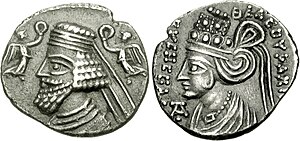 Coin with the image of King Phraat V and Queen of the Muse of Parthia | |||||||
| |||||||
| Predecessor | Phraat IV | ||||||
| Successor | Orod III | ||||||
| Birth | |||||||
| Death | |||||||
| Kind | Arshakids | ||||||
| Father | Phraat IV | ||||||
| Mother | Muse of Parthian | ||||||
| Spouse | Muse of Parthian | ||||||
Board
Relations with Rome
Artavazd , seated on the throne of Armenia with the help of Rome , did not enjoy the sympathy of many of his subjects and, of course, the Parthians. The coalition of these two groups overthrew him about 1 year BC. e. , Tigran IV and his sister-wife Erato again gained power. If Rome wanted to maintain its sphere of influence in Armenia and prestige in the Middle East , urgent measures should be taken. At that moment, Augustus had few people whom he could instruct to cope with such a situation. His grandson Guy was placed at the head of the troops sent to restore Roman power.
When the news of Guy's movement reached Parthia, Fraatac sent an embassy to Augustus to clarify the matter and ask for the return of the elder half-brothers sent to the Roman Empire as hostages. Rome’s response addressed directly to Fraatac demanded that he renounce the title of king and resign from Armenia. The Parthian answered in an equally harsh manner. Alarmed by this turn of affairs, the Armenian Tigran tried to make peace with Augustus and was sent to Guy with a promise of assistance. Soon Tigran died fighting the barbarians, possibly on the northern border, and Erato abdicated. [one]
When Guy reached the Euphrates , Fraatac, indignant at such an energetic intervention of Rome, met him on the island, while their armies lined up on the opposite banks. Later, these two dined first on the Roman side, and then on the Parthian side, thus binding themselves with promises of a conscientious attitude to each other in a typically Eastern manner. One of the Roman commanders, Velley Patculus , a young tribune under Gaia, describes Fraataka as a youth of prominence. The proposed peace terms, apparently, were acceptable to the Romans, as a result of which the parties agreed that the Parthians should abandon all claims to Armenia, and the four Parthian princes should remain in Rome. [2]
The marriage of Fraat V to his own mother
In the year 2 n. e. Fraatak and his mother Muse were married. This act, which horrified the Greeks and Romans, suggests a possible connection with the changes that the Zoroastrian religion had undergone at that time. The customs, long practiced exclusively by magicians, have now been adopted by the entire population of Iran. Among mages, closely related marriages were common. [3]
Events in Armenia and the preparation of the Romans for an attack on Parthia
After meeting with Fraatak, Guy moved north to Armenia, where he seated on the throne Ariobarzan , the son of the king of the Medes, Artabaz . But soon a rebellion broke out against this new Roman protege, and Guy began military action aimed at suppressing it. He attacked the fortress of Artagiru, which Addon defended - probably the satrap , raised by the Parthian king. During the negotiations on September 9, 3 years n. e. when Addon was supposed to show the whereabouts of the treasure trove of the Parthian ruler, he wounded the young Roman commander, and although the Romans captured this city, Guy died the following year from the effects of the wound. Augustus could now boast that all of Armenia was subordinate, and the poets glorified the return of Guy. There are some indications that this Armenian campaign only preceded the attack on the Parthians. Guy is said to have died in the midst of preparations for the Parthian war, and Augustus was considering expanding the borders of the empire beyond the Euphrates . Ariobarzan, who was imposed by Guy on the Armenian throne, soon died, and his son Artavazd IV took his place. [4] [5] [6] [7] [8]
The death of the king
Fraatak was not in power for long after his marriage to his own mother - a step that never received approval from his subjects. In the year 4 n. e. he was killed or expelled to Syria , where he soon died. [9]
The last coins of Muse and Fraataka date from the month of hyperbereus of the year 315 of the Seleucid era (August – September 4 years A.D.).
Notes
- ↑ Dion Cassius . Roman history. Book LV Chapter 10 (20)
- ↑ Welley Patculus . Roman history. Book II, chapter 101
- ↑ Joseph Flavius . Jewish antiquities. XVIII, ch. 2, §4
- ↑ Dion Cassius . Roman history. Book LV, Chapter 10a (6-9)
- ↑ Welley Patculus . Roman history. Book II, Chapter 102 (2)
- ↑ Lucius Anney Flor . Epitomes. Book II, chapter 32
- ↑ Cornelius Tacitus . Annals. Book I, Chapter 3 (3)
- ↑ Ankir monument. Acts of the Divine Augustus. Chapter 27
- ↑ Ankir monument. Acts of the Divine Augustus. Chapter 32
Links
Literature
- Dibvoiz N.K. Political history of Parthia / Per. from English, scientific ed. and bibliographic Appendix V.P. Nikonov. - SPb. : Faculty of Philology, St. Petersburg State University, 2008. - 816 p. - (Historical Library). - ISBN 978-5-8465-0638-1 . [one]
- Fraat // Brockhaus and Efron Encyclopedic Dictionary : in 86 volumes (82 volumes and 4 additional). - SPb. , 1890-1907.