Mucor [1] ( Latin Mucor ), also white mold [2] is a genus of lower mold fungi of the zygomycete class, which includes about 60 species [1] . Widespread in the upper soil layer, also develop on food and organic residues. Some species cause diseases ( mucoromycosis ) of animals and humans, others are used to produce antibiotics or as starter cultures (as some mushroom fungi have high enzymatic activity). The mycelium is not divided by partitions and is represented by one giant multinucleated branched cell.
| Mukor |
Mucor mucedo |
| Scientific classification |
|---|
| Subdivision : | Mucoromycotina |
|
| International scientific name |
|---|
Mucor Fresen. , 1850 |
|
Content
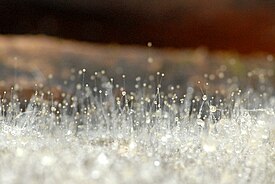
Mukor, visible black sporangia heads in the form of small black dots
Single colorless sporangios, on top of which one sporangia develops in the form of a spherical black head [2] . Sporangiophores - simple or branched (monopodial, incorrectly sympodial or racemose). Mycelium is a single multinucleated branched cell, not divided by partitions [2] . Colonies, usually beige or gray , grow rapidly (up to several centimeters in height). Old colonies are darker due to the formation of numerous sporangia with spores.
With asexual reproduction, the shell of mature sporangia easily dissolves from moisture, releasing several thousand spores.
Two branches of the same (homotallic species) or different (heterotallic species) mycelia participate in sexual reproduction . They merge and form a diploid zygote , which sprouts a hypha with germinal sporangia in warm and humid conditions.
Chinese mucor ( Mucor sinensis ), racemose ( Mucor racemosus ) , cochlear mucor ( Mucor circinelloides ) are used as starter culture (“ ”, “ragi”) or directly for the production of fermented food products (“ soy cheese ”, “ tempe ”) from soy and cereals , as well as for the production of ethanol from potatoes . [3]
- ↑ 1 2 Accent and basic information are given according to the source:
Mucor / Biology. Modern illustrated encyclopedia. Ch. ed. A.P. Gorkin; M .: Rosman, 2006 .-- p. 290 - ↑ 1 2 3 Korchagina V.A. §85. Mold fungi and yeast // Botany: Textbook for grades 5-6 of high school. - 18th ed. - M .: Education , 1985. - S. 203-204.
- ↑ . The family Mukorovye ( Mucoraceae ) // Plant life : in 6 tons / hl. ed. Al A. Fedorov . - M .: Education , 1976. - T. 2: Mushrooms / ed. M.V. Gorlenko . - S. 69 .-- 479 p. - 300,000 copies.
