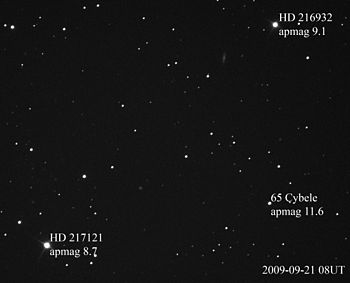
The apparent magnitude ( m ) is a measure of the brightness of a celestial body (more precisely, the illumination created by this body) from the point of view of an earth observer. Usually use a value adjusted to the value that it would have in the absence of atmosphere . The brighter the object, the lower its magnitude .
The refinement “visible” indicates only that this magnitude is observed from Earth; this refinement is necessary to distinguish it from the absolute . It does not indicate the visible range : the quantities measured in the infrared or some other range are also called visible. A value measured in the visible range is called visual [1] .
In the visible part of the spectrum, the brightest star in the night sky is Sirius , and in the infrared , Betelgeuse .
Content
History
| Visible unarmed the eye [2] | Visible value | Brightness regarding Vega | Number of stars brighter than this visible quantities [3] |
|---|---|---|---|
| Yes | −1.0 | 250% | one |
| 0,0 | 100 % | four | |
| 1,0 | 40% | 15 | |
| 2.0 | sixteen % | 48 | |
| 3.0 | 6.3% | 171 | |
| 4.0 | 2.5% | 513 | |
| 5,0 | 1,0% | 1 602 | |
| 6.0 | 0.40% | 4 800 | |
| 6.5 | 0.25% | 9,096 [4] | |
| Not | 7.0 | 0.16% | 14,000 |
| 8.0 | 0.063% | 42,000 | |
| 9.0 | 0.025% | 121,000 | |
| 10.0 | 0.010% | 340,000 |
The modern scale of magnitude originates in ancient Greece. She was offered in the II century BC. e. Hipparchus , dividing the stars visible with the naked eye, in six quantities. He called the brightest of them stars of the first magnitude ( m = 1 ), and the weakest - stars of the sixth magnitude ( m = 6 ). Modern astronomy is not limited to six quantities or only visible light. Very bright objects have a negative value.
Magnitude and Luminosity
The apparent magnitude of objects 1 and 2 is defined as
where m - magnitudes of objects, L - illumination from these objects.
Thus, a difference of 5 magnitudes corresponds to a ratio of illuminations of 100 times , and a difference of one magnitude corresponds to 100 1/5 ≈ 2.512 times .
Total magnitude
The total visible magnitude of two closely spaced celestial bodies is obtained by summing the apparent magnitudes of each component. Its value ( m f ) is calculated by converting two quantities ( m 1 ) and ( m 2 ) to the luminosity dimension and the subsequent inverse transformation to the logarithmic form after their addition: [5]
By the same principle, the total magnitude of systems that have higher levels of multiplicity can be calculated.
Examples
The apparent magnitude of the full moon is −12.7; the brightness of the sun is −26.7.
The magnitude difference of the moon ( ) and the sun ( ):
The ratio of illumination from the sun and moon:
Thus, the Sun is about 400,000 times brighter than the full Moon.
Notes
- ↑ Surdin V.G. Magnitude . Glossary Astronet.ru . Date of treatment February 28, 2015. Archived November 28, 2010.
- ↑ Vmag <6.5 . SIMBAD Astronomical Database. Date of treatment June 25, 2010.
- ↑ Magnitude . National Solar Observatory — Sacramento Peak. Date of treatment August 23, 2006. Archived February 6, 2008.
- ↑ "The catalog of bright stars"
- ↑ Magnitude Arithmetic . Weekly Topic . Caglow. Date of treatment January 30, 2012.
Links
- The astronomical magnitude scale (International Comet Quarterly)