The Order of Glory is a military order of the USSR, established by the Decree of the Presidium of the Supreme Soviet of the USSR of November 8, 1943 "On the establishment of the Order of Glory of the I, II and III degrees . " The order was awarded to ordinary soldiers, sergeants and foremen of the Red Army , and in aviation - to persons with the rank of junior lieutenant . It was handed over only for personal merits; military units and formations were not awarded to them.
| Order of Glory | |||
|---|---|---|---|
| I degree | |||
| |||
| II degree | |||
| |||
| III degree | |||
| |||
| A country |  the USSR the USSR | ||
| Type of | order | ||
| Status | not awarded | ||
| Statistics | |||
| Options | Diameter 46 mm | ||
| Established | November 8, 1943 | ||
| First award | November 28, 1943 | ||
| Number of awards | more than 1 million | ||
| Precedence | |||
| Senior award | Order "For personal courage" | ||
| Junior Award | Order of Labor Glory I degree | ||
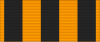

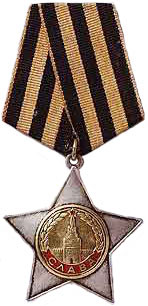

The Order of Glory in its statute and color of the ribbon almost completely repeated one of the most revered awards in pre-revolutionary Russia - the George Cross (among the differences - a different number of degrees: 3 and 4, respectively).
The Order of Glory has three degrees, of which the sign of the order of the highest, I degree is gold, and II and III are silver (the second degree sign has a gilded central medallion). According to the statute of the order, awards must be made in strict sequence from the lowest to the highest.
For the differences in the battles of the Great Patriotic War and exploits in other military conflicts, about a million signs of the Order of Glory of the III degree, more than 46 thousand - II degree and 2678 - I degree were awarded. According to updated data, there are 2671 full cavaliers of the Order of Glory, among them four women. 7 people were awarded the Order of the 1st degree, but were not full gentlemen.
The full cavaliers of the order - Ivan Grigoryevich Drachenko , pilot of the assault aviation regiment, Pavel Khristoforovich Dubinda , marine infantryman, and Nikolai Ivanovich Kuznetsov , artillery men , Andrei Vasilyevich Alyoshin also received the title of Hero of the Soviet Union during the war years.
For the courage and heroism shown in the battle on the left bank of the Vistula River on January 14, 1945 during the Vistula-Oder operation , all privates, sergeants and foremen of the 1st battalion of the 215th Red Banner Regiment of the 77th Guards Chernigov Red Banner Order of Lenin and Suvorov Rifle the divisions were awarded the Order of Glory, the commanders of this battalion's company - the Order of the Red Banner , platoon commanders - the Order of Alexander Nevsky , and the battalion commander B.N. Emelyanov and the platoon commander Guryev, Mikhail Nikolaevich became Heroes of the Soviet Union. Thus, the unit was the only one in which all fighters in one battle received the Order of Glory. For the collective feat of the soldiers of the 1st Infantry Battalion, the Military Council of the 69th Army assigned him the honorary name "Battalion of Glory" [1] .
Content
Statute of the Order
The Order of Glory is awarded to individuals of the rank and file of the Red Army, and in aviation and to those with the rank of junior lieutenant, who have shown glorious feats of courage, courage and fearlessness in the battles for the Soviet Motherland.
The Order of Glory consists of three degrees: I, II and III degrees. The highest degree of the order is I degree. Awarding is made sequentially: first the third, then the second and, finally, the first degree.
The Order of Glory is awarded to one who:
- Bursting first in the enemy’s position, personal courage contributed to the success of the common cause;
- While in a lighted tank, he continued to carry out a combat mission;
- In a moment of danger he saved the banner of his unit from capture by the enemy;
- From personal weapons with marksmanship, destroyed from 10 to 50 enemy soldiers and officers;
- In a battle with anti-tank rifle fire, disabled at least two enemy tanks;
- Destroyed one to three tanks with hand grenades on the battlefield or behind enemy lines;
- Destroyed at least three enemy aircraft with artillery or machine gun fire;
- Despising danger, he was the first to burst into the enemy's bunker (bunker, trench, or dugout), and decisively destroyed his garrison;
- As a result of personal intelligence, he established the enemy’s defense weaknesses and led our troops behind enemy lines;
- Personally captured an enemy officer;
- At night removed the guard post (patrol, secret) of the enemy or captured him;
- Personally, with resourcefulness and courage, having made his way to the enemy’s position, he destroyed his machine gun or mortar;
- Being in a night outing, he destroyed the enemy’s warehouse with military equipment;
- Risking his life, he saved the commander in battle from imminent danger that threatened him;
- Neglecting personal danger, he captured the enemy banner in battle;
- After being wounded, after dressing he returned to duty again;
- He shot down an enemy aircraft from personal weapons;
- By destroying enemy firepower with artillery or mortar fire, he ensured the successful operations of his unit;
- Under enemy fire, he made a passage in the enemy’s wire barriers for the advancing unit;
- At the risk of life, under enemy fire, he assisted the wounded during a series of battles;
- Being in a wrecked tank, he continued to carry out a combat mission from the weapons of the tank;
- Rapidly crashing into the enemy column on his tank, crumpled it and continued to carry out the combat mission;
- With his tank crushed one or more of the enemy’s guns or destroyed at least two machine gun nests;
- While in intelligence, he obtained valuable information about the enemy;
- In a dogfight, a fighter pilot destroyed from two to four enemy fighter planes or from three to six bomber aircraft;
- As a result of an assault raid, an attack pilot destroyed two to five enemy tanks or three to six steam locomotives, or detonated a train at a railway station or train, or destroyed at least two aircraft at an enemy airfield;
- As a result of bold initiative actions in an air battle, an attack pilot destroyed one or two enemy aircraft;
- The crew of the day bomber destroyed the train, blew up the bridge, the ammunition depot, fuel, destroyed the headquarters of any enemy unit, destroyed the railway station or stage, blew up the power station, blew up the dam, destroyed the military ship, transport, boat, destroyed at least two enemy aircraft airplanes;
- The crew of a light night bomber blew up an ammunition depot, fuel, destroyed the enemy’s headquarters, blew up the train, blew up the bridge;
- The crew of a long-range night bomber destroyed a railway station, blew up an ammunition depot, fuel, destroyed a port facility, destroyed sea transport or a train, destroyed or burned an important plant or factory;
- The crew of a day bomber for a bold action in an air battle, as a result of which one to two aircraft were shot down;
- Scout crew for successfully completed reconnaissance, as a result of which valuable data about the enemy were obtained.
Awarding the Order of Glory is made by Decree of the Presidium of the Supreme Soviet of the USSR .
Awarded the Orders of Glory of all three degrees are awarded the right to confer the military rank:
- privates, corporals and sergeants - foremen ;
- having the rank of foreman - lieutenant ;
- junior lieutenants in aviation - lieutenant .
The Order of Glory is worn on the left side of the chest and, in the presence of other orders of the USSR, is located after the Order of the Badge of Honor in order of seniority.
Description of the Order
The badge of the Order of Glory is a five-pointed star with a size between opposite vertices of 46 mm. The surface of the rays of the star is slightly convex. On the front side in the middle part of the star there is a circle-medallion with a diameter of 23.5 mm with a relief image of the Kremlin with the Spasskaya Tower in the center. Around the medallion is a laurel wreath. In the lower part of the circle is the convex inscription “GLORY” on a red enamel ribbon.
On the reverse side of the order there is a circle with a diameter of 19 mm with a relief inscription in the middle of the “USSR”.
On the edge of the star and the circle on the front side are convex sides.
The badge of the order of the 1st degree is made of gold (test 950). Gold content in the order of the I degree - 28.619 ± 1.425 g. The total weight of the order - 30.414 ± 1.5 g.
The badge of the Order of the II degree is made of silver, and the circle with the image of the Kremlin with the Spasskaya Tower is gilded. The silver content in the order of the II degree is 20.302 ± 1.222 g. The total weight of the order is 22.024 ± 1.5 g.
The badge of the Order of the III degree is silver, without gilding in the central circle. The silver content in the order of the III degree is 20.549 ± 1.388 g. The total weight of the order is 22.260 ± 1.6 g.
The sign with the help of an eye and a ring is connected to a pentagonal block covered with a silk moire ribbon 24 mm wide. On the tape there are five longitudinal equal in width alternating stripes: three black and two orange. At the edges of the tape has one narrow orange strip 1 mm wide.
Order Creation History
Originally, the Order of the Soldiers was supposed to be named after Bagration . A group of nine artists developed 26 sketches. A.V. Khrulev selected 4 of them and presented them to Stalin on October 2, 1943. It was envisaged that the order would have four degrees and be worn on a black and yellow ribbon - the colors of smoke and flame. N.I. Moskalev proposed the St. George ribbon. Stalin approved the tape and decided that the order would have three degrees, as well as the orders of Suvorov and Kutuzov . Having said that victory cannot be without glory, he proposed to name the award the Order of Glory. A new sketch of the order was approved on October 23, 1943 [2] .
Full Knight of the Order of Glory
The first cavaliers of the Order of Glory of the II degree in the Red Army were the soldiers of the 665th separate combat engineer battalion of the 385th infantry division, sergeant M.A. Bolshov , the Red Army S.I. Baranov and A.G. Vlasov (order No. 634 for troops of the 10th Army of December 10, 1943 ) [3] .
As early as December 28, 1943, M. A. Bolshov [4] , S. I. Baranov [5] and A. G. Vlasov [6] were presented to the Order of Glory of the 1st degree, but they were awarded this order by the Decree of the Presidium of the Supreme Soviet of the USSR dated March 24, 1945, that is, almost fifteen months after the presentation for the award.
Thus, M. A. Bolshov, S. I. Baranov and A. G. Vlasov are full holders of the Order of Glory, who deserved all three degrees of the order already in 1943, just a month and a half after the establishment of this order, for the military distinctions committed them for a little over a month; by the time they were presented to the orders of Glory of the 1st degree, they did not even have time to hand them the orders of Glory of the 2nd and 3rd degrees, with which they had been awarded earlier.
Officially, Corporal M.T. Pitenin [7] and Senior Sergeant K.K. Shevchenko [8] (Decree of the Presidium of the Supreme Council of the USSR of July 22, 1944 ), presented to the Orders of Glory of the first degree much later Bolshov, became the first full cavaliers of the Order of Glory. , Baranova and Vlasov - in June 1944. Mitrofan Pitenin died before he received the award; Konstantin Shevchenko fought until the last day of the war and, besides all degrees of the Order of Glory, he was a holder of orders of the Patriotic War of the 1st degree, the Red Star and (which was rare for soldiers and sergeants) the Red Banner.
The badge of the Order of Glory of the 1st degree under No. 1 was awarded to the senior sergeant N. A. Zaletov (awarded by decree of the Presidium of the Supreme Soviet of the USSR of October 5, 1944 ). Presentation of the award with a lower number to the person awarded later was explained by the fact that orders were usually transferred to different sections of the front in batches and distributed among the headquarters of the compounds entitled to the award in any order. In this regard, N. A. Zaletov is often considered the first in the USSR to complete the knight of this order, which is even reflected on the plaque in Penza (see image) .
The youngest full holder of the Order of Glory was the gun commander of the 185th Guards Artillery Regiment of the 82nd Guards Rifle Division of the 8th Guards Army Guards, Junior Sergeant I.F. Kuznetsov , born December 28, 1928 . He was presented to the Order of Glory of the I degree at the age of 16 in April 1945 and was awarded by him on May 15, 1946 , and the oldest soldier of the order was the shooter of the 459th Infantry Regiment of the 42nd Infantry Division, I. A. Shiryaev born September 29, 1891 .
In the post-war years, work was carried out to bring the order of the cases of re-awarding with signs of the order of one degree and re-awarding (replacing one sign with another, the next degree) in accordance with the statute of the order. There were no special documents for the full gentlemen of the Order of Glory at that time. The recipient was awarded only the order book of the general sample, and it listed all three degrees of the order and other awards (if any). However, in 1967 and 1975, additional benefits were introduced to the full cavaliers of the Order of Glory, equalizing their rights with the Heroes of the Soviet Union . In particular, the right to grant him personal pensions of national importance, large housing benefits, the right to free travel, etc. appeared. The consequence of this was the appearance in 1976 of a special document for full knights of the order - an order book awarded with the Order of Glory of three degrees. The first such books were written out in February 1976 by the military commissariats at the place of residence of the awarded.
The current legislation of the Russian Federation confirms to all holders of the Order of Glory all the rights and privileges granted during the Soviet period.
Gallery
- Order on stamps and coins
USSR stamp from the issue “Orders and Medals of the USSR” (1945, painter A. Mandrusova, CFA No. 953).
USSR stamp from the issue "Orders and Medals of the USSR" (1945, artist A. Mandrusova, CFA No. 960).
Commemorative coin of the Bank of Russia in 2010 in honor of the 65th anniversary of the Victory with the image of the Order of Glory
Commemorative coin of the Bank of Russia 2000
Image of the order on the front side of the jubilee medal “65 years of Victory in the Great Patriotic War of 1941-1945”
See also
- List of Full Knights of the Order of Glory
- Guard tape
- St. George Ribbon
- Order of St. George
- St. George's Cross
- Heroes of the Fatherland Day
Notes
- ↑ Great Victory. "Battalion of Glory . "
- ↑ Balyazin V.N. For the feat of labor and labor. - M .: Education , 1987. - S. 147-148.
- ↑ Order of Glory
- ↑ Bolshov Prize Sheet (inaccessible link) . Date accessed May 23, 2019. Archived March 5, 2016.
- ↑ Baranov Prize Sheet (inaccessible link) . Date of treatment May 23, 2019. Archived on September 19, 2016.
- ↑ Vlasov Prize Sheet (inaccessible link) . Date accessed May 23, 2019. Archived March 5, 2016.
- ↑ Pitenin Mitrofan Trofimovich
- ↑ Shevchenko Konstantin Kirillovich


Literature
- Durov V. A. Russian and Soviet military decorations / State Order of Lenin Historical Museum. - M .: Vneshtorgizdat, 1990. - S. 53-60.
- Kolesnikov G.A., Rozhkov A.M. Orders and medals of the USSR. - Mn. : People's Asvet, 1986. - S. 50-53.
- Malinkin A.N. Symbols of Orders of the USSR. Research on Sociology Awards. - M .: The New Millennium Foundation, 2005. - 136 p. - ISBN 5-86947-958-7 .
- Gorbachev A.N. Multiple Knights of the Orders of the USSR. M., 2006
- Potrashkov S.V. Awards of the USSR, Russia and Ukraine. - Belgorod : Family Leisure Club, 2011. - P. 176-181. - ISBN 978-5-9910-1393-2 .
- Potrashkov S.V., Livshits I.I. World War II Awards. - M .: Eksmo , 2008 .-- S. 184-185. - ISBN 978-5-699-29296-7 .
- Glories of the Order // Soviet Encyclopedia of the History of Ukraine: in 4 volumes = Radyansk Encyclopedia of History of Ukraine (Ukrainian) / Відп. ed. A. D. Skaba . - K .: Goal. Editorial URE, 1972. - T. 4. - P. 112.
- Smyslov O.S. Awards of the Great Victory. - M .: Veche, 2010 .-- S. 125-134. - (History of awards). - ISBN 978-5-9533-4637-5 .
- Surzhik D.V. Awards of the Second World War. - M .: OLMA Media Group , 2011 .-- S. 58-60. - ISBN 978-5-373-03798-3 .
- Tsareva T. B. All awards of the Second World War. Orders, medals and badges. - Rostov n / a : Vladis, 2010 .-- S. 60-64. - (Historical Library). - ISBN 978-5-9567-0859-0 .