FitzJohn Porter ( August 31, 1822 - May 21, 1901 ) ( Fitz John Porter , sometimes FitzJohn Porter or Fitz-John Porter ) - a regular American military and army general of the Union during the Civil War in the United States . Known mainly for participation in the Second Battle of Bull Run and the subsequent tribunal.
| Fitzgeon Porter | |
|---|---|
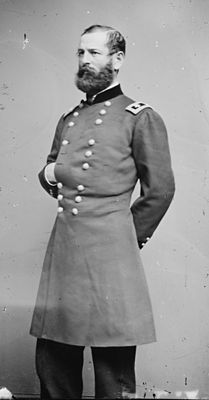 General fitz john porter | |
| Date of Birth | August 31, 1822 |
| Place of Birth | Portsmouth, New Hampshire |
| Date of death | May 21, 1901 (78 years old) |
| Place of death | Morristown, New Jersey |
| Affiliation | USA U.S. Army |
| Type of army | U.S. Army |
| Years of service | 1845 - 1863 or 1886 [1] |
| Rank | major general |
| Commanded | 1st Division III Corps of the Potomac Army V Corps of the Potomac Army |
| Battles / wars | Mexican war
American Civil War
|
| Retired | Commissioner for Public Works New York City Police and Fire Commissioner |
Porter served quite successfully in the early years of the war, but his career was broken by a tribunal that was guided in part by political considerations. The next 25 years, Porter saved his reputation, and, in the end, was rehabilitated.
Early years
Porter was born in Portsmouth, New Hampshire . He came from a family of hereditary fleet officers, his cousins (cousins) were William Porter, David Dixon Porter and Admiral David Farragut . However, Porter's father, captain John Porter, suffered from alcoholism and was written off to land. Porter’s illness affected Porter’s childhood in a bad way. In his youth, he decided to go to military service and in 1841 entered the military academy of West Point , which he graduated from as the eighth of 41 cadets graduating in 1845 , and was assigned to the 4th artillery regiment in the temporary rank of second lieutenant.
June 18, 1846 he received the permanent rank of second lieutenant, and May 29, 1847 - until the first lieutenant. He took part in the Mexican war and on September 8, 1847 was temporarily promoted to captain for his courage at Molino del Rey . On September 13, he was wounded in the battle of Chapultepec and received for this temporary promotion to major (September 13).
After the war, Porter returned to West Point and from 1849 to 1853 worked there as an instructor in cavalry and artillery. Then until 1855 he served as an adjutant under the head of the academy. He then served at Fort Leavenworth in Kansas , assistant adjutant general of the Department of the West in 1856 and was temporarily promoted to captain in July of that year. In 1857 and 1858, he participated in an expedition against the Mormons under the command of the future Confederate General Albert Sidney Johnson . Until the end of 1860, he was organizing the defense of Charleston Bay, after which he was involved in the evacuation of army personnel from Texas - after the secession of the latter.
Civil War
When the civil war broke out, Porter became chief of staff and assistant to the adjutant general of the Pennsylvania department, but was soon promoted to colonel and on May 14, 1861, began to command the 15th Infantry Regiment. In August, he was promoted to brigadier general, and retroactively on May 17, so he received the right to command the division of the Potomac Army, formed by George McClellan . Soon Porter became McClellan's confidant and adviser, and subsequently McClellan's disgrace also affected Porter's career.
After receiving the division, Porter took part in the Campaign on the Peninsula , where the division was involved in the siege of Yorktown. McClellan at this time created two additional corps, and Porter began to command the Fifth Corps . At that time, the corps consisted of divisions of George Morell , George Sykes and George McCall, a total of 9 brigades. Future generals Mead and Reynolds served in Porter’s corps.
This corps did not take part in the battle of Seven Pines , since it was on the north side of the river, while southerners advanced south of the river, however, during the Seven-Day Battle , Porter’s corps was the first to be hit, and the main burden fell on it at the battle of Beaverd Scream (June 26), at the Battle of Gains Mill and Malvern Hill . Porter’s corps competently defended, but, in the end, was forced to retreat. For successful leadership of the corps on the Peninsula, Porter was promoted to the rank of Major General of the Volunteer Army on July 4.
Bull Run
During the North Virginia campaign , Porter’s corps was removed from the Potomac Army and aimed at strengthening John Pope’s Virginia Army - despite the fact that Porter publicly criticized both this decision and Pope himself. During the Second Battle of Bull Run , on August 29, 1862, Porter received orders to attack the flank and rear of General Thomas Jackson . However, near the Dawkins Branch Porter met Jeb Stewart's cavalry cover. The Commander-in-Chief ordered him to attack the right flank of the North Virginia Army , but at the same time maintain contact with the John Reynolds division - and these conflicting orders confused Porter. Pope clearly did not know that General Longstreet’s corps was already on the battlefield — which Porter already knew from intelligence — so he expected Jackson to be hit by Longstreet if he attacked the flank. Therefore, Porter postponed the attack.
On August 30, Porter again received orders to attack and reluctantly obeyed. The corps (5,000 people) turned against Jackson's right flank and began to advance, but at the same time its flank was opened just at the moment when 30,000 Longstreet corps rushed to the attack and overturned the corps - which, in fact, Porter was afraid of. Pope was furious with the defeat, accused Porter of not executing the order, and on September 5 removed him from command.
Soon he was reinstated as commander of the corps, and he took part in the Maryland campaign , but during the battle of Entityam was in reserve. It is believed that he said to McClellan: "Remember, General, I command the last reserve of the last army of the republic." McClellan took note of this, and did not engage the corps, although this could lead to the complete defeat of the enemy.
After Entitym, Porter's corps was sent to pursue General Lee's retreating army. On the evening of September 19, parts of the corps got involved in the battle of Shepardstown : the northerners managed to drop two brigades guarding the crossing of the Potomac River and cross to the south bank of the river, but in the morning General Hill's division approached. Porter ordered a retreat, and this was executed with serious losses.
Tribunal
On November 25 (20 days after McClellan's resignation), Porter was arrested and tried for his actions under Bull Run. Porter’s proximity to disgraced McClellan and open criticism of Pope seriously affected the outcome of the case. On January 10, 1863, Porter was found guilty of failure to comply with the order and misconduct, and on January 21 was dismissed from the US Army.
Post-war activities
Memory
- In 1904, in Portsmouth, in Haven Park, a statue of Porter by James Kelly was installed.
- During World War II, a Liberty class ship (SS FitzJohn Porter) was named after Porter.
See also
Notes
- ↑ convicted by a military court in 1863 , reinstated and dismissed from service in 1886 with the rank received in 1861