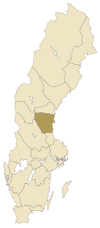
Helsingland (old transfer - Helsingland , Swede. Hälsingland ) - the historical province of Sweden in the Norrland region . Most of them belong to the Gävleborg Lena , but small areas are part of the Emtland and Western-Irish Lena.
| Historic Province of Sweden | |||
Landskap Helsingland | |||
| |||
| Region | Norrland | ||
| Lena | Gulborg Emtland Västernorrland | ||
| Square | 14,264 km² | ||
| Symbols of the province | |||
Plant | Flax ordinary [1] | ||
Animal | Lynx | ||
Bird | Long-tailed tawny | ||
A fish | Ide | ||

Content
Geography
The province borders on Estrikland from the south, on Dalarna and Kherédalen from the west, on Medelpad from the north. Its area is 14,264 km².
Most of Helsingland is hilly. Hills gradually decrease to the southeast, however, and to the east of the Yusnansky valley, there are areas with very rough terrain. In the northeast of the province are the Delle Lakes , the occurrence of which is associated with the fall of a meteorite.
History
Until the XIV century, Helsingland was the common name for the northern coastal regions of Sweden, but then the meaning of the word narrowed to modern borders. Since 1772, when the Gävleborg region was formed, which included Helsingland and neighboring Estrikland, the province has no administrative significance, but preserves its cultural and historical significance.
Origin of title
The name Lanskapa Helsingland first mentions Adam of Bremen at the end of the 10th century as a Swede. Hälsingland . Helsingland was interpreted as a combination of the words “neck” and “residents along the road” [2] . This name does not refer to a part of the body, but is considered as a narrow part of water, that is, a narrow channel or a narrow piece of land. The most common opinion is that this is the “neck” (mouth) in the Gulf of Bothnia and the people who lived on the shores on both sides of the bay.
Snorri Sturluson tells in the XII century about Helsingland also in the Norse sagas “ Circle of the Earth ”, about a country that stretched to the shores with the name Helsingland Swede. Hälsingland [3] .
Until the 90s of the XVII century, the name of the province was used colloquially as a euphemism for hell [4] .
Economy
Helsingland is famous for farming.
Attractions
Starting from the Middle Ages, the motley decoration of the wooden dwellings of the peasants is characteristic of this area. The seven most notable peasant estates of the 19th century, selected by UNESCO for inclusion in the register of World Heritage , are distinguished by a kind of internal and external decor in the style of rural baroque with numerous folklore injections.
See also
- Swedish provinces
Notes
- ↑ Svenska landskapsblommor : [ arch. September 29, 2017 ]: [ Swede ] . - Naturhistoriska riksmuseet , 1996. - 28 juli. - Date of appeal: 04/07/2018.
- ↑ Tunberg, Sven (1937). Helsingia Major: Det stora Hälsingland i Curman, Sigurd: Fornvännen årgång 1937, Stockholm: Generalstabens Litografiska Anstalts Förlag, sid. 337-342. (Swede.)
- ↑ Hallberg, Göran (1999). "En hälsing bodde vid halsen". Populär Historia. Läst 22 augusti 2008. Archived August 21, 2010. (Swede.)
- ↑ Hellquist, Elof (1922). Svensk etymologisk ordbok (utgåva första upplagan). Lund: Gleerups förlag. sid. 257 (Swede)
Links
- HälsinglandTurism (Swedish)
- Hälsingelänkar på bergsjöportalen (Swedish)
- Hälsinglands, Medelpads och Ångermanlands historia (Swedish)
- Intryck Hälsingland (Swedish)
- Hälsingegårdar (Swedish)
- Fotografier av hela hälsingland från 1800-talet och framåt (Swedish)
- Lyssna till några av Hälsinglands dialekter (Swedish)
- Kyrkbåtar i Hälsingland (Swedish)