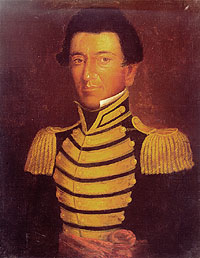
Juan Nepomuseno Segin ( Spanish: Juan Nepomuceno Seguín , , - , ) - techno , the hero of the Texas Revolution .
Content
Biography
Youth
Juan Segin was born in the Texas city of San Antonio de Bejar on October 27, 1806 . A descendant of the Frenchman Guillaume Séguin (Guillaume Séguin), who moved in 1700 from Paris to the Mexican city of Aguascalientes (Aguascalientes). Guillaume married the Spaniard Cruz, who bore him four sons.
Juan was the eldest of two sons in the family of Juan Jose Maria Erasmo Seguin and Maria Josefa Becerra (Becerra). Although his education was short-lived, his father insisted that Juan learn to write and read. Juan also showed some interest in music.
At the age of nineteen, Juan married Maria Gertrude Flores de Abrego from a prominent Behara family. They had ten children.
Segin began to join public work when he was young, helping his father in his post office, and later served in the local Congress in 1823-1824. Segin's election as an alderman in December 1828 was evidence of his remarkable potential. Later he worked in various election committees until his election as an Alcald in December 1833 . For most of 1834, he combined this post with the post of political director of the Behar department, after the previous leader fell ill and resigned.
Participation in the Texas Revolution
As a teenager in Mexico, Juan showed a strong interest in politics. And, very critical of his peer Antonio Lopez de Santa Anne , he joyfully joined the Texas Revolution to rid Texas of Santa Anne's power. After the Battle of Gonzalez in October 1835, Stephen F. Austin promoted Segin to the rank of captain and placed him at the head of a company of thirty-seven people. In the fall of the same year, his company was involved in the reconnaissance and supply of the revolutionary army, and on December 5 participated in the assault on Behar . Then Segin led a detachment of twenty-five technos fighting on the Texas side in the battle for Alamo . Since Segin owned Spanish, it was easier for him to go through Mexican patrols around the besieged fortress , and he was sent on purpose with a message that the Texans " would not give up and would not leave ." Segin delivered a letter to the Texas troops. And he returned to Alamo - but by this moment the fort had already fallen under the blows of the army of Santa Anna. There he organized the burial of the remains of the Alamo defenders with military honors.
Segin later commanded an infantry company at the Battle of San Jacinto . He was present at the Mexican surrender in San Antonio on June 4, 1836, and observed the withdrawal of Mexican troops. Until the fall of 1837 he remained the military commandant of Behar, resigning at the end of the year in connection with his appointment to the Texas Senate.
After the Revolution
In the Senate, Segin was the only techno , having been in its composition during the second, third and fourth convocations. There he served on the committee of accounts and claims, and - despite a lack of knowledge of English - on the committee on military affairs. Among his legislative initiatives should be noted the translation of laws of the Texas Republic into Spanish.
In 1841, Segin became mayor of San Antonio . In this position, he found himself embroiled in a growing hostility between English-speaking settlers and Mexican-Texans. In addition, he was faced with personal problems, having made enemies in the distribution of land allotments.
In the end, Segin was forced to resign due to the persecution he was subjected to in connection with the active defense of the rights of the technos. In addition, the enemies accused him of aiding the Mexican army
In 1842, he fled to Mexico in order to " find refuge among enemies ", where he was arrested - and forcibly drafted into the Mexican army as an officer. He later fought against Texas and the United States in the US-Mexican War .
Segin periodically returned after these events to Texas, where he was elected magistrate in Bejar County for two terms, in 1852 and 1854, and District Judge in Wilson County in 1869 . He eventually settled in Nuevo Laredo , Tamaulipas , Mexico , where his son Santiago was mayor. There he died on August 27, 1890 . In 1974, his remains were transported to Texas and solemnly reburied on July 4, 1976 , in the city of Segin , named after him.
Memory
- The city of Segin in Texas is named after him.
- In the series Rebellion of Texas (2015) it was played by Raul Mendes .
Notes
- ↑ 1 2 SNAC - 2010.
- ↑ 1 2 Find a Grave - 1995. - ed. size: 165000000