Persimmon ( Latin Diōspyros ) is a genus of subtropical and tropical deciduous or evergreen trees and shrubs of the Ebenaceae family . Trees can live up to five hundred years. In many species, the fruits are edible, some tropical species serve as a source of valuable wood - ebony .
| Persimmon | |||||||||||||||||||
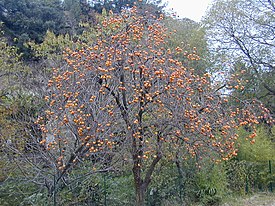 Persimmon Eastern ( Diospyros kaki ) | |||||||||||||||||||
| Scientific classification | |||||||||||||||||||
|---|---|---|---|---|---|---|---|---|---|---|---|---|---|---|---|---|---|---|---|
| |||||||||||||||||||
| International scientific name | |||||||||||||||||||
Diospyros L. , 1753 | |||||||||||||||||||
| Synonyms | |||||||||||||||||||
List
| |||||||||||||||||||
| Type view | |||||||||||||||||||
Diospyros lotus L. [2] - Caucasian Persimmon | |||||||||||||||||||
Content
Title
The Latin name of the genus, Diospyros , is of Greek origin and can be translated as “food of the gods”, another meaning is “divine fire”.
In Russian, the word "persimmon" came from Farsi , where in the original it sounds like خرمالو khormâlu - that is, a date plum. The word خرما khormâ itself means a date , the word آلو âlu - plum . The name khormâlu originally refers to Caucasian persimmon . The dried persimmon tastes very much like dates, hence the name of the Caucasian persimmon in Farsi. Then this name spread to other types of persimmons, including eastern (Japanese) .
Species with edible fruits may call: “wild date”, “date plum”.
Botanical Description
Trees or shrubs , deciduous or evergreen. There are no terminal kidneys. Leaves are simple, alternate, sometimes with small translucent glands. Dioecious or polygamous flowers. Male axillary flowers are usually collected in brushes. Stamens from 4 to many, often paired. Female flowers are usually single, axillary. Calyx usually 3-5 (sometimes up to 7) petal, can be reduced. Corolla is bell-shaped or tubular, 3-5 (-7) lobed. The fruit is a fleshy berry , leathery, as a rule, with a large cup. Seeds from 1 to 10 or more, often squeezed on the sides. [3]
Distribution
Species of this genus are pantropic with the greatest diversity in the Indomalai region .
In the culture, plants probably spread from China .
For the sake of fruits, plants are cultivated in many countries of Eurasia , America and Australia , where their endemic species are also found.
Some species are a source of valuable wood .
Systematics
According to the database of The Plant List , the genus includes 725 species [4] . Some types:
- Diospyros discolor Willd. - Persimmon is colorful , or Mabolo [ syn. Diospyros blancoi A.DC. ].
- Diospyros ebenum J. Koenig - Persimmons ebony , or Black ebony , or Ceylon ebony , a source of valuable wood.
- Diospyros kaki Thunb. - Persimmon Eastern , or Kaki [ syn. Diospyros chinensis Blume nom. nud. - Persimmon Chinese], a species with large (up to 8 cm) orange-red fruits from Japan and China.
- Diospyros lotus L. - Caucasian persimmon , or ordinary
- Diospyros melanoxylon Roxb. - Coromandel ebony
- Diospyros mespiliformis Hochst. ex A.DC. - Persimmons are medlar-like , African in appearance.
- Diospyros oppositifolia Thwaites - Persimmon
- Diospyros sandwicensis ( A.DC. ) Fosberg - Hawaiian Persimmon
- Diospyros virginiana L. - Virgin Persimmon , or American Persimmon [ syn. Diospyros mosieri SFBlake ]
The black Persimmon species ( Diospyros digyna Jacq. ) Is recognized as a synonym for the species Diospyros nigra ( JFGmel. ) Perrier .
The Persimmon species is low ( Diospyros humilis ( R.Br. ) F. Muell. ) Recognized as a synonym for the species Diospyros vera ( Lour. ) A.Chev.
Fruits
Persimmon is the fruit of a number of species, usually bright orange large with light flesh and fleshy 1-10-seed berries .
Persimmon varieties are divided into two groups: variable and constant. Variables are called varieties whose fruits, depending on how they were formed - as a result of fertilization or parthenocarpic - have different consumer qualities, that is:
- Fruits formed without fertilization and not containing seeds do not change the color of the pulp upon ripening, and astringency is lost only after the final ripening, when the pulp already acquires a jelly-like consistency.
- The fruits of the same varieties, but formed after pollination and having seeds, already when picked, have not tart flesh, and the color of the flesh darkens, up to a dark brown color. This group also includes korolkovye, or chocolate varieties, such as "Hyakume" and "Zanji Maru" [5] .
Today, persimmons are grown everywhere where there is a warm climate, therefore, in addition to traditional types of persimmons (about two hundred), there are exotic ones. These include South American persimmons, which are called “chocolate pudding” or “black apple”, because it grows to the size of a large green apple weighing from 700 to 900 g, and then, ripening, gradually darkens, acquiring the taste and color of dark chocolate.
In the Philippines, grows its own persimmon - a bright red called "velvet apple." Paraguayan persimmon has a flat fruit shape. Caucasian persimmon produces fruits whose sizes do not exceed 2-3 cm. The Sharon variety bred in Israel is widespread. It does not contain seeds and has a milder taste, as it contains little tannin [6] .
Fruit Use
Unripe persimmon fruits have an astringent taste and can cause gastrointestinal upset.
Despite the relatively high sugar content, persimmon does not contribute to a sharp increase in blood sugar (it has a low glycemic index ) and contains only 62 kcal per 100 g of product. The bright orange color of persimmon suggests that it contains a high content of beta-carotene and bioflavonoids . Ripe persimmon contains (from the daily intake): 25% sugars, 1.5% protein , 0.85% fat, up to 55% vitamin C , tannins , various trace elements, including iodine , iron , magnesium , potassium .
Therefore, persimmon is recommended for patients with diseases of the cardiovascular system, hypertension , anemia . In the Caucasus, persimmons are eaten in large quantities in the early forms of toxic goiter . In China and Japan, atherosclerosis is treated with persimmon, and scurvy is treated with juice, and intestinal worms are thrown out in Thailand, persimmon is considered an anti-inflammatory agent in Korea and is used in the treatment of dysentery , enterocolitis and bronchitis . The effectiveness of a diet rich in persimmons in normalizing lipid metabolism is confirmed by scientific studies [7] . Persimmon fruits favorably affect the condition of the liver and biliary tract.
Persimmon has a pronounced diuretic effect.
Persimmon pulp has bactericidal properties, so the inclusion of persimmons in the diet during epidemics contributes to the overall treatment. Persimmon cut in half is applied in some countries to burns and wounds. Persimmon is useful for exhaustion (both nervous and physical). Enuresis is treated with a decoction of stiff “tail” fruits.
Traditional medicine uses, in addition to fruits, persimmon leaves. Dried persimmon leaves are considered biologically active, so tea from them is useful for older people, as well as patients with anemia. Steamed leaves are applied to festering wounds and abscesses.
Persimmon fruits can be consumed fresh, dried, made from them preserves, desserts, made cider , molasses, wine, beer and moonshine.
The roasted and ground Virgin persimmon seeds were used by soldiers of the Confederate army and the population of the South during the Civil War in the United States as a substitute for coffee [8] .
Contraindications
Due to the high content of tannin, persimmons can not be consumed in the postoperative period (abdominal organs), as well as people who, due to surgery on the abdominal cavity, have developed adhesive bowel disease. Excessive consumption of persimmons, especially immature fruits, in which the highest content of tannin and plant fibers, can lead to acute intestinal obstruction due to the formation of phyto- bezoar and emergency surgery [9] [10] .
Wood
In a number of countries, furniture and sports equipment are made from wood.
Persimmon wood is so sophisticated and delicate that some musical instruments are made of it. The famous black ebony is obtained from persimmon wood.
Notes
- ↑ For the conventionality of specifying the class of dicotyledons as a superior taxon for the plant group described in this article, see the APG Systems section of the Dicotyledonous article .
- ↑ Information on the genus Diospyros (Eng.) In the Index Nominum Genericorum database of the International Association for Plant Taxonomy (IAPT) .
- ↑ Flora of China, 1996 .
- ↑ Diospyros . The Plant List . Version 1.1. (2013). Date of treatment August 7, 2016.
- ↑ Persimmon cultivation on the territory of the USSR . Zooengineering faculty of RSAU-MSHA (unofficial site) .
- ↑ Types of Persimmon . BerkeleyWellness.com . School of Public Health at UC Berkeley (November 12, 2015.).
- ↑ Daily Mail article on the results of studies conducted by the Hebrew University (Israel)
- ↑ CH Briand. The common persimmon (Diospyros virginiana L.): The history of an underutilized fruit tree (16th-19th centuries) (Eng.) // Huntia. - Pittsburgh, PA, USA: Hunt Institute for botanical Documentation, 2005. - Vol. 12 , no. 1 . - P. 71-90 . - ISSN 0073-4071 .
- ↑ Gastrointestinal Bezoar: Clinical Study of 15 Years Experience from A Medical Center in Eastern Taiwan (Link not available) . Date of treatment August 13, 2011. Archived November 4, 2013.
- ↑ A Muscovite nearly died from a raw food diet , 04/05/2017, Mail.Ru Health.
Literature
- Rostovtsev S.I. Ebony // Brockhaus and Efron Encyclopedic Dictionary : 86 volumes (82 volumes and 4 additional). - SPb. , 1904. - T. XL (79): Shuiskoye - Electrical excitability.
- Persimmon // Great Soviet Encyclopedia : [in 30 vol.] / Ch. ed. A.M. Prokhorov . - 3rd ed. - M .: Soviet Encyclopedia, 1969-1978.
- Diospyros // Flora of China : [ eng. ] = 中国 植物 志 : in 25 vol. / ed. by Z. Wu , PH Raven , . - Beijing: Science Press; St. Louis: Missouri Botanical Garden Press, 1996. - Vol. 15: Myrsinaceae through Loganiaceae. - P. 215. - 387 p. - ISBN 978-0-915279-34-0 . - ISBN 978-0-915279-37-1 (vol. 15).
Links
- Diospyros (English) : Tropicos taxon information.
- Diospyros : information on the taxon in the Plantarium project (a identifier of plants and an illustrated atlas of species).
- Persimmon - Diospyros