Leonid Mikhailovich Polyakov ( August 21, 1906 , St. Petersburg - June 19, 1965 , Moscow ) - Soviet architect [1] , teacher, professor. Twice winner of the Stalin Prize of the second degree (1949 - stripped, 1950).
| Leonid Mikhailovich Polyakov | |||||
|---|---|---|---|---|---|
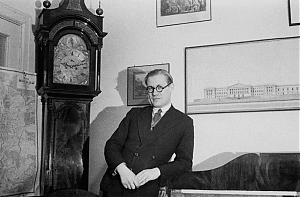 | |||||
| Basic information | |||||
| A country | |||||
| Date of Birth | |||||
| Place of Birth | |||||
| Date of death | |||||
| Place of death | |||||
| Work and Achievements | |||||
| Study | |||||
| Worked in the cities | Leningrad , Moscow | ||||
| Architectural style | neoclassicism , Stalin's empire | ||||
| Awards |
| ||||
| Awards |
| ||||


Biography
Born in St. Petersburg on August 8 (21), 1906 in a family (according to family tradition, Old Believers) of immigrants from the city of Soltsy, Porkhov district, Pskov province . In 1923 he began his studies at the Faculty of Architecture of the Second Petrograd Polytechnic Institute . After the abolition of the institute in August 1924, he was transferred to the Leningrad Higher Art and Technical Institute (LVHTI, formerly Academy of Arts), among whose teachers: A. E. Belogrud , L. N. Benois , L. V. Rudnev , I. A. Fomin , V. A. Shchuko , V. G. Gelfreich , S. S. Serafimov .
While studying at the institute, he began working in the Sevzaples trust, first as a draftsman, and since 1928 as an architect. Thesis - "Onega Sawmill and Paper Mill" defended November 5, 1929.
In 1933, among the designers of the Palace of Soviets , headed by V. A. Shchuko and V. G. Gelfreich, Polyakov moved to Moscow. He worked in the Construction Department of the Palace of Soviets (USDS) and the architectural workshop of the Moscow City Council No. 3 (led by I. A. Fomin).
- In October 1939 he was transferred from USDS and enrolled as the head of the workshop of the Moscow City Council No. 9.
- On June 2, 1941, he headed Workshop No. 3.
- In September 1941 - April 1943 he was at the construction of the plants of the People's Commissariat of Armaments (trust No. 24 NKV) in the cities of Zlatoust and Mednogorsk . He had the rank of military engineer of the 3rd rank. In May 1943 he was seconded to Moscow at the disposal of the Academy of Architecture of the USSR.
- At the beginning of 1944 he was transferred to the Committee for Architecture at the Council of People's Commissars of the USSR and was appointed senior inspector-architect of the Inspectorate for the Protection of Architectural Monuments of the Main Directorate for the Protection of Architectural Monuments.
- From July 1944 to December 1948, he was the head of the workshop of the State workshops of the Committee on Architecture.
- From December 1948 to December 1950 - the chief architect of Sevastopol , a member of the Board of the Office for the Restoration of Sevastopol under the Council of Ministers of the USSR.
- In 1950-1957 - Chief Architect of the Hydroproject Institute .
- In 1947-1951, concurrently was the chief architect of the Voenmorproekt-2 Institute of the Ministry of Construction of Military and Naval Facilities. He was relieved of his post as chief architect of the Mosproject workshop by a resolution of the Central Committee of the CPSU and the Council of Ministers of November 4, 1955.
- From October 1957 to April 1958, he was the chief architect of the GIPRONII of the USSR Academy of Sciences.
- 1958-1961 - Chief Architect of the Institute Mosoblproekt, head of the workshop Mosoblproekt.
- He taught at the Moscow Architectural Institute (April - December 1937 - Acting Associate Professor; 1943-1945 - Senior Lecturer, Associate Professor) and the Moscow Higher Art and Industrial School (formerly Stroganov) in 1947-1950 and in 1958-1965, professor 1963 year
- By a resolution of the Central Committee of the CPSU and the Council of Ministers of the USSR of November 4, 1955, L. M. Polyakov, together with co-author A. Boretsky, were deprived of the prize awarded to them for the design of the Leningradskaya Hotel. There is an opinion that the initiator of this was E. A. Furtseva , who did not forgive Polyakov that during his visit to the construction site, she indicated her incompetence in architecture [1] .
- Corresponding member of the Academy of Architecture of the USSR (1947), full member of the Academy of Architecture of the USSR (1950).
- L. M. Polyakov died on June 19, 1965 . He was buried in Moscow at the Novodevichy cemetery (plot number 6). The monument on his grave was designed by the architect E.N. Stamo (gravestone is an identified object of cultural heritage).
Awards and Prizes
- Stalin Prize of the second degree (1949) - for the architecture of the 17-story building of the Leningradskaya Hotel on Kalanchevskaya Square in Moscow
- Stalin Prize of the second degree (1950) - for the architecture of the Kaluzhskaya station of the Moscow metro station named after L. M. Kaganovich
- Order of Lenin (1952)
- Order of the Red Star
- Order of the Badge of Honor (1939)
- medal "For Labor Distinction" (1939)
Leningrad segment of life. Projects and Buildings
The first projects were completed by L. M. Polyakov in Leningrad in collaboration with teachers and comrades at the Higher School of Arts and Culture - Academy of Arts:
- House of Industry in Sverdlovsk (1928; co-authored with V. A. Shchuko , V. G. Gelfreich - managers; A. P. Velikanov ; custom-made competition);
- Crematorium at the Volkov Cemetery (1929; with the participation of R. A. Puring; All-Union Competition, 4th Prize);
- Housing estate “Leningrad printer” on Revolution Square (1928-1929; with the participation of R. A. Puring, V. B. Vogel; competition; 3rd recommendation);
- Residential building in Leningrad on Bolshaya Posadskaya street , No. 7-7a. (1928; together with A.F. Khryakov , P.V. Abrosimov ; built in 1932);
- Central Park of Culture and Rest (1931; together with E. I. Katonin , V. V. Danilov, T. I. Ichugina, V. A. Gaikovich ; competition);
- Dynamo Stadium with the Palace of Physical Education on Krestovsky Island (1931; together with E. I. Katonin , V. A. Gaykovich ; competition);
- The building of the Moscow Regional Committee of the CPSU (b). (1931; co-authored with V. A. Shchuko , V. G. Gelfreykh - leaders; A. P. Velikanov );
- Restaurant and steamboat marina in TsPKiO them. S. M. Kirov in Leningrad (1931; together with A.P. Velikanov and A.F. Khryakov );
- Plant management of a metallurgical plant in Kuzbass (1931; together with architects P.V. Abrosimov and A.F. Khryakov ).
- Zoo in Shuvalovo-Ozerki (1932; together with A.P. Velikanov , V.A. Vitman, V.V. Stepanov, 1st and 2nd Prizes at the All-Union Competition);
- Children's Musical Theater of the Gosnardom (1933; together with A.P. Velikanov , A.F. Khryakov ; implemented);
- Red Theater in the garden of the Gosnardom (1933; together with A.P. Velikanov , A.F. Khryakov ; competition);
- American Mountains - an attraction in the garden of the Gosnardom (1932-1933, together with A.P. Velikanov , A.F. Khryakov ., Engineer P.V. Startsev; discovered in May 1934, burned down on October 16, 1941 );
- Academy of Light Industry Kirova (Promacademia) on Suvorovsky Prospekt in Leningrad (1932, together with A.P. Velikanov , A.F. Khryakov , with the participation of R.A. Puring; built in two stages).
- The building of the Red Banner Military Academy of the Red Army. M.V. Frunze on the Maiden Field in Moscow (1932; co-authored with V. A. Shchuko , V. G. Gelfreykh - leaders, A. P. Velikanov ; custom-made competition);
- The Palace of Soviets in Moscow - the 3rd and 4th stages of design (1932-1933, co-authored with V. A. Schuko , V. G. Gelfreykh - leaders; A. P. Velikanov , I. E. Rozhin , G.V. Selyugin, E.N. Selyakova-Shukhaeva, A.F. Khryakov , G.V. Shchuko (Yuri) and others; competition).
Academy of Light Industry
Moscow segment of life. Projects and Buildings
Implemented Designs
- Changing the facades of a house designed by M.O. Barshch and G. A. Zundtblat (1933-1935; 45 Arbat St.);
- Changing the facades of the house, designed by G. I. Voloshinov (1933-1935, Spiridonevsky Lane , 2/22);
- Arch of the Main (now North) entrance of the All-Union Agricultural Exhibition (sculptor G.I. Motovilov ) (1939; Prospekt Mira , d. 119);
- The high-rise building of the Leningradskaya Hotel , co-author A. B. Boretsky , engineer E. V. Myatlyuk (1948-1954, Komsomolskaya Square ), the project was awarded the Stalin Prize of the 2nd degree;
- The development project of Nakhimov Avenue and Bolshaya Morskaya Street in Sevastopol (1948-1951; leader; co-authors: E.P. Vulykh , V.V. Pelevin , V.A. Petrov , I.S. Samoilova);
- Volga-Don Shipping Canal . V.I. Lenin (1950-1952; leader; co-authors: S. M. Biryukov , G. G. Boris, S. V. Demidov, A. Ya. Kovalev, V. V. Musatov, M. V. Pankov, A. G. Rochegov , F. G. Topunov, R. A. Yakubov; engineers: S. Ya. Zhuk , V. A. Marsov, A. G. Oskolkov, N. V. Shakhov; sculptor G. I Motovilov);
- Kuybyshevsky waterworks (1952-1957; leader; co-authors: S. M. Biryukov , S. V. Demidov, A. Ya. Kovalev, A. G. Rochegov, R. A. Yakubov; architectural processing has repeatedly changed in the direction of “ refusal of excesses ");
- A complex of residential buildings (1958, Taras Shevchenko Embankment No. 3-7);
- USSR Embassy in Ethiopia in Addis Ababa ;
- Embassy of the USSR in Albania in Tirana .
Stations of the Moscow Metro Kaganovich:
- "Kursk" of the second stage; (design engineers N. M. Komarov and G. I. Kibardin; opened in 1938);
- “October-Ring” (until 1961 - “Kaluga”; 1946; sculptor G. I. Motovilov ; design engineers B. M. Prikot, V. M. Dmitriev; opened January 1, 1950);
- Pushkinskaya metro station in Leningrad (1950-1955; with the participation of architect V.A. Petrov ; sculptor M.K. Anikushin ; art. M. A. Engelke);
- "Arbat" of the fifth stage (1953; co-authors: V.V. Pelevin , Yu.P. Zenkevich; engineer A.N. Pirozhkov; art. G.I. Opryshko );
- Completion of design and supervision of the construction of the Sverdlova Square station (since 1990 theatrical ), one of the latest designs by I. A. Fomin (1936-1938).
Arbat, d. 45
Arch VSHV 1939
"Kursk" -radial
"October" -ring
"Arbat" 5th stage
"Pushkinskaya" in Leningrad
Typical designs developed at State Architectural Studios
- The mansion is brick four-room. Project No. 112-45 (1946);
- The house is a two-story residential sixteen-apartment. Project No. 1 / 09-45 (1946);
- The house is a two-story residential eighteen-apartment cinderblock. Project No. 127 (1947);
- The dormitory is two-story slag concrete. Project No. 111 (1947; co-author P.N. Aranovich);
- The house is a two-story residential eight-room cinderblock. Project No. 109 (1948; co-author A. M. Zaltsman);
- The house is a two-story residential twelve-room cinder-block. Project No. 110 (1948; co-author A. M. Zaltsman);
- Nursery for 88 people. Project No. 43 (1948; co-author F.N. Korotkov).
Monuments
- Monument to I.V. Stalin at the gateway No. 1 of the Volga-Don canal (1952; sculptor E.V. Vuchetich ; removed in 1961, the statue of V.I. Lenin was installed on the same pedestal in 1973);
- Monument “ Connection of fronts ” at the gateway No. 13 of the Volga-Don (sculptor E.V. Vuchetich);
- Monument to Lieutenant General P.V. Volokh in the Raisins of Kharkov region. (sculptor G.I. Motovilov , 1950);
- Monument to A.P. Chekhov in Yalta (sculptor G.I. Motovilov; 1953, Seaside Park);
- Monument to M.I. Kutuzov in Smolensk (sculptor G.I. Motovilov; 1954, Bolshaya Sovetskaya Street);
- Monument to V. G. Belinsky in Penza (sculptor E.V. Vuchetich; 1954; Theater Square);
- Monument to M. V. Lomonosov in the village of Lomonosovo, Arkhangelsk Region (sculptor I. I. Kozlovsky ; 1958; square in front of the village administration [2] );
- Monument to A.N. Tolstoy in Moscow (sculptor G.I. Motovilov; 1957, 36 Bolshaya Nikitskaya Street );
- Monument to N. A. Nekrasov in Yaroslavl (sculptor G. I. Motovilov; 1958, Volzhskaya Embankment);
- Monument to I.M.Sechenov in Moscow (sculptor L.E. Kerbel ; 1958, Bolshaya Pirogovskaya street , 2/6);
- Monument-bust to A.P. Chekhov in Melikhovo (sculptor Motovilov G.I. (1951, Moscow Region , State Literary and Memorial Museum-Reserve of A.P. Chekhov );
- Monument-bust to A. N. Ostrovsky in Moscow (sculptor G. I. Motovilov; 1954, Malaya Ordynka , 9);
- Monument-bust twice to the hero of the Soviet Union E. M. Kungurtsev in Izhevsk (sculptor I. I. Kozlovsky ; 1950);
- Monument-bust twice to the hero of the Soviet Union A. P. Beloborodov in Irkutsk (sculptor G. I. Motovilov; 1953 [3] );
- Monument-bust twice to the hero of the Soviet Union K. A. Evstigneev in the town of Shumikha, Kurgan Region. (sculptor G.I. Motovilov);
- monument-bust to the Hero of the Soviet Union E.V. Mikhailov in the village. Idritsa of the Pskov region (1955; sculptor G.I. Motovilov) [4]
- Tombstone to A.N. Tolstoy (sculptor G.I. Motovilov, 1965, Moscow , Novodevichy cemetery , 2nd section, 30th row);
- Tombstone of I.O. Dunaevsky at the Novodevichy Cemetery (sculptor P. Melnikova);
- Tombstone to V.N. Aksyonov at the Novodevichy Cemetery (sculptor N. Markov);
Monument to M.I. Kutuzov in Smolensk
Monument to V.I. Lenin (on the pedestal of the monument to I.V. Stalin)
Bust of A.P. Beloborodov in Irkutsk
Unfulfilled Projects
- Bolshoi Bolshoi Residential Building in Bryusov Lane (1933; transferred to A.V. Shchusev );
- Residential building RZHSKT "Engineer-drummer" on Leningradskoye Shosse, 12-14-16 (1934);
- Reconstruction of the Sukharevskaya Square to preserve the Sukharev Tower (1934; under the leadership of I. A. Fomin );
- The Government Square development project in Kiev (together with I. A. Fomin; 1935, competition);
- Sanatorium of the Commission for the Promotion of Scientists (KSU) in Sochi (together with I. A. Fomin; 1935, competition);
- USSR pavilion at the 1937 international exhibition in Paris (1936; co-authored with V. A. Schuko, V. G. Gelfreich, A. P. Velikanov, Yu. V. Schuko, competition);
- metro station "Paveletskaya" (1937-1938; jointly with I. E. Rozhin, competition);
- metro station "Plant them. Stalin ”(1937-1938; jointly with I. E. Rozhin, competition);
- Pervomaiskaya metro station (1937-1938; competition);
- Pavilion of the Moscow, Voronezh, Kursk regions and the Tatar Autonomous Soviet Socialist Republic at the All-Union Agricultural Exhibition (1939; competition);
- Residential building at Kursk station st. Chkalov (1939-1940);
- New Solyanka - development of the highway (1940);
- Second House of the SNK of the USSR in Zaryadye (1940; with the participation of A. B. Boretsky, E. N. Stamo; competition);
- The Izvestia plant at the Kiev railway station (1940; together with A. B. Boretsky , E. N. Stamo, competition);
- Novo-Arbat bridge (1939-1940; competition);
- Monument to the sailors-defenders of Leningrad and a house for World War II veterans in the vicinity of Oranienbaum (1943; competition);
- Admiralty - Ministry of the Navy in Moscow on Frunze Embankment (1945; competition);
- House of Soviets in Stalingrad (1946-1947; co-author A. B. Boretsky ; competition);
- Monument to A. S. Pushkin in Leningrad (1946-1949; sk. Motovilov G. I .; custom-made contest);
- Stalingrad hydroelectric complex (1951–1955; the head of the Hydroproject group; the project was not implemented);
- Volga-Baltic Shipping Canal (1952-1953; leader, co-authors of the Leningrad branch of the Hydroproject: L. M. Banshchikov, A. I. Goritsky, A. V. Ikonnikov, R. P. Kostylev, L. T Lipatov, K. M. Mitrofanov, G. S. Nikulin, G. F. Perestoronina, V. A. Petrov, Z. F. Semenova, M. V. Smagina, G. A. Sharovarov, P. R. Yasensky ; after the death of I.V. Stalin, the construction site was frozen; the canal was built according to another project in 1956-1964);
- The Main Turkmen Canal (1951-1953; leader; co-authors - employees of the Hydroproject);
- Monument in honor of the reunification of Ukraine with Russia (1953; sculptor G.I. Motovilov, the highest prize at the All-Union competition);
- Covered collective farm market in Moscow (1954);
- USSR Ministry of Oil Industry in Moscow (co-author V.V. Pelevin);
- Pantheon - Monument to the eternal glory of the great people of the Soviet country (1954; co-authors: E.P. Vulykh , V.V. Pelevin, A.G. Rochegov; competition);
- Palace of Soviets on the Lenin Hills (competition 1957-1958).
L. M. Polyakov's print articles
- "October gave me everything." Architectural newspaper. November 7, 1938, No. 62 (291). Page 2.
- The New Solyanka. Architecture of the USSR, 1940, No. 4. Pages. 53-55.
- “What architects are working on. L. M. Polyakov. Moscow". Architecture of the USSR, 1940, No. 8. Pages. 71.
- "Thoughts on the synthesis." Architecture of the USSR, 1941, No. 1. Pages. 42-44.
- "Metro stations of the third stage." Architecture of the USSR, 1941, No. 3. Pages. 47-51.
- "About the profile of the architect." The architecture of the USSR. Journal, 1941, No. 5. Page 4-8.
- “Architecture of Volga-Don Canal Structures”. Architecture of the USSR, 1951, No. 1. Pages. 2-7.
- “Architecture of the Volga-Don Shipping Canal named after V. I. Lenin. " True. Newspaper. July 21, 1952
Addresses
St. Petersburg - Petrograd - Leningrad
- Glazovskaya St. (from December 1952 - St. Konstantin Zaslonov), d. 36.
- Kirochnaya St. (from 1932 to 1998 - Saltykov-Shchedrin St.), d. 43-b, apt. eleven.
Moscow
- 4. Lenivka, 4. Dormitory of the Construction Management of the Palace of Soviets (USDS).
- Mozhayskoye Shosse, 57, apt. 28. In different years, the same house was listed on 2nd Izvoznaya St. and on Studentskaya Street.
- St. Tchaikovsky, d. 16-20, apt. 18.
- Trekhprudny Lane, d. 5/15, apt. 26.
Links
See also
- Stalin's architecture
Notes
- ↑ 1 2 On the centenary of the birth of L. M. Polyakov (Inaccessible link) . Date of treatment October 10, 2010. Archived May 21, 2008.
- ↑ Monument to M.V. Lomonosov in the village of Lomonosovo (Unavailable link) . Date of treatment February 11, 2010. Archived June 10, 2017.
- ↑ Photos of a bust in Irkutsk
- ↑ Resolution of the Council of Ministers of the RSFSR of August 30, 1960 N 1327. (Unavailable link) . Date of treatment May 16, 2011. Archived on August 21, 2011.
Archive Sources
- NBA AH USSR, f. 7, op. 8, d. 2 120. The personal file of the student L. M. Polyakov. 1923-1929
- RGALI, f. 2 466, op. 6, d. 252. Personal file of L. M. Polyakov. Moscow branch of the Union of Soviet Architects. 1943-1965
- MGHPU, op. 27L, d. 152, bunch 27, l. 2-96. Personal files of employees laid off in 1965. From the letter "P" to "C".
- Research Museum of the Academy of Fine Arts (NIMAH).
- State Research Museum of Architecture named after A.V. Shchuseva (GNIMA).
- TSGALI St. Petersburg, f. 341, op. 1, d. 286. "Architecture of the Volga-Don Canal." Verbatim report. Report of the Chief Architect of the Hydroproject ... L. M. Polyakova.
Literature
- Yearbook of the Society of Architects-Artists. Issue 13. Leningrad, 1930
- Yearbook of the Society of Architects-Artists. Issue 14. Leningrad, 1935. Pages. 23-26, 72-74, 233-239, 256.
- Yearbook of the Leningrad branch of the Union of Soviet Architects. Issue 1-2 (XV — XVI). Leningrad, 1940. pp. 63, 350-355.
- Laureates of the Stalin Prize in Architecture, 1941-1950. Kornfeld, Y. A. Moscow: State. publishing house of literature on construction and architecture, 1953. Pages. 134-136, 170-172, 200-203.
- Architectural newspaper. Appendix to No. 10. February 17, 1939 Goltz G. P. "Academy of Light Industry named. Kirov ".
- Architecture of the USSR, 1940 No. 11. Pages. 4-19. "Competition for the project of the second house of the SNK of the USSR." Isaxon A.
- Yearbook of the Leningrad branch of the Union of Soviet Architects. Issue 3.
- Monuments constructed according to the designs of sculptors of the Russian Federation, 1945-1965. - L.: Artist of the RSFSR , 1967. p. 7, 12, 26, 29, 30, 35, 38.
- Zhuravlev A.M. L. M. Polyakov // Architects of Moscow. M., 1988. Prince. 2;
- Polyakova A. L. On the Centenary of the Birth of L. M. Polyakov // Architectural Bulletin. 2007. No. 4 (97);
- Polyakova A.L. Architect L.M. Polyakov. - M .: “The book house. University (KDU) ”, 2008 - ISBN 978-5-91304-031-2 [1]
- Polyakova A. L. “The past passes before me ...” - M .: “Book house. University (KDU) ”, 2010. - ISBN 5-98227-752-5 , ISBN 978-5-98227-752-7