Spienne , fr. Spiennes is a Walloon village in the municipality of Mons , Belgium .
| UNESCO World Heritage Site | |
| Neolithic flint quarries in Spienne (Mons) [* 1] | |
|---|---|
| Neolithic Flint Mines at Spiennes (Mons) [* 2] | |
| Type of | cultural |
| Criteria | i, iii, iv |
| Link | 1006 |
| Region [* 3] | Europe and North America |
| Turning on | 2000 (24th session) |

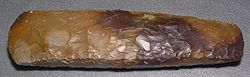

The village is included in the UNESCO World Heritage List due to the Neolithic stone quarry where flint mining took place [1] . According to the UNESCO roster, this is “the largest and earliest accumulation of ancient mines in Europe”, which deserves inclusion, since it reflects the high level of technology at the time. [2]
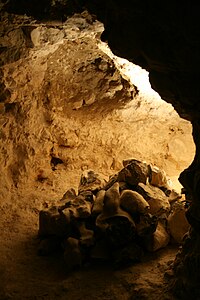
Mines occupy about 100 hectares of lowlands near Mons in Belgium. They are interesting in that they represent the transition between open and underground flint mining. Flint tendons were harvested with deer antlers kyle. After that, the flints were hewn, taking the shape of axes, and then polished.
The trade in blanks for axes covered a fairly wide area, often polishing occurred only at the destination. Polishing strengthened the final product, it could then serve longer. The axes were originally used for logging in the early Neolithic , as well as for working wood for building houses and boats.
Analogues of this mine were found in the UK - these are Grimes-Graves and Sissbury , where flint was also mined.
See also
- Sissbury
- Grimes graves
- Rudna Head
Notes
- ↑ Neolithic Flint Mines of Petit-Spiennes: Official web site (not available link) . The date of circulation is December 16, 2007. Archived December 31, 2007.
- ↑ Neolithic Flint Mines at Spiennes (Mons) . World Heritage List . UNESCO (2000). The appeal date is March 16, 2007. Archived April 2, 2012.