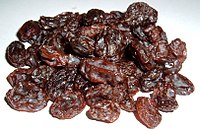
Raisins (from Turk. Üzüm - grapes ) - dried grapes . As a product, it has the greatest culinary application in the Near and Middle East , as well as in the Mediterranean .
Types of Raisins
| Pitted raisins Nutrition value per 100 g of product | ||||||||||||||||||||||||||||||||||||||||||||||||
|---|---|---|---|---|---|---|---|---|---|---|---|---|---|---|---|---|---|---|---|---|---|---|---|---|---|---|---|---|---|---|---|---|---|---|---|---|---|---|---|---|---|---|---|---|---|---|---|---|
| Energy value 300 kcal 1252 kJ | ||||||||||||||||||||||||||||||||||||||||||||||||
| ||||||||||||||||||||||||||||||||||||||||||||||||
| Link to USDA Database entry Source: USDA Nutrient database | ||||||||||||||||||||||||||||||||||||||||||||||||
The names of different types of raisins change very often. Therefore, in cookbooks published even relatively recently, 15–20 years ago, they differ from today's books, and even more so from names a hundred years ago.
Distinguish:
- light, small raisins, pitted from sweet green and white (gray) grape varieties. Most often it is called kishmish (culinary name), or sabza (modern trade name);
- dark, almost black or blue, and more often dark burgundy seedless raisins, according to the old culinary terminology - “ cinnamon ” (when preparing cinnamon from the grape variety group), according to the modern trade - “bidana”, or “shigani”. It has two main varieties: very sweet and slightly sweet with one stone;
- large, fleshy, very sweet, tasty, with two or three large pits. They get it from Husayne grapes - "ladies' fingers" or from Hermian.
The first and second types of raisins are used in bakery and confectionery products , the second - especially in cupcakes and Easter cakes . The third type of raisin is usually used for the preparation of compotes , drinks . Also used in the preparation of meat dishes and for pilaf , especially in combination with apricot .
The fourth type - large seed raisins - has a very diverse application. Pitted, chopped, it goes to the preparation of confectionery and puddings , in general - for flavoring drinks - kvass , fruit drinks , it can be used in compotes as dried fruit that preserves the taste even after cooking.
Factory raisins are smoother, better cleared of impurities, but less aromatic than hand-made raisins. Otherwise, the nature of the processing is not significant for culinary use. In fancy pastry, it is better to use raisins in a crushed form, having previously diced it in flour. Then the raisins will not concentrate in one place of the dough, but will be distributed evenly in the baked product.
It can also be used to make compote or “sea pebbles” .
Translated from Persian: “Kish-Mish” - dried grapes.
Literature
- Raisins // Willow - Italics. - M .: Soviet Encyclopedia, 1972. - (The Great Soviet Encyclopedia : [in 30 vols.] / Ch. Ed. A. M. Prokhorov ; 1969-1978, vol. 10).
- Raisins, dried grapes // Brockhaus and Efron Encyclopedic Dictionary : in 86 tons (82 tons and 4 extra). - SPb. , 1890-1907.
- "Ampelography with the basics of viticulture." Negrul A.M. , Gordeeva L.N., Kalmykova T.I., M .: Higher school, 1979
- "Viticulture". Smirnov K.V., Kalmykova T.I., Morozova G.S., M .: Agropromizdat, 1987
- "Encyclopedia of Viticulture." Chisinau: ITU, 1986-1987
- "Viticulture". K.V. Smirnov, L.M. Maltabar, A.K. Radjabov, N.V. Matuzok, M .: Publishing House of the Moscow Art Academy, 1998
- Raisins // Brief Encyclopedia of Household / Ed. A.I. Revina . - M .: Soviet Encyclopedia, 1960. - T. 1. - S. 219-220. - 770 s.